
Australia Wireless Router Market to Reach US$ 559.4 Million by 2033 as Smart Homes and High-Speed Connectivity Drive Demand
Rising Internet Usage, Remote Work Trends, and Wi-Fi 6 Adoption Transform Australia's Wireless Networking Landscape

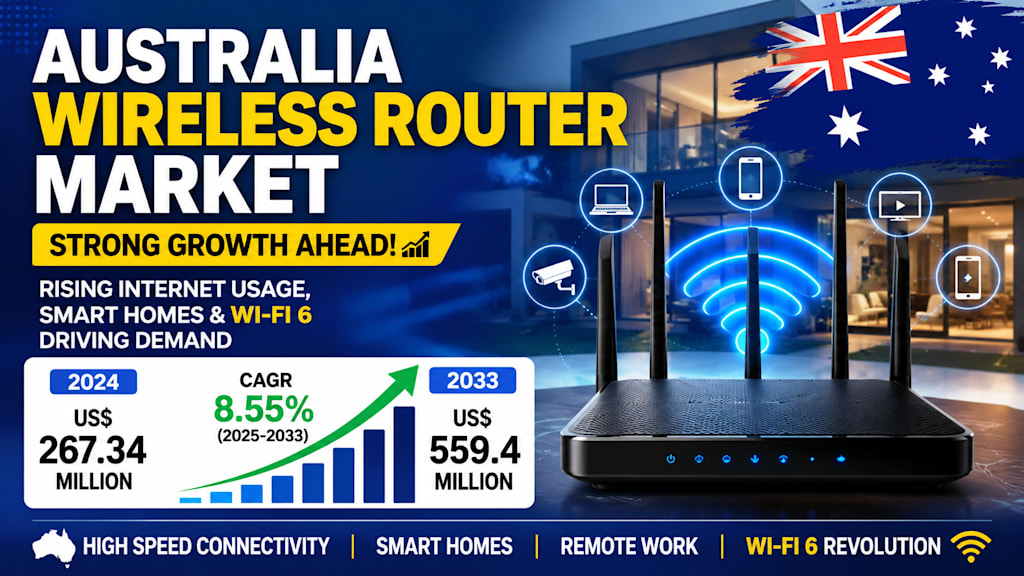
Australia Wireless Router Market Set for Strong Growth Through 2033
Australia's digital transformation is accelerating at an unprecedented pace, and at the center of this evolution lies a critical technology that many households and businesses rely on every day—the wireless router. As internet connectivity becomes essential for work, education, entertainment, and smart home operations, demand for high-performance wireless networking solutions continues to surge across the country.
According to Renub Research, the Australia Wireless Router Market is projected to grow from US$ 267.34 million in 2024 to US$ 559.4 million by 2033, expanding at a CAGR of 8.55% during 2025–2033.
The market's growth is being fueled by increasing internet penetration, widespread adoption of connected devices, advancements in wireless technologies, and the growing importance of reliable home and business networking infrastructure.
Australia's Digital Economy Creates New Opportunities
Australia has become one of the world's most digitally connected nations. Businesses, households, educational institutions, and government organizations increasingly depend on high-speed internet connectivity to support their daily activities.
The country's digital economy continues to expand as consumers embrace online banking, streaming services, cloud computing, video conferencing, e-commerce, and smart home ecosystems. These trends have significantly increased the demand for robust wireless networking solutions capable of handling multiple connected devices simultaneously.
Wireless routers have evolved from basic internet-sharing devices into sophisticated networking hubs that manage security, connectivity, bandwidth allocation, and device communication. As technology requirements become more complex, consumers are seeking advanced routers that provide superior speed, coverage, and reliability.
Internet Penetration Reaches Record Levels
One of the strongest growth drivers for the wireless router market is Australia's exceptionally high internet adoption rate.
With internet access becoming nearly universal across urban and suburban regions, households require reliable networking equipment to support everyday online activities. From video streaming and online gaming to remote work and cloud-based applications, internet consumption continues to rise dramatically.
The expansion of the National Broadband Network (NBN) has further strengthened connectivity across the country. As faster broadband plans become more accessible, consumers are upgrading their networking infrastructure to fully utilize available internet speeds.
This trend is encouraging households and businesses to replace older routers with modern systems capable of supporting higher bandwidth requirements and improved performance.
Smart Home Revolution Fuels Router Demand
The growing popularity of smart home technology is reshaping Australia's residential networking landscape.
Modern households increasingly incorporate devices such as:
Smart speakers
Security cameras
Smart thermostats
Connected lighting systems
Smart televisions
Home automation hubs
Video doorbells
Intelligent appliances
Each connected device relies on stable Wi-Fi connectivity to function effectively. As the number of smart devices within homes continues to grow, traditional networking equipment often struggles to maintain consistent performance.
Consequently, consumers are investing in advanced dual-band and tri-band wireless routers that can efficiently manage multiple simultaneous connections without compromising speed or reliability.
This smart home revolution is expected to remain a major catalyst for market growth throughout the forecast period.
Remote Work Continues to Reshape Connectivity Needs
The workplace has undergone a fundamental transformation over the past several years.
Remote and hybrid work models have become deeply embedded across numerous Australian industries. Employees now depend on home internet connections for video conferencing, cloud collaboration, file sharing, and virtual communication.
This shift has elevated the importance of reliable wireless networking infrastructure.
Households with multiple remote workers or students require routers capable of supporting bandwidth-intensive activities simultaneously. As a result, consumers are prioritizing networking equipment that delivers enhanced coverage, lower latency, and uninterrupted connectivity.
Businesses are also investing in upgraded networking solutions to support distributed workforces and maintain productivity in increasingly digital environments.
Online Education Expands Market Opportunities
The education sector represents another important growth avenue for wireless router manufacturers.
Digital learning platforms, virtual classrooms, educational streaming services, and cloud-based collaboration tools have become standard components of modern education.
Students increasingly rely on home Wi-Fi networks for accessing coursework, attending online lectures, participating in discussions, and completing assignments.
Educational institutions themselves are investing heavily in wireless infrastructure to accommodate growing digital requirements.
As online and blended learning models continue to evolve, demand for high-performance networking equipment is expected to remain strong across both residential and institutional segments.
Wi-Fi 6 Technology Drives Upgrade Cycles
Technological innovation continues to play a vital role in market expansion.
One of the most significant developments in recent years has been the adoption of Wi-Fi 6 and Wi-Fi 6E technologies, which offer several advantages over previous generations:
Faster data transmission speeds
Improved network efficiency
Lower latency
Better support for multiple connected devices
Enhanced power efficiency
Greater reliability in high-density environments
As consumers become aware of these benefits, many are replacing older routers with newer models designed to maximize network performance.
The growing availability of Wi-Fi 6-enabled smartphones, laptops, gaming consoles, and smart devices is further accelerating adoption.
Mesh Networking Gains Popularity
Australian consumers are increasingly embracing mesh Wi-Fi systems as a solution to coverage challenges.
Traditional routers often struggle to provide strong connectivity throughout larger homes or multi-story buildings. Dead zones and inconsistent signal strength can negatively impact user experiences.
Mesh networking systems address these issues by utilizing multiple access points that work together to create seamless wireless coverage throughout a property.
The convenience and effectiveness of mesh solutions have made them particularly attractive for households with extensive smart home ecosystems and multiple connected users.
As awareness grows, mesh networking is expected to capture an increasing share of the Australian wireless router market.
Commercial Sector Generates Significant Demand
While residential users represent a substantial portion of the market, commercial applications continue to contribute significantly to industry growth.
Organizations across sectors require reliable wireless connectivity to support digital operations, including:
IT and Telecommunications
Technology companies depend on robust wireless networks to facilitate communication, collaboration, and cloud-based operations.
Healthcare
Hospitals and medical facilities increasingly utilize connected devices, telehealth platforms, and digital record systems that require secure and reliable networking infrastructure.
BFSI
Banks, financial institutions, and insurance providers rely on secure wireless networks to support customer services and operational efficiency.
Education
Schools, universities, and training centers continue investing in wireless infrastructure to meet growing digital learning demands.
As digital transformation accelerates across industries, commercial demand for advanced networking equipment is expected to remain strong.
Security Remains a Critical Challenge
Despite strong growth prospects, security concerns remain a significant challenge for the Australian wireless router market.
Cybersecurity threats continue to evolve, exposing vulnerabilities in outdated networking equipment.
Common risks include:
Unauthorized access
Malware attacks
Data breaches
Network hijacking
Privacy violations
Many users fail to update router firmware regularly, leaving devices exposed to emerging threats.
Manufacturers are responding by integrating advanced security features such as:
WPA3 encryption
Automatic firmware updates
Built-in threat detection
Enhanced firewall protection
Parental controls
As cybersecurity awareness grows, security functionality is becoming a major purchasing consideration for consumers and businesses alike.
Intense Competition Shapes Market Dynamics
The Australian wireless router market remains highly competitive.
Manufacturers continuously compete on pricing, performance, design, and feature offerings. While competition benefits consumers through increased innovation and affordability, it also places pressure on profit margins.
Price-sensitive buyers often prioritize affordability over advanced features, creating challenges for premium manufacturers seeking to differentiate themselves.
Companies must balance innovation, performance, security, and cost efficiency to maintain market share in an increasingly crowded marketplace.
Market Segmentation Overview
By Component Type
Single Band Wireless Router
Dual Band Wireless Router
Tri Band Wireless Router
By End User
Residential
The residential segment continues to dominate demand due to increasing smart home adoption and growing internet usage.
Commercial
IT and Telecom
Healthcare
BFSI
Education
Others
Commercial demand is supported by ongoing digital transformation initiatives and increasing reliance on wireless connectivity.
10 Recent Developments from Major Industry Companies
1. Cisco
Cisco continues expanding its enterprise Wi-Fi portfolio with enhanced cloud-managed networking solutions and AI-driven network optimization capabilities.
2. Netgear
Netgear has strengthened its Wi-Fi 7 product lineup, targeting premium residential users seeking ultra-fast wireless performance.
3. Comcast
Comcast continues investing in advanced gateway technologies that integrate enhanced security and smart home management features.
4. Charter Communications
The company has expanded deployment of next-generation wireless networking equipment to improve customer connectivity experiences.
5. AT&T
AT&T is increasing investments in fiber broadband expansion, driving demand for advanced home networking hardware.
6. Verizon
Verizon continues integrating fixed wireless access solutions with next-generation Wi-Fi technologies for residential users.
7. Lumen Technologies
Lumen is enhancing enterprise networking capabilities through advanced cloud networking and edge computing initiatives.
8. Viasat
Viasat continues improving satellite internet services, creating opportunities for high-performance wireless router adoption in remote regions.
9. Cisco Meraki Division
Meraki has expanded AI-powered network management features designed to simplify deployment and enhance operational efficiency.
10. Netgear Business Solutions
Netgear is growing its business networking portfolio with secure wireless solutions aimed at small and medium-sized enterprises.
Final Thoughts
Australia's wireless router market is entering a period of sustained expansion driven by growing internet penetration, smart home adoption, remote work trends, online education, and continuous technological advancements.
As consumers and organizations demand faster, more secure, and more reliable connectivity, wireless routers are becoming increasingly essential components of modern digital infrastructure. The transition toward Wi-Fi 6, mesh networking, and next-generation wireless technologies will continue creating significant opportunities for manufacturers and service providers.
With the market forecast to reach US$ 559.4 million by 2033, Australia is poised to remain one of the most dynamic wireless networking markets in the Asia-Pacific region, supported by a digitally connected population and a rapidly evolving technology ecosystem.
About the Creator
Enjoyed the story? Support the Creator.
Subscribe for free to receive all their stories in your feed.
Comments
There are no comments for this story
Be the first to respond and start the conversation.