
Australia Warehouse Market 2026: E-Commerce Expansion, Logistics Modernization & Automation Driving Growth
How rising online retail activity, third-party logistics demand, and smart warehousing technologies are transforming the Australia warehouse industry

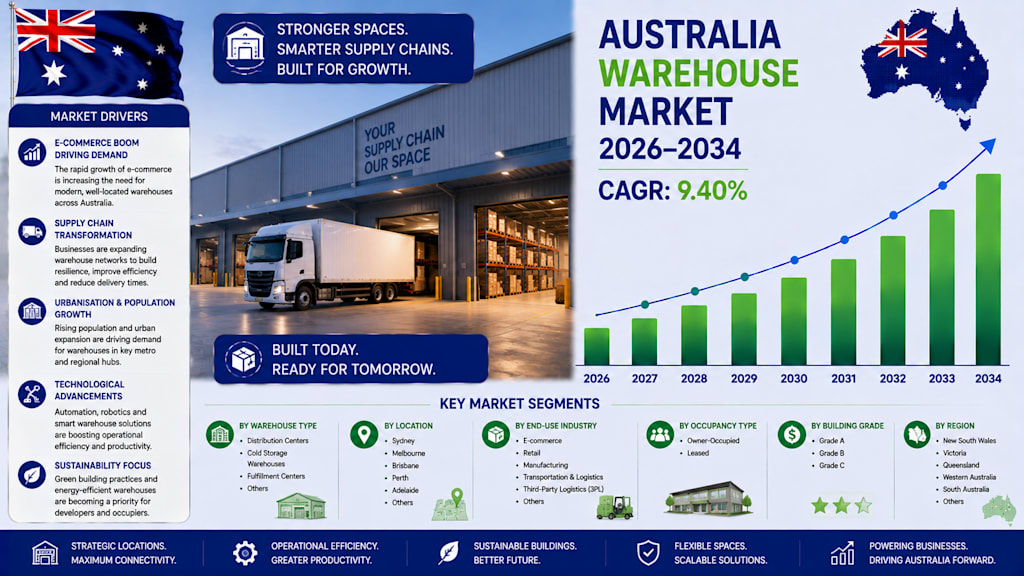
Australia Warehouse Market Overview
The Australia warehouse market is a crucial component of the country’s logistics, supply chain, and industrial infrastructure ecosystem. The sector encompasses industrial warehouses, agricultural warehouses, cold storage facilities, fulfillment centers, bonded warehouses, distribution hubs, and technologically advanced logistics facilities that support the movement, storage, and distribution of goods across Australia.
According to IMARC Group, the Australia warehouse market reached USD 3.78 Billion in 2025 and is projected to reach USD 8.68 Billion by 2034, exhibiting a compound annual growth rate (CAGR) of 9.40% during 2026–2034. The market is experiencing robust growth due to rapid expansion of e-commerce, increasing adoption of third-party logistics (3PL) services, rising demand for faster last-mile delivery, and growing investments in warehouse automation and supply chain modernization.
The growing importance of inventory management, fulfillment efficiency, and resilient supply chains is encouraging businesses to invest in modern warehouse infrastructure across metropolitan and regional markets throughout Australia.
Key Market Drivers
Rapid Growth of E-Commerce
Australia's expanding online retail sector continues to drive demand for large-scale fulfillment centers, urban distribution hubs, and strategically located warehouse facilities. Retailers and logistics operators are investing heavily in warehousing infrastructure to support faster order processing and delivery requirements.
Increasing Demand for Third-Party Logistics Services
Businesses are increasingly outsourcing warehousing and logistics functions to specialized service providers. This trend is fueling demand for public and multi-user warehouse facilities that offer operational flexibility and scalable storage solutions.
Expansion of Last-Mile Delivery Networks
Consumer expectations for rapid delivery services are encouraging investments in urban warehousing facilities positioned close to major population centers. Last-mile logistics optimization remains a major catalyst for warehouse development across Australia.
Adoption of Warehouse Automation Technologies
Advanced warehouse management systems, robotics, artificial intelligence, automated storage solutions, and smart inventory technologies are helping operators improve efficiency, reduce operational costs, and enhance service levels.
Growth in Pharmaceutical and Cold Chain Logistics
Increasing demand for temperature-controlled storage and pharmaceutical distribution is creating opportunities for specialized warehouse facilities equipped with advanced monitoring and compliance systems.
Request a Sample Report with the Latest 2026 Data & Forecasts
What the Opportunities Are
Development of Automated Fulfillment Centers
The rising volume of online orders is encouraging investment in highly automated fulfillment facilities that improve processing speed, order accuracy, and labor efficiency. These facilities represent one of the fastest-growing opportunities within the warehouse sector.
Expansion of Cold Chain Infrastructure
Growing demand from pharmaceutical, healthcare, food processing, and fresh produce industries is creating substantial opportunities for refrigerated and temperature-controlled warehouse facilities.
Growth of Urban Logistics Hubs
Major metropolitan areas are witnessing increased development of urban consolidation centers and micro-fulfillment facilities designed to support same-day and next-day delivery services.
Increasing Investment in Industrial Real Estate
Warehouse assets continue attracting significant institutional investment due to strong occupancy rates, long-term demand fundamentals, and growing logistics requirements across the Australian economy.
Rising Adoption of Sustainable Warehousing
Developers are increasingly incorporating energy-efficient systems, solar power installations, smart building technologies, and sustainable construction practices into modern warehouse developments.
Recent News and Developments
July 2025 : Emirates introduced its Emirates Courier Express service in Australia, strengthening cross-border logistics capabilities and supporting growing demand for efficient freight movement and warehousing services.
May 2026 : Warehouse operators continued investing in automation technologies, robotics integration, and advanced inventory management systems to improve fulfillment performance and operational efficiency.
April 2026 : Developers accelerated construction of industrial and logistics facilities to accommodate increasing e-commerce demand and expanding third-party logistics operations.
March 2026 : Cold chain warehousing investments continued expanding as pharmaceutical and food industries increased demand for temperature-controlled logistics infrastructure.
February 2026 : Businesses increasingly adopted outsourced warehousing solutions to improve supply chain flexibility and reduce capital investment requirements.
January 2026 : Logistics providers strengthened distribution networks through investments in strategically located warehouse facilities and urban fulfillment centers.
2025–2026 (Market Trend) : The Australia warehouse market is being shaped by rapid e-commerce growth, logistics modernization, warehouse automation, pharmaceutical supply chain expansion, and increasing demand for efficient distribution networks. Industry participants are focusing on smart warehousing technologies, cold chain infrastructure, urban logistics facilities, and sustainable warehouse development to strengthen competitiveness and support long-term growth.
Why You Should Know About the Australia Warehouse Market?
The Australia warehouse market is becoming an increasingly important pillar of the country's logistics, e-commerce, industrial property, and supply chain ecosystem.
With projected growth from USD 3.78 Billion in 2025 to USD 8.68 Billion by 2034, the market demonstrates strong long-term potential supported by digital commerce expansion, increasing logistics complexity, rising automation adoption, and growing investment in industrial infrastructure.
As retailers, manufacturers, logistics providers, and property developers continue investing in advanced warehousing capabilities, the sector is expected to play a vital role in enhancing supply chain resilience, supporting economic growth, and enabling faster and more efficient goods distribution across Australia.
About the Creator
Amyra Singh
Market research analyst who loves spotting patterns, digging into data, and turning insights into strategies that help brands grow and stay ahead of the curve.
Enjoyed the story? Support the Creator.
Subscribe for free to receive all their stories in your feed.
Comments
There are no comments for this story
Be the first to respond and start the conversation.