
Australia Utility Services Market 2026: Smart Infrastructure, Renewable Integration & Urban Development Driving Growth
How digital transformation, clean energy adoption, and infrastructure modernization are shaping the Australia utility services industry

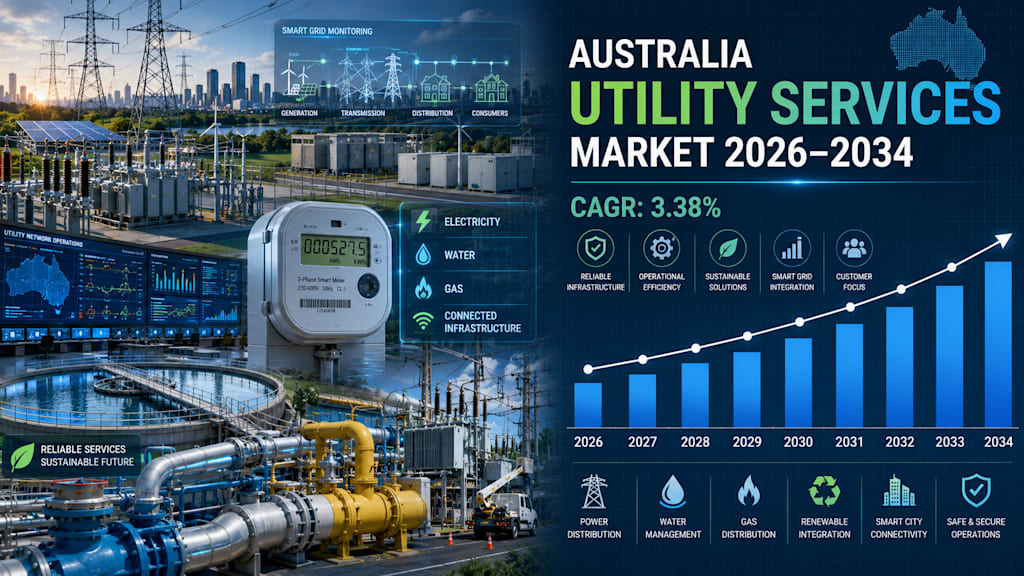
Australia Utility Services Market Overview
The Australia utility services market is a vital component of the country’s infrastructure sector, encompassing essential services such as electricity, water, gas, telecommunications, and waste management provided to residential, commercial, industrial, and public sector consumers.
According to IMARC Group, the Australia utility services market size reached USD 4.8 Billion in 2025 and is projected to reach USD 6.5 Billion by 2034, exhibiting a compound annual growth rate (CAGR) of 3.38% during 2026–2034.
The market is driven by increasing urbanization, smart infrastructure investments, renewable energy integration, and rising demand for reliable and sustainable utility services across the country.
Key Market Drivers
Growing Urbanization and Infrastructure Development
Rapid urban growth and expanding commercial developments are increasing demand for electricity, water, gas, and telecommunications infrastructure across Australia.
Integration of Renewable Energy Sources
The transition toward renewable energy, including solar and wind power, is reshaping utility operations and driving investments in grid modernization and energy storage systems.
Adoption of Smart Utility Technologies
Technologies such as smart meters, automated grid systems, and AI-driven monitoring solutions are improving operational efficiency and service reliability.
Government Support for Sustainable Infrastructure
Federal and state governments are investing heavily in clean energy projects, smart cities, and infrastructure modernization initiatives to improve long-term sustainability.
Rising Demand for Reliable Energy and Water Services
Population growth and industrial expansion are increasing pressure on utility providers to ensure stable and uninterrupted service delivery.
Request a Sample Report with the Latest 2026 Data & Forecasts
What the Opportunities Are
Expansion of Smart Grid Infrastructure
The development of intelligent electricity grids is creating opportunities for improved energy management and real-time monitoring.
Growth in Decentralized Energy Systems
Rooftop solar installations, battery storage systems, and virtual power plants are driving new business opportunities for utility providers.
Increasing Investment in Water Management Solutions
Advanced water recycling, desalination, and conservation technologies are gaining importance due to climate-related challenges.
Development of Sustainable and Low-Carbon Utilities
Utilities are focusing on reducing emissions through cleaner energy generation and environmentally friendly operational practices.
Digitalization and Customer-Centric Services
The use of digital platforms and data analytics is enhancing customer engagement, billing efficiency, and service personalization.
Recent News and Developments
May 2026: Rising electricity demand from artificial intelligence (AI) and data centre expansion is placing increasing pressure on Australia’s utility infrastructure. According to industry estimates, operational data centres currently consume around 5 terawatt-hours (TWh) of electricity annually, equivalent to the power usage of approximately 900,000 homes. If all proposed projects proceed, electricity demand from data centres could rise to 34 TWh, equivalent to around 6 million homes, significantly impacting utility planning and grid stability.
April 2026: Australia’s utility sector continues to benefit from accelerating renewable energy integration and grid modernisation initiatives. Renewable energy projects and smart grid deployments are driving investments in electricity, water, and gas infrastructure as utilities seek to improve operational efficiency and meet decarbonisation targets. Government-backed programs supporting transmission upgrades and renewable integration remain key growth drivers.
March 2026: The utility services market is increasingly influenced by rapid adoption of distributed energy resources such as rooftop solar and home battery systems. More than 140,000 Australian households installed solar panels for the first time, while over 185,000 home batteries were deployed under clean energy initiatives, strengthening decentralised energy generation and increasing demand for advanced utility management systems.
February 2026: Investments in flexible utility infrastructure are expanding as energy providers respond to market volatility and reliability concerns. Companies such as AGL are investing more than AUD 2 billion in large-scale batteries and gas peaking assets to improve grid resilience and support rising electricity demand from households, industries, and digital infrastructure.
2025–2026: The Australia utility services market is undergoing structural transformation driven by renewable energy integration, electrification, and digitalisation. Utilities are increasingly adopting smart meters, automation systems, and predictive analytics to improve efficiency and service reliability. At the same time, rising infrastructure costs, supply chain constraints, and increasing electricity demand from AI-driven industries are creating operational and investment challenges across the sector.
Why You Should Know About the Australia Utility Services Market?
The Australia utility services market is a critical sector supporting the country’s economic growth, sustainability goals, and infrastructure modernization.
With projected growth from USD 4.8 Billion in 2025 to USD 6.5 Billion by 2034, the market demonstrates stable expansion driven by renewable energy integration, digital transformation, and rising infrastructure demand.
As Australia continues to modernize its utility networks and transition toward cleaner and smarter systems, utility services will remain essential for ensuring energy security, efficient resource management, and long-term sustainable development.
About the Creator
Amyra Singh
Market research analyst who loves spotting patterns, digging into data, and turning insights into strategies that help brands grow and stay ahead of the curve.
Enjoyed the story? Support the Creator.
Subscribe for free to receive all their stories in your feed.
Comments
There are no comments for this story
Be the first to respond and start the conversation.