
Australia Solar Power Market 2026: Renewable Energy Expansion, Battery Storage & Clean Energy Investments Driving Growth
How government sustainability targets, declining solar costs, and large-scale renewable infrastructure are transforming the Australia solar power industry

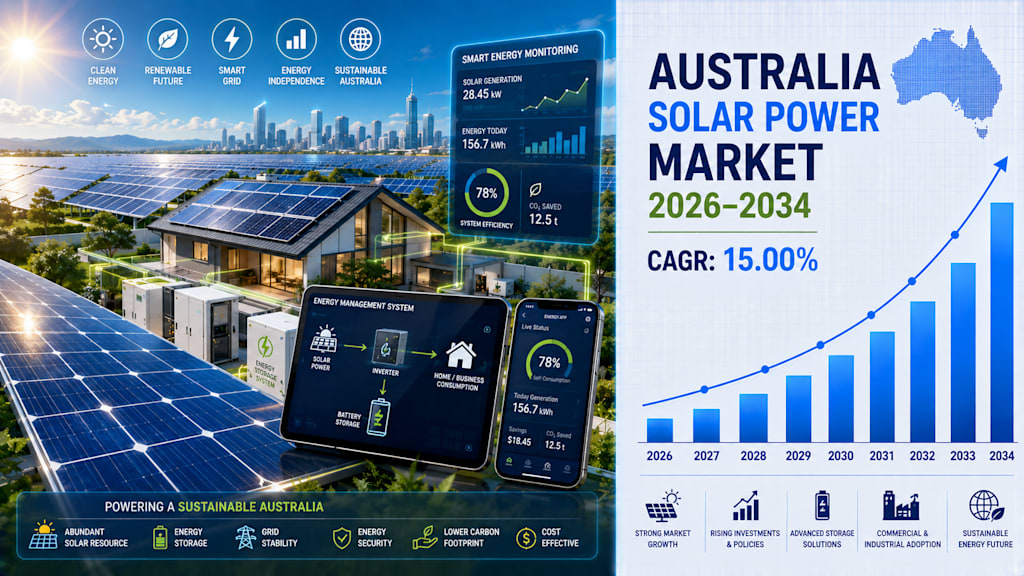
Australia Solar Power Market Overview
The Australia solar power market is a rapidly expanding segment of the country’s renewable energy industry, involving electricity generation through photovoltaic (PV) systems and concentrated solar power technologies across residential, commercial, industrial, and utility-scale applications.
According to IMARC Group, the Australia solar power market size reached USD 9.6 Billion in 2025 and is projected to reach USD 33.9 Billion by 2034, exhibiting a compound annual growth rate (CAGR) of 15.00% during 2026–2034.
The market is witnessing strong growth driven by rising investments in renewable energy infrastructure, increasing adoption of rooftop solar systems, declining solar panel costs, supportive government policies, and growing demand for sustainable electricity generation.
Key Market Drivers
Rising Demand for Renewable Energy
Australia’s transition toward clean energy and decarbonization is significantly increasing the adoption of solar power systems across residential, commercial, and industrial sectors.
Government Incentives and Sustainability Policies
Federal and state-level renewable energy targets, feed-in tariffs, tax incentives, and emissions reduction initiatives are supporting solar market expansion.
Declining Costs of Solar Technologies
Falling prices of photovoltaic panels, inverters, and battery storage systems are improving affordability and accelerating solar installations.
Growth of Utility-Scale Solar Projects
Large-scale solar farms and renewable energy infrastructure projects are contributing significantly to electricity generation capacity growth.
Increasing Adoption of Energy Storage Systems
Battery storage integration is improving energy reliability and enabling efficient use of solar-generated electricity during peak demand periods.
Request a Sample Report with the Latest 2026 Data & Forecasts
What the Opportunities Are
Expansion of Rooftop Solar Installations
Residential and commercial consumers are increasingly adopting rooftop solar systems to reduce electricity costs and improve energy independence.
Growth of Solar Battery Storage Solutions
The increasing deployment of home and grid-scale battery systems is creating opportunities for integrated solar energy management solutions.
Development of Smart Grid Infrastructure
Advanced smart grid technologies and digital energy management systems are improving solar power distribution and efficiency.
Rising Investments in Green Hydrogen Production
Solar energy is increasingly being utilized to support green hydrogen projects and clean industrial energy initiatives.
Increasing Adoption of Community Solar Projects
Shared solar systems and community-based renewable energy programs are expanding access to clean energy solutions.
Recent News and Developments
May 2026: The Australia solar power market continued achieving record rooftop installation levels. Australia registered a record 442 MW of new small-scale rooftop solar capacity in April 2026, representing a 31% month-on-month increase and almost double the volume installed in April 2025. The surge was largely driven by rapid adoption of home battery systems under the federal Cheaper Home Batteries Program.
May 2026: Australia’s residential battery boom is significantly strengthening solar adoption and grid flexibility. More than 350,000 home battery systems had reportedly been installed within the first 10 months of the Cheaper Home Batteries Program, helping households store excess rooftop solar generation and reduce evening grid demand.
May 2026: Renewable energy and solar generation are increasingly lowering wholesale electricity prices across Australia. According to Australian Energy Market Operator data, renewable energy sources including solar, wind, hydro, and batteries generated nearly 47% of electricity during the first quarter of 2026, while gas-fired power generation fell to its lowest quarterly average since 1999.
April 2026: Australia’s rooftop solar fleet exceeded approximately 28.3 GW of installed capacity across around 4.3 million installations nationwide by the end of 2025. Rooftop solar contributed approximately 14.2% of total electricity generation during the second half of 2025, highlighting Australia’s position as one of the world’s leading rooftop solar markets.
April 2026: Utility-scale solar projects continue facing profitability pressure due to falling wholesale electricity prices and increasing renewable generation. Genex Power scaled back the first stage of its Bulli Creek Clean Energy Park project in Queensland from an originally planned 775 MW solar farm to approximately 300 MW, while delaying construction timelines because of difficult market conditions.
March 2026: Australia’s rooftop solar market recorded the largest February installation total in history, with approximately 281 MW of new rooftop solar capacity installed during the month. Year-to-date installation volumes were approximately 6% ahead of the same period in 2025, demonstrating continued strong consumer demand despite broader market maturity.
February 2026: The Clean Energy Regulator projected that Australia could install between 350,000 and 520,000 residential battery systems in 2026, representing approximately 8–12 GWh of storage capacity. The regulator also forecast rooftop solar installations could rebound to between 3 GW and 3.7 GW during 2026.
February 2026: BloombergNEF reported that investment in Australia’s utility-scale solar sector declined by approximately 35% in the second half of 2025, with financing falling to around AUD 379 million. Most newly financed projects now include integrated battery energy storage systems as developers increasingly prioritize hybrid renewable energy projects.
January 2026: Australia added approximately 7 GW of renewable energy capacity during 2025, with renewables supplying nearly 43% of total electricity generation nationally. Government and industry stakeholders continue targeting 82% renewable electricity generation by 2030, supported by ongoing expansion in rooftop solar, batteries, and large-scale renewable infrastructure.
2025–2026 (market trend): The Australia solar power market is being shaped by record rooftop solar adoption, rapid battery storage deployment, falling renewable generation costs, and growing electrification of households and businesses. Solar-plus-storage systems are increasingly improving grid reliability and reducing dependence on fossil fuel generation. At the same time, transmission bottlenecks, declining wholesale power prices, project financing challenges, and grid integration complexity continue to influence utility-scale solar development across the country.
Why You Should Know About the Australia Solar Power Market?
The Australia solar power market is becoming a major pillar of the country’s renewable energy transition and decarbonization strategy.
With projected growth from USD 9.6 Billion in 2025 to USD 33.9 Billion by 2034, the market demonstrates substantial expansion potential driven by renewable energy investments, declining technology costs, and increasing adoption of sustainable power solutions.
As Australia continues accelerating its clean energy transition, solar power is expected to play a critical role in supporting energy security, emissions reduction, and long-term environmental sustainability.
About the Creator
Amyra Singh
Market research analyst who loves spotting patterns, digging into data, and turning insights into strategies that help brands grow and stay ahead of the curve.
Enjoyed the story? Support the Creator.
Subscribe for free to receive all their stories in your feed.
Comments
There are no comments for this story
Be the first to respond and start the conversation.