
Australia Solar Panel Market 2026: Renewable Energy Expansion, Battery Storage Adoption & Government Incentives Driving Growth
How rising electricity costs, clean energy targets, and technological advancements are transforming the Australia solar panel industry

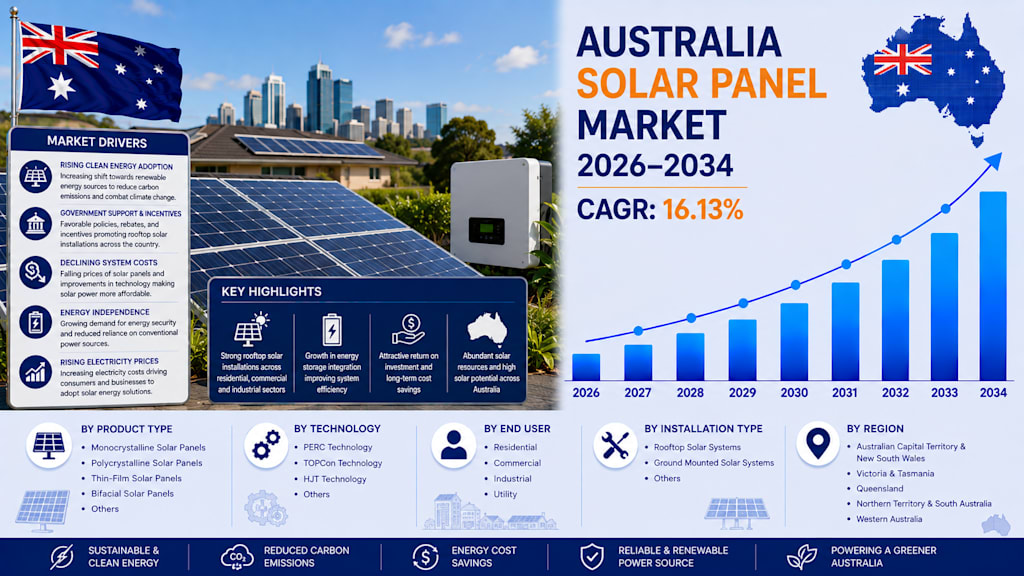
Australia Solar Panel Market Overview
The Australia solar panel market is a crucial component of the country’s renewable energy transition, encompassing photovoltaic (PV) panels, residential solar installations, commercial solar systems, industrial solar projects, and utility-scale solar energy developments.
According to IMARC Group, the Australia solar panel market size reached 9.9 Gigawatt in 2025 and is projected to reach 46.6 Gigawatt by 2034, exhibiting a compound annual growth rate (CAGR) of 16.13% during 2026–2034. The market is experiencing rapid expansion driven by rising electricity prices, supportive government policies, declining solar technology costs, increasing environmental awareness, and growing adoption of battery storage solutions.
Key Market Drivers
Rising Residential Solar Installations
Australian households are increasingly adopting rooftop solar systems to reduce electricity expenses and improve energy independence. Federal incentive programs such as the Small-scale Renewable Energy Scheme (SRES) continue making solar installations more affordable for homeowners.
Growing Integration of Battery Storage Systems
The adoption of solar-plus-storage systems is accelerating as consumers seek reliable energy solutions and greater control over electricity consumption. Battery storage technologies enable users to maximize solar energy utilization while reducing dependence on the power grid.
Strong Government Support and Renewable Energy Policies
Federal and state governments continue implementing incentives, rebates, renewable energy targets, and feed-in tariff programs that encourage solar panel adoption across residential, commercial, and industrial sectors.
Increasing Commercial and Industrial Solar Investments
Businesses are increasingly investing in solar energy systems to lower operational costs, improve sustainability performance, and meet corporate environmental commitments. Power purchase agreements (PPAs) are further supporting large-scale commercial solar deployments.
Abundant Solar Resources and Favorable Climate Conditions
Australia benefits from some of the highest solar irradiance levels globally, creating highly favorable conditions for efficient solar power generation and long-term investment returns.
Request a Sample Report with the Latest 2026 Data & Forecasts
What the Opportunities Are
Expansion of Utility-Scale Solar Farms
Large-scale solar energy projects are creating significant opportunities for solar panel manufacturers, developers, infrastructure providers, and renewable energy investors as Australia accelerates its clean energy transition.
Growth of Smart Energy Management Solutions
The integration of artificial intelligence, smart monitoring systems, predictive analytics, and energy optimization platforms is improving solar system efficiency and creating new growth opportunities across the sector.
Rising Demand for High-Efficiency Solar Technologies
Consumers and businesses are increasingly seeking advanced solar panel technologies that deliver higher energy output, improved durability, and better long-term performance.
Development of Distributed Energy Networks
The expansion of decentralized energy generation systems and community energy projects is creating opportunities for distributed solar infrastructure and localized energy management solutions.
Increasing Corporate Sustainability Commitments
Organizations across multiple industries are investing in renewable energy solutions to reduce carbon emissions, achieve sustainability targets, and strengthen environmental performance.
Recent News and Developments
May 2026 : The Australia solar panel market continued expanding as households and businesses increasingly invested in renewable energy systems to reduce electricity costs and improve long-term energy security.
April 2026 : Battery storage adoption continued accelerating nationwide as consumers sought greater energy independence and improved utilization of solar-generated electricity.
March 2026 : Commercial and industrial sectors expanded solar investments through large-scale installations and power purchase agreements designed to lower operational expenses and support sustainability initiatives.
February 2026 : Government incentive programs and renewable energy targets continued encouraging new solar installations across residential, commercial, and industrial segments.
January 2026 : Technological advancements in solar panel efficiency, energy storage integration, and smart energy management systems further strengthened market growth and adoption rates.
December 2025 : Solar energy remained one of the fastest-growing renewable energy sources in Australia, supported by strong consumer demand, favorable policy frameworks, and declining equipment costs.
November 2025 : Solar-plus-storage solutions gained significant traction as consumers increasingly prioritized energy resilience, lower electricity bills, and sustainable energy generation.
2025–2026 (Market Trend) : The Australia solar panel market is being shaped by rapid renewable energy adoption, increasing battery storage integration, expanding utility-scale solar projects, supportive government policies, and technological innovation. Industry participants are investing heavily in high-efficiency solar technologies, smart energy systems, and large-scale renewable infrastructure to meet growing energy demand and sustainability goals. At the same time, grid integration challenges, supply chain considerations, and evolving regulatory frameworks continue influencing market development.
Why You Should Know About the Australia Solar Panel Market?
The Australia solar panel market is becoming an increasingly important pillar of the country’s renewable energy, sustainability, and energy security ecosystem.
With projected growth from 9.9 Gigawatt in 2025 to 46.6 Gigawatt by 2034, the market demonstrates exceptional long-term potential supported by government incentives, abundant solar resources, declining technology costs, and increasing adoption across residential, commercial, and industrial sectors.
As solar developers, technology providers, utilities, and consumers continue investing in renewable energy infrastructure, battery storage systems, and smart energy management solutions, the sector is expected to play a critical role in shaping Australia’s clean energy future and achieving long-term decarbonization objectives.
About the Creator
Amyra Singh
Market research analyst who loves spotting patterns, digging into data, and turning insights into strategies that help brands grow and stay ahead of the curve.
Enjoyed the story? Support the Creator.
Subscribe for free to receive all their stories in your feed.
Comments
There are no comments for this story
Be the first to respond and start the conversation.