
Australia Sodium Cyanide Market 2026: Gold Boom Mining, Aggressive Capacity Expansion & Sustainability Gains
How record gold prices, low grade ore processing and capital intensive supplier expansions are driving the Australian sodium cyanide market

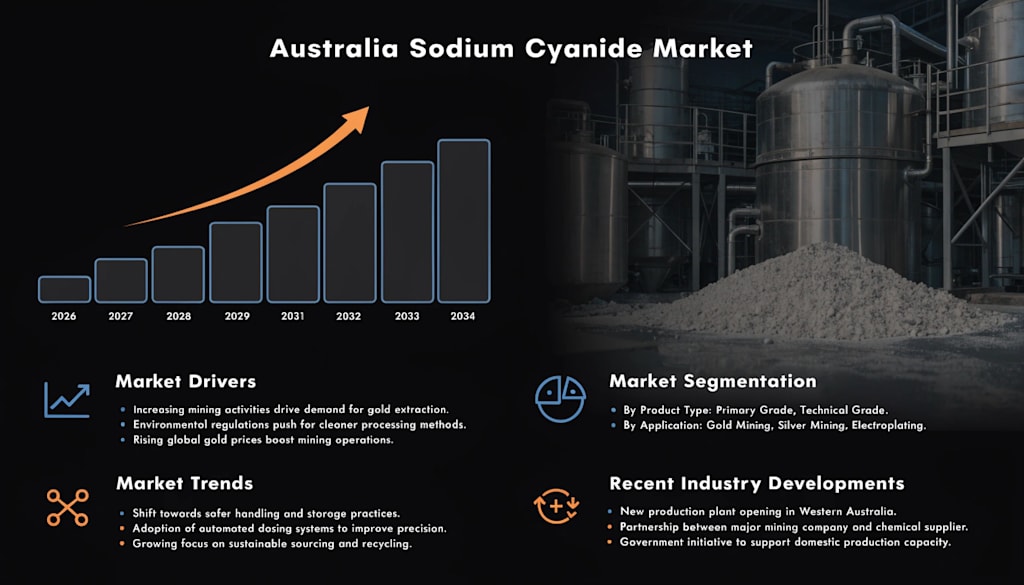
The Australia sodium cyanide market is expanding rapidly as gold miners, chemical manufacturers and logistics operators increasingly invest in specialised capacity, advanced safety systems and sustainable production technologies. Sodium cyanide — a white, highly toxic inorganic compound — is overwhelmingly deployed in gold mining operations to extract fine gold particles from crushed ore through the cyanidation process, where it forms soluble complexes with precious metals enabling efficient recovery. According to IMARC Group, the market size reached USD 61.06 Million in 2025 and is projected to reach USD 115.64 Million by 2034, exhibiting a strong compound annual growth rate (CAGR) of 7.35% during 2026–2034.
Australia’s gold mining sector has always been central to the sodium cyanide market, but the relationship has intensified in recent years. Gold prices have surged to record highs—reaching $4,071 per ounce in late 2025—driving domestic production and triggering a wave of capital intensive supplier expansions. More than 90% of Australia’s 100+ gold mines rely on sodium cyanide for processing. The industry is now responding with multi hundred million dollar capacity investments and a structural shift toward sustainability, including incineration upgrades that cut emissions intensity by 28 % and wastewater recycling exceeding 70 %. As Western Australian mines process lower grade ore and major projects like the Hemi gold mine prepare to come online by 2030, sodium cyanide has become not only an essential reagent but a strategic differentiator for miners racing to capitalise on a sustained gold boom while delivering on environmental and safety commitments.
What’s Driving Market Growth?
Record Gold Prices and Mining Expansion. The most powerful driver of Australian sodium cyanide demand is the extraordinary run up in global gold prices. In late 2025, gold reached 4,071 per ounce, a staggering **57 % increase** from 2,590 per ounce just one year earlier, driven by US tariffs, Middle East tensions and sustained geopolitical instability. Australia, the world’s third largest gold producer accounting for about 10 % of global output, produced 303 tonnes (approximately 9.75 million ounces) of gold in calendar 2025, worth $71 billion at peak prices—cementing gold as one of the nation’s largest single exports. Quarterly production reached 77 tonnes in the December 2025 quarter, and the industry is increasingly deploying sodium cyanide to process lower grade ores as higher prices make marginal deposits economic.
Low Grade Ore Processing Intensifies Reagent Consumption. Unlike most commodity markets, gold producers have historically responded to price surges not by expanding mine output but by extracting lower grade ores, creating a backward rising supply curve. This phenomenon is now unfolding at major Australian operations, including Newmont’s Boddington mine and Northern Star Resources’ Kalgoorlie Super Pit. Processing lower grade ore requires substantially higher sodium cyanide consumption per ounce produced, because larger volumes of crushed rock must be leached to extract the same quantity of gold. AGR General Manager Barney Jones confirmed this dynamic: “With the gold price at such a high, mines are striving to produce more gold… by expanding their current mines or developing new mines, and that’s where the AGR team come in.” While Australia’s gold production is forecast to decline marginally to 10.2 million ounces in 2025 — the fifth consecutive annual decrease — it is set for a strong rebound thereafter, reaching approximately 13.2 million ounces by 2030 as major projects like Northern Star’s Hemi gold mine come online.
Dual Domestic Supplier Expansions Creating Capacity Cushion. Australia’s sodium cyanide market is defined by two major domestic producers, both of which are engaged in aggressive capacity expansions. Orica, a global leader in mining chemicals and one of the world’s largest sodium cyanide manufacturers, operates a production plant in Yarwun, Queensland, with an annual capacity of 95,000 tonnes. The facility has achieved six consecutive certifications under the International Cyanide Management Code, representing 17 years of continuous compliance, and supplies key mining regions in Latin America, Africa and Oceania.
AGR, which is 75 % owned by Wesfarmers and 25 % by Coogee Chemicals, operates the Kwinana complex in WA—the only mass production site of sodium cyanide in Western Australia. In February 2025, AGR announced a 30 % capacity increase from 91,000 tonnes per annum to 130,000 tonnes, supported by a new low emissions incinerator partially funded by a $7.5 million Australian Government Powering the Regions Fund grant. In May 2025, the company lodged a further application to expand production from 170,000 tpa to 210,000 tpa, targeting both domestic and international markets. First production from the expanded plant is scheduled for financial year 2026, with full capacity expected online in the second half of financial year 2027.
Sustainability and Environmental Performance Gains. Both Orica and AGR have achieved the most recent recertification of their respective operations in full compliance under the International Cyanide Management Code. AGR’s expansion is delivering substantial environmental benefits: the new incinerator reduces greenhouse gas emissions intensity by approximately 28 %, while the plant will recycle over 70 % of wastewater onsite, conserving valuable resources and reducing reliance on external water sources. The company is also exploring technology to use waste heat from the manufacturing process to generate zero emissions electricity, potentially exporting clean power to nearby facilities or supporting the local grid. These sustainability gains are increasingly important as miners face tightening regulatory standards and investor pressure to demonstrate responsible sourcing.
Market Segmentation & Key Insights
By Form, the market includes solid sodium cyanide (briquettes, flakes or powder) and sodium cyanide solution. Solid forms are preferred for international export due to transport efficiency and triple packaged safety systems — typically a strong woven bulk bag inside a heat sealed plastic bag, further protected by a wooden box to prevent damage. Solution is more common for domestic mines with close proximity to production facilities. AGR’s expansion included increased solids production capacity specifically to facilitate exports to international customers.
By Application, the market is overwhelmingly dominated by gold extraction, accounting for more than 90 % of consumption. Silver extraction represents a smaller but steady secondary application, while electroplating, chemical synthesis and other industrial uses constitute residual demand.
By End Use Industry, the market segments include gold mining, silver mining, electroplating, chemical manufacturing and others. Gold mining generates the vast majority of demand, and WA alone accounts for nearly two thirds of all gold mined in Australia.
By Region, Western Australia is the dominant market due to its concentration of gold mining activity, including the Kalgoorlie Super Pit, Tanami and Tropicana mines. AGR’s Kwinana facility is strategically located to serve this core customer base. Queensland represents the second largest market, anchored by Orica’s Yarwun plant. Exports to Asia, Africa, the Americas and the Middle East represent a growing share as WA produced and Queensland produced cyanide is shipped to international gold mining operations.
What the Opportunities Are?
Domestic Capacity Expansion and Supply Security. Australia currently relies on two domestic producers, but AGR’s expansion from 91,000 tpa to 130,000 tpa, and the further application to reach 210,000 tpa, demonstrates the capacity for continued growth. Between 2023 and 2024, AGR sold 54,000 tonnes of sodium cyanide solution to local mines, forecast to rise to 73,000 tonnes within a few years and to grow substantially beyond that as 2030 approaches. Investors can explore opportunities in logistics, supply chain optimisation and regional distribution hubs to capture growing demand from both established and emerging gold mines.
Sustainability Driven Production Technologies. With the Australian government funding industrial decarbonisation projects (the $7.5 million grant to AGR is a concrete example), producers that invest in low emissions incineration, wastewater recycling and waste heat recovery can reduce operating costs while strengthening their ESG credentials. The 28 % reduction in emissions intensity and 70 %+ wastewater recycling achieved by AGR demonstrates what is commercially feasible, and similar technologies could be deployed at other chemical manufacturing facilities. Suppliers of catalytic incineration systems, advanced water treatment membranes, and thermal energy recovery equipment will find receptive customers as the industry’s sustainability investments accelerate.
ICMC Certification and Regulatory Compliance Services. Adherence to the International Cyanide Management Code is increasingly non negotiable for international offtake agreements. Both Orica and AGR have maintained full compliance for over 17 years, and new producers or logistics operators entering the market will require similar certifications. There is opportunity for consulting firms, auditors and training providers specialising in Cyanide Code compliance, including third party verification, substance management plans and safe transport protocols for Division 6.1 toxic substances. Western Australia’s 2025 Mines Safety Bulletin No. 130, which identified dangerous mis labelling of cyanide containing reagents transported in inappropriate containers, underscores the regulatory scrutiny and demand for compliant supply chain expertise.
Low Grade Ore Processing Formulations and Technical Services. As Australian gold mines increasingly rely on lower grade stockpiles to maintain output, demand will grow for sodium cyanide formulations optimised for specific ore types, gangue mineralogies and process conditions. Chemical suppliers offering advanced solution chemistry, application optimisation services and on site technical support to maximise gold recovery while minimising cyanide consumption will capture long term contracts. AGR’s General Manager noted the demand is driven partly by “an increased need for SCN in processing low grade ore, as well as more gold mining projects coming online,” positioning technical service providers to play a pivotal role.
Export Market Growth and Port Logistics. AGR’s expansion specifically included increased solids production capacity “to facilitate increased exports to our international customers,” with gold producers across Asia, Africa, the Americas and the Middle East as target markets. Shipping solid sodium cyanide internationally requires specialised, triple packaged and fully compliant transport systems. Companies offering verified bulk packaging solutions, port side storage infrastructure and end to end supply chain management for hazardous goods can capture value from the growing export orientation of Australian cyanide production. With AGR projecting total solution capacity to reach 130,000 tonnes and total capacity to reach 210,000 tonnes, port logistics near Kwinana and Yarwun will see substantial volume growth.
Global Gold Mining Recovery and New Project Pipelines. Gold output is set for a strong rebound after 2025, rising from 10.2 million ounces to around 13.2 million ounces by 2030 as major projects come online. Northern Star’s Hemi gold mine alone is expected to contribute 17 tonnes of annual output, while operational recoveries at established mines across WA, NT and Queensland continue to expand. Each new or expanding mine creates long term sodium cyanide offtake agreements, offering stable demand visibility for producers.
Recent News and Developments in Australia Sodium Cyanide Market
February 2025: AGR announced a final investment decision to expand its Kwinana sodium cyanide facility, increasing annual solution capacity by over 30 % to approximately 130,000 tonnes per annum. The expansion included a new low emissions incinerator, partially funded by a $7.5 million Australian Government Powering the Regions Fund grant, reducing greenhouse gas emissions intensity by 28 % and enabling recycling of over 70 % of wastewater onsite. First production was scheduled for financial year 2026.
May 2025: Wesfarmers’ wholly owned chemicals subsidiary lodged an application to further expand AGR’s Kwinana production capacity from 170,000 tpa to 210,000 tpa, citing booming demand from WA gold miners and international customers. The expansion would include installation of a new sodium cyanide storage tank and modifications, replacement and duplication of existing process equipment.
October 2025: AGR moved the sodium cyanide plant expansion from engineering into construction, completing a major Reverse Osmosis slab pour that required 400 m³ of concrete. The project focuses on debottlenecking and modernising the existing plant while maintaining safe and continuous operations.
December 2025: Australia’s gold output for the full calendar year totalled 303 tonnes (approximately 9.75 million ounces) worth 71 billion**, with the December quarter alone producing 77 tonnes. The average gold price during the quarter reached US4145 per ounce, peaking at a record US4549. In Australian dollars, that equated to **6322 per ounce, $1041 more than the September quarter.
Early 2026: AGR reported that 54,000 tonnes of sodium cyanide solution were sold to local mines in the previous year, forecast to increase to 73,000 tonnes within the next few years and substantially further by 2030 due to low grade ore processing and new mine developments.
Why Should You Know About Australia Sodium Cyanide Market?
You should know about this market because it captures how record commodity prices, process chemistry optimisation and industrial sustainability intersect to create a strong growth segment at the interface between mining and specialty chemicals. Sodium cyanide is no longer just a hazardous industrial reagent—it is a critical performance input that enables Australian gold miners to extract value from marginal ores, maintain export volumes and meet increasingly stringent environmental and safety standards.
For investors, the sodium cyanide market offers exposure to a high growth industrial chemicals category anchored in structurally elevated gold prices, the multi year rebound in Australian gold production toward 13.2 million ounces by 2030, and the multi hundred million dollar capacity expansion plans of both Orica and AGR. The projected CAGR of 7.35 %, significantly above the global sodium cyanide market growth rate of 3 5 %, reflects strong confidence in the Australian mining sector’s demand trajectory. Recent price stability, with Australian sodium cyanide at USD 2,163/MT in Q2 2025 compared to significantly higher prices in the US (USD 3,066/MT), has reinforced the cost competitiveness of domestic suppliers.
For mining executives, chemical supply chain planners, infrastructure investors and sustainability officers, understanding sodium cyanide form segmentation, sustainability certification requirements (ICMC compliance, low emissions incineration, wastewater recycling), and safety transport protocols helps shape intelligent procurement decisions, risk management frameworks and technology investments that deliver measurable operational efficiency, regulatory compliance and responsible environmental outcomes.
In essence, the Australia sodium cyanide market captures how chemistry, mining and industrial decarbonisation converge—making it a compelling area for investors, chemical manufacturers and logistics providers seeking smarter approaches to gold extraction efficiency, supply chain resilience and sustainable production in one of the world’s most significant gold mining jurisdictions.
About the Creator
Thomas
Market Research Analyst | Industry Trends & Forecasting | Turning market data into clear, actionable business insights across global sectors.
Enjoyed the story? Support the Creator.
Subscribe for free to receive all their stories in your feed.
Comments
There are no comments for this story
Be the first to respond and start the conversation.