
Australia Smart Manufacturing Market 2026: Industry 4.0 Adoption, AI Integration & Industrial Automation Driving Growth
How digital transformation, connected factories, and advanced automation technologies are reshaping the Australia smart manufacturing industry

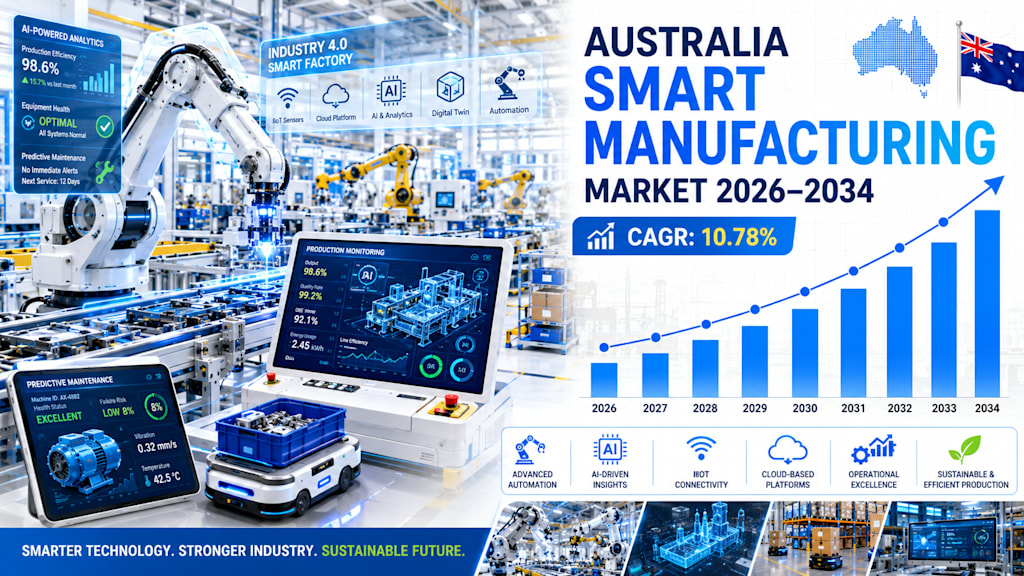
Australia Smart Manufacturing Market Overview
The Australia smart manufacturing market is rapidly evolving as industries increasingly adopt advanced digital technologies to improve operational efficiency, productivity, and supply chain optimization. Smart manufacturing combines automation, artificial intelligence (AI), industrial Internet of Things (IIoT), robotics, cloud computing, and data analytics to create connected and intelligent production systems.
According to IMARC Group, the Australia smart manufacturing market size reached USD 11.1 Billion in 2025 and is projected to reach USD 28.7 Billion by 2034, exhibiting a compound annual growth rate (CAGR) of 10.78% during 2026–2034.
The market is witnessing substantial growth driven by increasing adoption of Industry 4.0 technologies, rising labor cost pressures, expanding industrial automation, and growing investments in digital transformation initiatives across manufacturing sectors.
Key Market Drivers
Rising Adoption of Industry 4.0 Technologies
Manufacturers across Australia are increasingly implementing Industry 4.0 solutions such as IoT-enabled machinery, AI-driven analytics, and smart sensors to improve production efficiency and reduce downtime.
Growing Demand for Industrial Automation
Automation technologies including robotics, autonomous systems, and smart control systems are helping manufacturers optimize workflows, enhance precision, and lower operational costs.
Increasing Focus on Operational Efficiency
Manufacturers are leveraging predictive maintenance, real-time monitoring, and digital twins to improve productivity, reduce equipment failures, and streamline operations.
Expansion of Connected Factory Infrastructure
The integration of cloud computing and industrial connectivity solutions is enabling the development of smart factories with centralized monitoring and data-driven decision-making capabilities.
Government Support for Advanced Manufacturing
Australian government initiatives supporting industrial innovation, digitalization, and advanced manufacturing adoption are contributing to market expansion.
Request a Sample Report with the Latest 2026 Data & Forecasts
What the Opportunities Are
Growth of AI and Machine Learning Applications
AI-powered manufacturing systems are creating opportunities for advanced quality control, predictive analytics, and intelligent production planning.
Expansion of Industrial IoT Networks
Increasing deployment of connected sensors and IIoT devices is enabling manufacturers to collect and analyze operational data in real time.
Development of Smart Supply Chain Systems
Digital supply chain platforms are improving inventory management, logistics coordination, and end-to-end operational visibility.
Rising Adoption of Collaborative Robotics
Cobots designed to work alongside human workers are gaining popularity due to improved workplace safety and operational flexibility.
Integration of Sustainable Manufacturing Practices
Smart manufacturing technologies are helping industries reduce energy consumption, minimize waste, and improve environmental sustainability.
Recent News and Developments
May 2026: Manufacturing conditions in Australia are being reshaped by rising digitalisation, energy uncertainty, and productivity pressures. According to the Australian Manufacturing Technology Institute Limited (AMTIL), manufacturers across the Asia-Pacific region are increasingly investing in automation, AI-driven production systems, and high-value manufacturing processes to remain competitive amid labour shortages and margin pressures.
April 2026: Microsoft announced a major A$25 billion (USD 17.9 billion) investment in Australia to expand AI and cloud computing infrastructure. The investment aims to increase the company’s cloud and AI capacity in Australia by more than 140% by 2029, significantly strengthening the digital infrastructure needed for smart manufacturing, industrial AI, and advanced automation systems.
April 2026: Australia’s smart manufacturing sector continues to benefit from growing Industry 4.0 adoption. According to IMARC, the Australia smart manufacturing market reached approximately USD 11.1 billion in 2025, driven by increasing deployment of Industrial Internet of Things (IIoT), robotics, machine learning, and predictive maintenance technologies across manufacturing facilities.
March 2026: Labour shortages remain a major driver of manufacturing automation in Australia. The 2024 Occupation Shortage List identified shortages in 303 out of 916 occupations, prompting manufacturers to accelerate investments in collaborative robots (cobots), automated guided vehicles (AGVs), and AI-enabled production systems to maintain productivity and reduce dependence on manual labour.
March 2026: Australia’s manufacturing sector recorded strong operational momentum before global geopolitical disruptions intensified. The Westpac-ACCI Actual Composite Index rose to 59.3 in early 2026, up from 54.7 in late 2025, marking the strongest manufacturing conditions since September 2023. Increased output growth, higher new orders, and renewed employment expansion supported rising investment in digital manufacturing technologies and smart factory systems.
February 2026: Smart factory and offsite manufacturing technologies are gaining traction in Australia’s construction and industrial sectors. Wesfarmers partnered with Built Group to establish a precast concrete manufacturing facility capable of producing over 2,000 apartments annually using Design for Manufacture and Assembly (DfMA) techniques. The project aims to reduce construction costs by 20% and cut build times by up to 50%, highlighting growing adoption of automated and digitally integrated manufacturing systems.
January 2026: Smart manufacturing software adoption is accelerating as businesses invest in cloud-based production systems, digital twins, cybersecurity, and real-time analytics. According to IMARC, the Australia smart manufacturing software market reached approximately USD 4.0 billion in 2025, supported by government-backed Industry 4.0 initiatives and rising demand for real-time production visibility and predictive maintenance solutions.
2025–2026: The Australia smart manufacturing market is being shaped by Industry 4.0 adoption, AI integration, robotics, and sustainability-driven production strategies. Manufacturers are increasingly implementing IoT-enabled systems, smart factories, and energy-efficient production technologies to improve operational efficiency and reduce emissions. At the same time, challenges such as skilled labour shortages, high implementation costs, and cybersecurity concerns continue to influence adoption across the sector.
Why You Should Know About the Australia Smart Manufacturing Market?
The Australia smart manufacturing market is becoming a critical driver of industrial modernization and economic competitiveness.
With projected growth from USD 11.1 Billion in 2025 to USD 28.7 Billion by 2034, the market demonstrates strong expansion potential driven by automation, AI integration, and Industry 4.0 adoption.
As manufacturers continue embracing connected technologies and data-driven production systems, smart manufacturing is expected to play a major role in improving productivity, sustainability, and long-term industrial growth across Australia.
About the Creator
Amyra Singh
Market research analyst who loves spotting patterns, digging into data, and turning insights into strategies that help brands grow and stay ahead of the curve.
Enjoyed the story? Support the Creator.
Subscribe for free to receive all their stories in your feed.
Comments
There are no comments for this story
Be the first to respond and start the conversation.