
Australia Smart Buildings Market 2026: IoT Integration, Energy Efficiency & Sustainable Infrastructure
How automation technologies, green building standards and digital systems are transforming Australia’s smart building industry

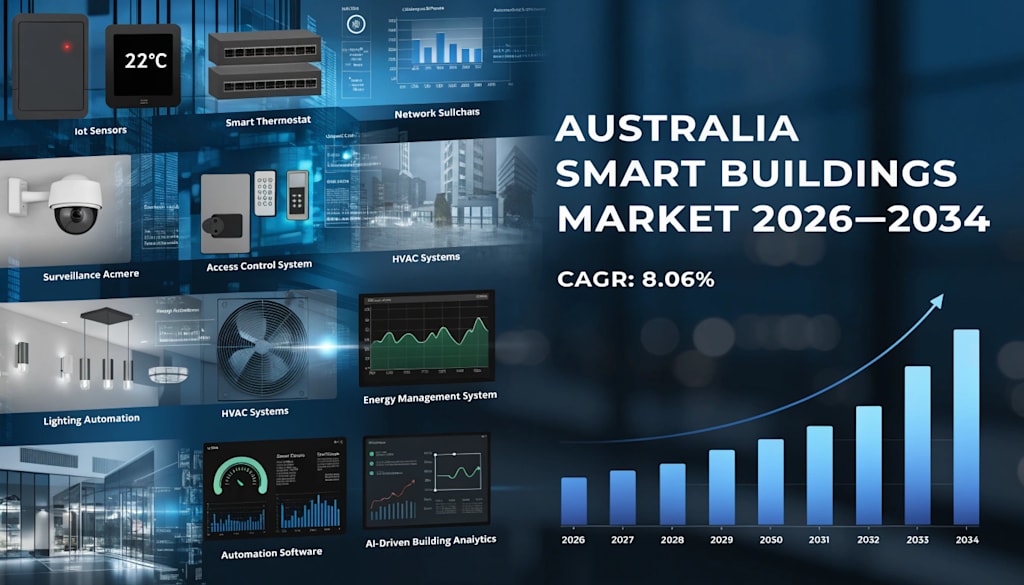
Australia Smart Buildings Market Overview
The Australia smart buildings market is an emerging and rapidly evolving segment of the country’s construction and infrastructure ecosystem, encompassing intelligent systems such as building automation, energy management, security and IoT-enabled solutions. Smart buildings are designed to enhance operational efficiency, reduce energy consumption and improve occupant comfort through integrated digital technologies.
According to IMARC Group, the Australia smart buildings market size reached USD 3.6 Billion in 2025 and is projected to reach USD 7.6 Billion by 2034, exhibiting a compound annual growth rate (CAGR) of 8.06% during 2026–2034.
The market is experiencing strong growth, driven by increasing demand for energy-efficient infrastructure, government regulations promoting sustainability and rapid adoption of Internet of Things (IoT) technologies. Urbanization and the development of smart cities are further accelerating the deployment of smart building solutions across residential, commercial and industrial sectors.
Key Market Drivers
Increasing Focus on Energy Efficiency and Sustainability
Stringent energy efficiency regulations and green building standards are encouraging the adoption of smart systems such as automated lighting, HVAC controls and real-time energy monitoring.
Government Initiatives and Incentive Programs
Programs like NABERS and green building incentives are promoting environmentally sustainable construction, boosting demand for smart building technologies across sectors.
Integration of IoT and Building Automation Systems
IoT-enabled devices are transforming building operations by enabling real-time monitoring, predictive maintenance and automated control of systems such as lighting, security and climate management.
Growth of Smart Cities and Urban Development
Rapid urbanization and smart city initiatives are increasing the adoption of connected infrastructure, driving demand for intelligent building solutions.
Rising Demand for Enhanced Occupant Comfort and Safety
Smart buildings provide improved indoor environments, enhanced security systems and seamless user experiences, making them attractive for modern residential and commercial developments.
Request a Sample Report with the Latest 2026 Data & Forecasts
What the Opportunities Are
The Australia smart buildings market presents significant growth opportunities as digital infrastructure and sustainability initiatives expand.
Expansion of Smart Energy Management Systems
Advanced energy management solutions are enabling efficient monitoring and optimization of power usage, reducing operational costs and environmental impact.
Growth of Retrofitting and Smart Upgrades
Upgrading existing buildings with smart technologies is creating opportunities for retrofitting solutions and modernization of aging infrastructure.
Integration with Renewable Energy Sources
Smart buildings are increasingly incorporating solar power and energy storage systems, enhancing sustainability and reducing reliance on traditional energy sources.
Development of AI-Driven Building Management
Artificial intelligence and data analytics are improving automation, predictive maintenance and decision-making in building operations.
Rising Investment in Commercial and Industrial Smart Infrastructure
Businesses are investing in smart offices, warehouses and industrial facilities to improve efficiency, reduce costs and enhance productivity.
Recent News and Developments
April 2026: Australia is accelerating the transition toward energy-efficient smart buildings, with initiatives such as Melbourne’s electrification program investing $5.3 million in building upgrades, while 80% of its 60-vehicle fleet is already electric or hybrid, highlighting strong integration of smart energy systems and building electrification.
April 2026: Smart building adoption is being driven by energy efficiency upgrades, with 4.2 million Australian households using rooftop solar, collectively saving around $3.15 billion annually, while individual households save approximately $1,500 per year, reinforcing demand for smart energy management systems and automation.
March 2026: Policy reforms are supporting smart construction and building technologies, with procurement changes expected to deliver up to $20.6 billion in savings over five years, encouraging adoption of modern construction methods and smart building integration across infrastructure projects.
January 2026: The Australia smart buildings market reached approximately USD 3.6 billion in 2025, reflecting strong demand for IoT-enabled building systems, automation technologies, and energy-efficient infrastructure across residential, commercial, and industrial sectors
2025: The Australia smart building market generated around USD 1,638.2 million in revenue in 2025 (alternative estimate), with the country accounting for about 1.2% of the global market, indicating a growing but still developing adoption landscape.
2025: Investment activity in smart building technologies remained active, with companies raising approximately $204 million in funding across 7 deals by March 2026, reflecting increasing investor interest in building automation, IoT platforms, and smart infrastructure solutions.
February 2026: Australia’s construction industry, a key driver for smart building deployment, is expanding strongly, expected to reach AUD 193.2 billion in 2026, supporting increased integration of smart technologies in new infrastructure projects.
Why You Should Know About the Australia Smart Buildings Market?
The Australia smart buildings market plays a crucial role in advancing sustainable infrastructure, improving energy efficiency and supporting smart city development.
With projected growth from USD 3.6 Billion in 2025 to USD 7.6 Billion by 2034, the market demonstrates strong expansion potential driven by technological innovation, regulatory support and increasing demand for intelligent environments.
As digital transformation continues to reshape the construction and real estate sectors, the Australia smart buildings market is expected to remain a key driver of sustainable urban development and infrastructure modernization.
About the Creator
Amyra Singh
Market research analyst who loves spotting patterns, digging into data, and turning insights into strategies that help brands grow and stay ahead of the curve.
Enjoyed the story? Support the Creator.
Subscribe for free to receive all their stories in your feed.
Comments
There are no comments for this story
Be the first to respond and start the conversation.