
Australia Semiconductor Fabrication Market 2026: Sovereign Capability, Quantum Integration & National Security
How government-led investment, quantum computing ambitions and defence-grade manufacturing are reshaping Australia's semiconductor fabrication sector

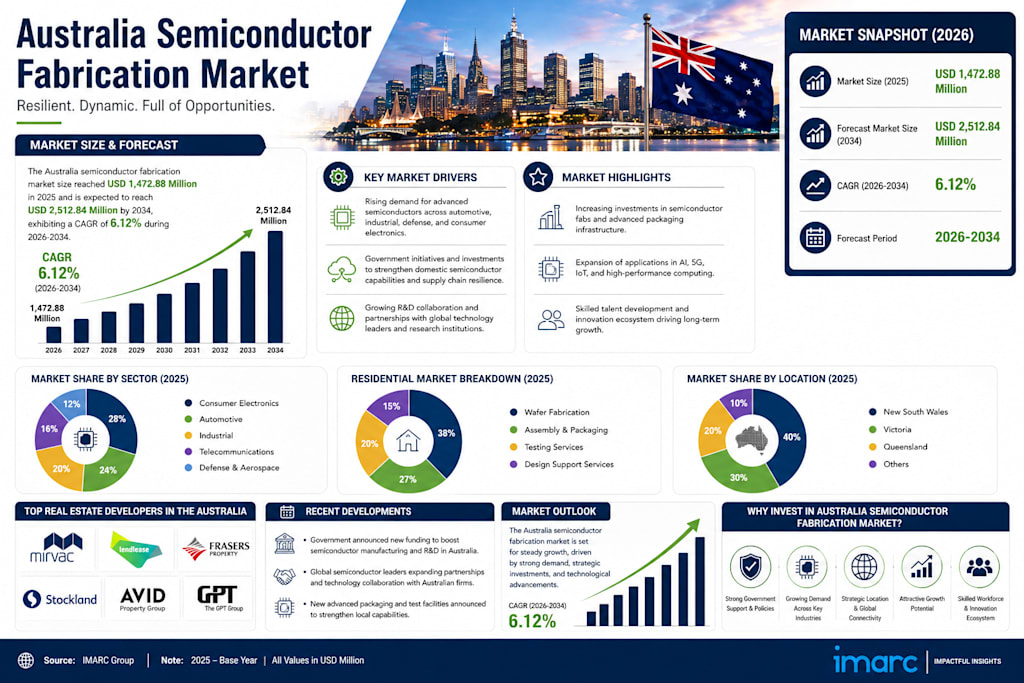
The Australia semiconductor fabrication market is undergoing a strategic transformation as government agencies, defence contractors and technology researchers increasingly prioritise sovereign manufacturing capabilities, supply chain resilience and advanced node development. Semiconductor fabrication — encompassing wafer processing, photolithography, etching, deposition and packaging — is deployed across defence electronics, quantum computing hardware, telecommunications infrastructure and automotive systems to power the devices that underpin modern industrial and military capabilities. According to IMARC Group, the market size reached USD 1,472.88 Million in 2025 and is projected to reach USD 2,512.84 Million by 2034, exhibiting a strong compound annual growth rate (CAGR) of 6.12% during 2026–2034 and reflecting growing demand for specialised chips in AI, IoT and 5G applications, together with the broader Australia semiconductor market valued at USD 14.8 billion in 2025 and projected to reach USD 25.3 billion by 2034 at a CAGR of 5.99%. As Australia accelerates its push for technological sovereignty, semiconductor fabrication has moved from a marginal industry to a central pillar of the nation's economic security and advanced manufacturing agenda.
What's Driving Market Growth?
Government-Driven Sovereign Capability Investment. The Australian government has embarked on an ambitious strategy to establish domestic semiconductor fabrication capabilities through substantial financial commitments and policy frameworks designed to reduce import dependence while strengthening national security. Federal and state governments are channelling significant resources into building pilot manufacturing facilities, upgrading research infrastructure and providing subsidies to attract both domestic startups and international semiconductor firms to establish operations within Australia. The government's $22.7 billion commitment over the next decade under the "Future Made in Australia" initiative supports advanced manufacturing and clean energy projects, with a focus on enhancing capabilities in renewable hydrogen, critical minerals and green metals. The National Reconstruction Fund Corporation (NRFC) is set to invest up to AUD 15 billion in critical technologies, while the government's approach emphasises mature-process-scale manufacturing initially, targeting the 90 to 130 nanometer node range which remains in high demand for automotive electronics, medical devices, industrial applications and defence systems.
Quantum Computing Integration and High-Value Infrastructure. The integration of quantum computing technologies requiring advanced fabrication infrastructure is a key growth driver. Australia is working to grow its quantum computing industry into a 6 billion business** that could produce about 20,000 jobs by 2045, supported by heavy investments including **940 million in PsiQuantum and $1 billion from the National Reconstruction Fund. Government-led strategic investments aimed at establishing sovereign manufacturing capabilities, combined with the expansion of public-private partnerships focused on developing research facilities and talent pipelines to support domestic semiconductor production, are propelling the Australia semiconductor fabrication market share.
Defence and National Security Requirements. The growing emphasis on supply chain resilience and national security considerations is a powerful driver of domestic fabrication demand. Semiconductors represent critical enablers for defence systems, telecommunications networks, healthcare technologies and energy infrastructure, and recognition of these vulnerabilities has accelerated strategic investment. The defence sector's requirement for secure, trusted supply chains for microelectronics is driving investment in domestic fabrication capabilities that meet stringent security certifications. Australia's partnerships with trusted semiconductor manufacturing nations including Taiwan, Japan, South Korea and the United States are enhancing Australia's access to manufacturing expertise, supply chain networks and technology transfer pathways.
Public-Private Partnerships and Research Infrastructure. Australia is strategically leveraging public-private partnerships and research infrastructure investments to bridge the gap between academic innovation and commercial semiconductor manufacturing. The country's extensive network of universities and research institutions possesses significant expertise in semiconductor device physics, materials science and nanofabrication techniques, providing a strong foundation upon which to build scalable manufacturing capabilities. Government agencies are facilitating partnerships between these research entities and commercial semiconductor firms to translate laboratory-scale innovations into pilot production processes and eventually full-scale manufacturing operations. Dedicated semiconductor sector service bureaus, shared fabrication facilities and industry-focused research hubs are creating an ecosystem conducive to rapid prototyping, process development and collaborative problem-solving.
Market Segmentation & Key Insights
By Type, the semiconductor fabrication market is segmented into Integrated Device Manufacturer (IDM) and Fabless. While the broader market includes both segments, the overall Australia semiconductor market reached USD 14.8 billion in 2025. The semiconductor foundry market — a closely related segment — is valued at USD 2.6 billion in 2025 and is projected to reach USD 4.1 billion by 2034 at a CAGR of 5.19%, driven by the rising demand for specialised chips in AI, IoT and 5G, along with government initiatives promoting local production.
By Application, key segments include defence and aerospace, telecommunications, automotive electronics, consumer electronics and industrial applications. Defence and telecommunications represent the largest application segments, driven by national security requirements and 5G infrastructure rollout. The semiconductor and electronic parts manufacturing market in Australia is gradually expanding, driven by rising demand for advanced technologies in defence, telecommunications and consumer electronics.
By Region, major fabrication and research hubs are concentrated in New South Wales and Victoria, with Queensland emerging as a strategic focus area through initiatives like the Queensland Semiconductor Initiative. NSW and Victoria are home to the majority of university-based nanofabrication facilities and research partnerships, while Queensland is positioning itself as the location for Australia's first pilot semiconductor manufacturing facility.
What the Opportunities Are?
Fabless Design and Pilot Manufacturing Capabilities. While Australia lacks full-scale commercial wafer fabs, there is significant opportunity in fabless semiconductor design and pilot-scale manufacturing. The Queensland Semiconductor Initiative (QSi) is building Australia's first end-to-end capability for semiconductor design, short-run manufacturing and future fabrication, working with global foundries and domestic researchers to develop secure, high-performance electronic devices. QSi serves as a bridge between innovation and manufacturing, ensuring that Australia's research breakthroughs become commercially viable technologies supporting critical industries like energy, defence, communications and health. With plans for Fab 1 designed and built between 2025 and 2028, and Fab 2 operational by 2030, QSi represents a foundational opportunity for investors in domestic fabrication infrastructure. The company provides fabless design services for ASICs, sensors and compound semiconductors, process development and short-run manufacturing through global partners, and workforce training and industry collaboration.
Silicon Wafer Market and Semiconductor Materials. The Australia Silicon Wafer market is expected to grow at 6.27% CAGR, fueled by rising investments in semiconductor fabrication and tech innovation. Silicon wafers are a critical foundational material for integrated circuits and microelectronic devices, and despite Australia's current lack of large-scale domestic wafer manufacturing, significant investments in chip design, photonics and advanced manufacturing are creating a foundation for local demand and potential future fabrication activity. The growth of advanced research hubs in New South Wales and Victoria, including partnerships between universities and international semiconductor firms, is fostering a sophisticated user base for custom and specialty wafers. Government initiatives like the $15 billion National Reconstruction Fund allocate capital to bolster sovereign manufacturing capability and are anticipated to increase domestic wafer testing, dicing and packaging needs over the next decade.
Ethical and Sustainable Semiconductor Manufacturing. Sustainability is a key trend in Australia's semiconductor fabrication market, with companies adopting eco-friendly manufacturing processes to reduce carbon footprints. As global scrutiny over electronics supply chains grows, Australian foundries are differentiating themselves through ethical sourcing of raw materials and energy-efficient fabrication techniques. Australia's Circular Economy Framework, published in December 2024, set targets of a 10% reduction in material footprint, a 30% increase in material productivity and an 80% recovery rate for resources by 2035. Renewable energy integration, such as solar-powered fabs, is gaining traction, aligning with Australia's strong renewable energy infrastructure, while there is a rising emphasis on reducing hazardous waste and water usage in chip production. This focus on sustainable and ethical production represents a competitive differentiator for Australian semiconductor manufacturing in global markets.
Critical Minerals Supply Chain Integration. Australia is fast becoming a key player in the AI supply chain, fuelling the semiconductor boom with its rare earths and critical minerals. With an abundance of rare earths and critical minerals, Australia sits at the foundation of the modern technology ecosystem. The US-Australia critical minerals cooperation agreement includes a $1 billion investment co-funding the construction of an advanced gallium refinery in Western Australia — a key material for semiconductors accounting for nearly half of global production. Australia produces 14 of the 31 critical minerals essential for modern technology and renewable energy, with at least 4 percent of the world's rare earth element reserves and global production of lithium reaching as high as 49%. This upstream positioning creates opportunities for vertically integrated investment linking domestic critical minerals processing with semiconductor materials production.
Talent Pipeline and Skilled Migration Support. Australia's semiconductor fabrication ambitions require a skilled workforce, and government initiatives are addressing this need. The permanent migration program planning level remains at 185,000, with a new "National Innovation Visa" allocating 4,300 places for key industry talent, marking a shift from an "elite" focus to "critical industry skills + active innovation". The new "Skills in Demand" visa replaces the 482 visa category, with a Core Skills Income Threshold of AUD 73,150 for general roles and an annual salary of at least AUD 135,000 for the Specialist Skills category for hard-to-recruit talent. Additionally, an investment of AUD 75.1 million will establish a new, modern trade skills assessment system starting in 2026-27.
Government Equity Investment in Semiconductor Design. The Australian government has demonstrated a willingness to take direct equity stakes in semiconductor companies. In October 2025, the government invested AUD 35 million from the National Reconstruction Fund into Morse Micro, Australia's largest semiconductor company, alongside a new injection of AUD 88 million from Japanese chip maker MegaChips and other investors. Morse Micro specialises in developing Wi-Fi HaLow microchip designs, with chips manufactured by TSMC. NRF executive David Gonski noted that while Australia cannot compete with Taiwan in chip mass production, Australia has advantages in research, design, prototyping and testing. This model of government equity investment in fabless semiconductor design companies offers a blueprint for future public-private collaboration.
Recent News and Developments in Australia Semiconductor Fabrication Market
October 2025: The Australian government invested AUD 35 million from the National Reconstruction Fund into Morse Micro, Australia's largest semiconductor company, alongside a new injection of AUD 88 million from Japanese chip maker MegaChips and other investors, valuing the company at AUD 500 million.
August 2025: The National Reconstruction Fund Corporation (NRFC) was established to invest up to AUD 15 billion in critical technologies, including semiconductor manufacturing and advanced materials, with the government committing USD 39.8 million to Simcoa Operations in Western Australia to expand local silicon production — a core upstream material in chip manufacturing.
March 2025: The federal government's 2025-26 Budget outlined $22.7 billion over the next decade for the "Future Made in Australia" initiative, supporting advanced manufacturing and clean energy projects including renewable hydrogen, critical minerals, green metals and low-carbon liquid fuels.
December 2025: Australia's Circular Economy Framework was published, setting targets of a 10% reduction in material footprint, a 30% increase in material productivity and an 80% recovery rate for resources by 2035, with industrial production playing a critical role in this transition through sustainable manufacturing practices, recycled ingredients, green chemistry and circular product design.
December 2025: The Semiconductor Sector Service Bureau (S3B) announced its MPW (Multi-Project Wafer) and CAD subsidies programme, with the next round opening at the end of January 2026, designed to unlock access, reduce barriers and build capability within Australia's semiconductor ecosystem.
2025: The Queensland Semiconductor Initiative (QSi) progressed its plan to build Australia's first end-to-end semiconductor capability from design to fabrication, with Fab 1 designed and built between 2025 and 2028, and Fab 2 operational by 2030, working with global foundries in Taiwan and Europe to bridge innovation and manufacturing.
2025: The broader Australia semiconductor market reached USD 14.8 billion in 2025, with IMARC projecting growth to USD 25.3 billion by 2034 at a CAGR of 5.99%, while the semiconductor manufacturing equipment market is projected to reach USD 4,739.4 million by 2034 at a CAGR of 7.97%.
Why Should You Know About Australia Semiconductor Fabrication Market?
You should know about this market because it captures how national security imperatives, strategic government investment and world-leading quantum research intersect to create a foundational transformation in Australia's advanced manufacturing capabilities. Semiconductor fabrication is no longer a distant ambition — it is the central pillar of the nation's push for technological sovereignty, supported by AUD 15 billion in National Reconstruction Fund capital, a 22.7 billion Future Made in Australia initiative and ambitious quantum computing investments exceeding 1.9 billion.
For investors, the semiconductor fabrication market offers exposure to a high-growth advanced manufacturing category anchored in Australia's strategic pivot toward domestic chip production, defence-grade microelectronics and quantum hardware development. The projected CAGR of 6.12% for fabrication specifically, alongside the broader semiconductor manufacturing equipment market's 7.97% CAGR, reflects strong confidence in adoption trends, technological differentiation and public-private partnership models.
For technology investors, defence contractors, advanced manufacturing specialists and policymakers, understanding semiconductor fabrication segmentation, the fabless-to-foundry transition pathway, quantum computing infrastructure requirements and the critical minerals supply chain helps shape intelligent investment decisions, strategic partnerships and sovereign capability roadmaps that deliver measurable economic security, technological advantage and national resilience outcomes.
In essence, the Australia semiconductor fabrication market captures how manufacturing sovereignty, quantum innovation and strategic materials converge — making it a compelling area for investors, technology developers and defence strategists seeking smarter approaches to domestic chip production, secure microelectronics and Australia's place in the global technology stack.
About the Creator
Thomas
Market Research Analyst | Industry Trends & Forecasting | Turning market data into clear, actionable business insights across global sectors.
Enjoyed the story? Support the Creator.
Subscribe for free to receive all their stories in your feed.
Comments
There are no comments for this story
Be the first to respond and start the conversation.