
Australia Rosehip Oil Market: Natural Beauty Amplified, Ethical Sourcing & Scientific Validation
How the clean beauty movement, Australia's ageing demographic and a shift to evidence-based skincare are driving a 9% annual growth rate

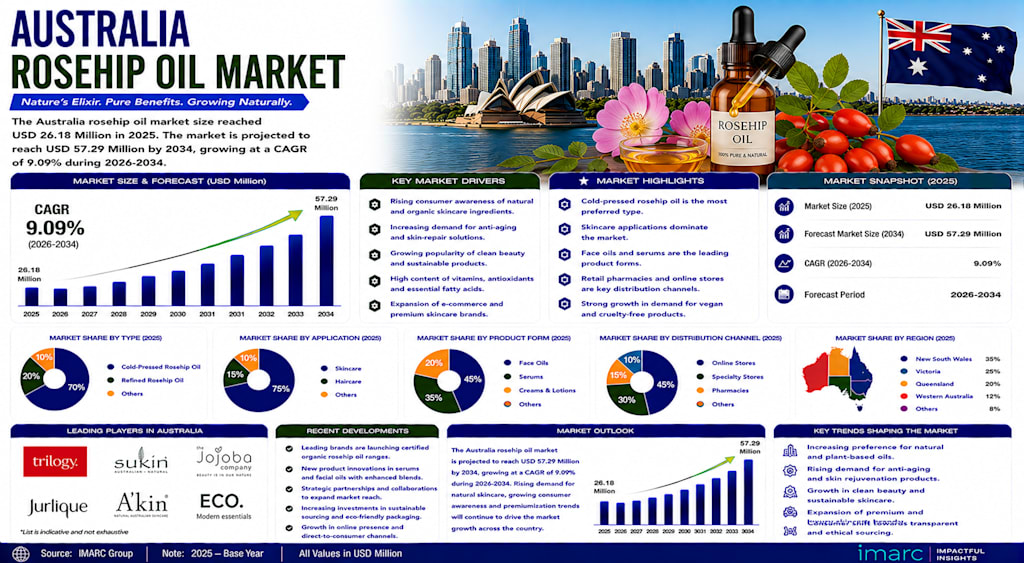
The Australian rosehip oil market is evolving from a niche homegrown success story into a globally competitive, science-backed segment of the nation's A$10+ billion beauty industry. The market is currently experiencing rapid expansion, driven by an unprecedented confluence of consumer demand for natural ingredients, the power of digital retail platforms, and a growing population seeking to combat the effects of Australia's harsh climate on their skin. According to IMARC Group, the market size reached USD 26.18 Million in 2025 and is projected to reach USD 57.29 Million by 2034, exhibiting a robust compound annual growth rate (CAGR) of 9.09% during 2026–2034.
As the clean beauty revolution matures, rosehip oil is no longer just a product; it is the cornerstone of a wellness-focused skincare ritual, prized for its rich content of essential fatty acids, vitamins A and C, and potent antioxidant properties that address concerns ranging from photoaging to acne scarring.
What's Driving Market Growth?
Surging Demand for Natural & Organic Skincare. The Australian consumer is increasingly sophisticated, scrutinising ingredient labels for synthetic chemicals and prioritising formulations that are "clean" and sustainably sourced. Millennials and Generation Z, in particular, are driving this shift, valuing transparency and ethical production. The Australian Industrial Chemicals Introduction Scheme (AICIS) maintains stringent standards for cosmetic ingredients, which provides assurance to consumers and favours natural botanical extracts, allowing rosehip oil to thrive in the marketplace. This has paved the way for certifications like Australian Certified Organic (ACO), COSMOS, and PETA Cruelty-Free, which have become a vital competitive moat for premium brands.
The Anti-Ageing Imperative & Evidence-Based Efficacy. Australia experiences one of the world's highest ultraviolet radiation levels, leading to accelerated skin ageing. According to the Australian Bureau of Statistics, individuals aged 55 and older represent a significant portion of the population, creating a consumer segment with disposable income and specific skincare requirements. Rosehip oil is positioned as an evidence-based solution for these issues. Clinical studies validate its efficacy in collagen formation, reducing the visibility of wrinkles, scars, fine lines and hyperpigmentation. Independent clinical studies have shown that rosehip oil can help improve the visible appearance of scars by 41%, stretch marks by 43%, and fine lines and wrinkles by 23%. Its rich composition of omega fatty acids supports skin barrier function and cellular regeneration, making it highly effective for addressing visible signs of aging.
E‑Commerce Dominance & Social Media Amplification. The digital transformation of the beauty sector has been a powerful catalyst. With a predicted annual growth rate of 12% between 2022 and 2027, e‑commerce is anticipated to be the beauty industry's fastest‑growing sales channel in Australia. Social media platforms, especially Instagram and TikTok, have become vital for rosehip oil brands, where skincare aficionados share reviews and transformative "before-and-after" photos that naturally create demand. Direct-to-consumer brands are leveraging digital channels to build authentic relationships with customers, offer subscription services, and provide personalized shopping experiences that traditional retailers struggle to replicate.
Market Segmentation & Key Insights
By Type, the market is segmented into Essential Oil and Compound Oil. Pure essential oils command a premium price point, while compound oils allow brands to offer targeted solutions for specific skin concerns at various price points.
By Application, the market is bifurcated into Skin Care and Hair Care. The skincare segment dominates, as rosehip oil is a key ingredient in anti-aging serums, facial oils, and moisturisers. The hair care segment is the fastest-growing, driven by demand for lightweight, plant-based scalp treatments.
By Region, the market is distributed across NSW & ACT, Victoria & Tasmania, Queensland, Northern Territory & SA, and Western Australia. The highest concentration of consumers remains in the populous eastern states, though online retail is democratising access nationwide.
Request a Sample Report with the Latest 2026 Edition
What the Opportunities Are?
Sovereign Supply & Ethical Sourcing Initiatives. Australia is reliant on imports of raw rosehip oil from Chile and Lesotho. This creates vulnerability to climate variations and global supply disruptions. There is a significant opportunity for domestic investors to establish local cultivation and cold-pressing facilities. A "grown in Australia" provenance story would command a substantial premium in both domestic and Asian export markets.
AI-Driven Personalisation & Digital Skin Analysis. The Australia personalised skincare products market is growing rapidly. Artificial intelligence is enabling individualized skincare recommendations through AI-powered skin analysis platforms, allowing customers to pinpoint specific skin issues and receive tailored product recommendations that include rosehip oil. Brands that integrate AI technology into their platforms to create custom-blended rosehip compounds will enhance customer engagement and justify premium price points.
Expansion into Asian Export Markets. Australia is viewed as a source of "clean and green" beauty products. The expanding export prospects to Asian markets, particularly China, Japan and South Korea, present a lucrative channel for premium Australian rosehip oil brands, bolstered by free trade agreements and a reputation for quality and ethical production.
Scientific & Clinical Validation for Therapeutic Skincare. Rosehip oil's anti-inflammatory and regenerative properties make it ideal for therapeutic skincare. There is growing demand for medical-grade formulations to support eczema and atopic dermatitis, which affect nearly 3 million Australians. Brands that bridge the gap between professional clinics and retail skincare, backed by clinical validation, will capture high-value market segments.
Sustainable, Zero-Waste Packaging. As part of the Australian Packaging Covenant aiming for 100% reusable, recyclable or compostable packaging by 2025, there is pressure to eliminate single-use plastics. There is significant opportunity for brands to adopt sugarcane-based tubes, glass droppers, and compostable sachets, appealing directly to the core demographic of eco-conscious skincare consumers.
Recent News and Developments in Australia Rosehip Oil Market
2025: The Australian Packaging Covenant reported reaching 86% of its goal for making packaging reusable or recyclable, but plastic recovery targets lagged, prompting calls for stricter government mandates on recycled content and stronger legislative action to reduce packaging waste.
2025: Kosmea Australia, a pioneering certified organic rosehip oil brand, continued to advocate for ethical sourcing and cold-pressed extraction methods, solidifying its position in the premium segment alongside RosehipPLUS and international conglomerates (L'Oréal, Unilever) incorporating rosehip into broader product lines.
2025: The Australian Government's National Reconstruction Fund allocated capital to bolster sovereign manufacturing capability in advanced materials and critical technologies, indirectly supporting potential future domestic rosehip oil refining facilities, emphasising value-added processing to capture downstream margins.
Why Should You Know About Australia Rosehip Oil Market?
You should know about this market because it captures how environmental consciousness, scientific validation, and digital retail intersect to create high-value growth in a mature consumer goods segment. The market is no longer a "fad" defined by a single hero product; it is a sophisticated ecosystem where brands compete on sourcing transparency, efficacy data, and environmental impact. For investors, the Australian market offers exposure to a high-growth category that benefits from global demand for clean beauty (export opportunities to Asia), the structural shift from in-store to direct-to-consumer online sales, and a regulatory environment in which natural products are favoured.
The projected CAGR of 9.09% reflects strong confidence in these adoption trends and the resilience of the natural beauty movement. The unique demographic pressures of Australia's ageing population and harsh climate create a captive audience for anti-aging solutions. As the market matures, the value is shifting from commoditised oils to branded products built on provenance, certification and AI-enabled personalisation.
For investors, brand managers and supply chain strategists, understanding the segmentation between skincare and hair care, the premiumisation of organic certifications, and the intricacies of global rosehip sourcing will be key to capturing the significant upside in one of Australia's most dynamic and internationally recognised natural beauty sectors. In essence, the Australia rosehip oil market captures how local provenance, global supply chains and scientific formulation converge, making it a compelling area for those seeking to invest in the future of sustainable, tech-enabled beauty.
About the Creator
Thomas
Market Research Analyst | Industry Trends & Forecasting | Turning market data into clear, actionable business insights across global sectors.
Enjoyed the story? Support the Creator.
Subscribe for free to receive all their stories in your feed.
Comments
There are no comments for this story
Be the first to respond and start the conversation.