
Australia Roofing Materials Market: Construction Surge, Climate Resilience & Solar‑Integrated Innovation
How NCC 2025 mandates, $15.2 billion infrastructure funding and extreme‑weather resilience are driving a $3.97 billion market by 2034

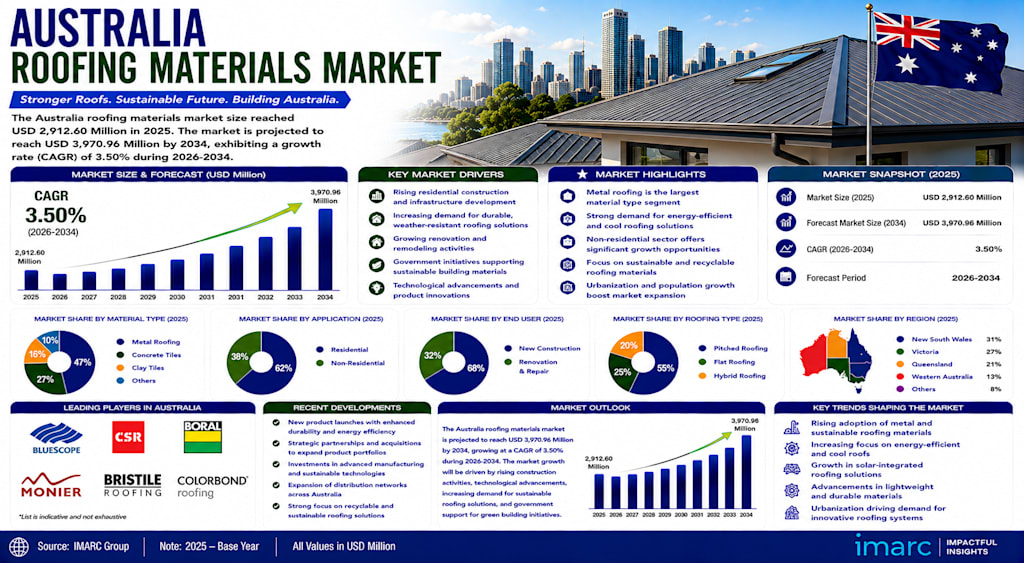
The Australia roofing materials market is expanding steadily as residential developers, commercial builders and government agencies increasingly demand high‑performance, energy‑efficient and climate‑resilient solutions. Roofing materials — including metal roofs (steel and aluminium), concrete and clay tiles, asphalt shingles, plastics and solar‑integrated systems — are deployed across new housing estates, commercial towers, industrial warehouses and public infrastructure to deliver durability, thermal performance and long‑term cost savings. According to IMARC Group, the market size reached USD 2,912.60 Million in 2025 and is projected to reach USD 3,970.96 Million by 2034, exhibiting a compound annual growth rate (CAGR) of 3.50% during 2026–2034. Accelerating infrastructure investments, surging urban development and the tightening of the National Construction Code (NCC) 2025 are driving a significant shift toward sustainable, energy‑efficient and bushfire‑resistant roofing materials across the country.
What's Driving Market Growth?
Rapid Infrastructure Development & Urban Construction. The swift urban development and continuous rise in infrastructure initiatives are key elements propelling the market. As residential, commercial and industrial construction activities expand, the need for sturdy, weatherproof roofing materials is rising. Cities such as Sydney, Melbourne and Brisbane are experiencing ongoing improvements in housing and infrastructure, driving demand for tiles, metal panels and composite roofing. State‑sponsored programs for urban housing and the refurbishment of public structures are contributing to market expansion. In the 2025–26 budget, the Australian Government is providing funding of $15.2 billion to support state infrastructure projects, covering road and rail corridors, renewable energy zones and major public works. Property Council data for December 2025 recorded 195,731 dwelling approvals over 2025, up 12.8% on the previous year, reinforcing the underlying demand for residential roofing.
NCC 2025 Energy Efficiency & Condensation Mandates. The updated NCC 2025 has emerged as a central driver for advanced roofing materials. The code introduces stricter energy performance standards for building envelopes, with specific provisions for condensation management and thermal resistance. The NCC 2025 strengthens minimum requirements for condensation management, including changes to roof ventilation to reduce moisture risk in cooler climate zones, affecting vent area calculations for steeper pitched roofs and external wall cavity designs. With adoption underway — Western Australia implemented NCC 2025 from 1 May 2026 and the code becomes mandatory for most building permits from 1 May 2027 — builders and specifiers are actively selecting roofing materials with verified U‑values, solar reflectance indices (SRI) and condensation management systems to meet the enhanced compliance pathways.
Climate Resilience & Bushfire‑Ready Materials. Australia's diverse and often extreme climatic conditions play a vital role in shaping the market. Regions facing high UV exposure, coastal humidity or heavy rainfall require durable and corrosion‑resistant roofing solutions. Frequent storms and bushfires have heightened demand for fire‑resistant and impact‑resistant materials. Metal roofs are popular for their durability, energy efficiency and weather resistance, particularly in bushfire‑prone regions. Products such as Aussie Gutter Protection's TuffMesh™ system, developed in July 2025, protect rooflines from ember attack while supporting safe rainwater collection, with material options for different Bushfire Attack Level requirements. The industry is seeing homeowners opt for non‑combustible metal roofing and ember‑proof roof vents as relatively modest‑cost upgrades in fire zones.
Sustainability, Green Star & Decarbonisation Pressure. Australia's increasing dedication to eco‑friendly construction methods is positively impacting the industry. Rising awareness about energy conservation and climate change effects is promoting the use of sustainable materials, including cool roofs, solar‑reflective coatings and recycled metal roofing. Green building certifications are encouraging the use of sustainable construction materials, increasing the demand for energy‑efficient roofing solutions. COLORBOND® steel is celebrating 60 years as Australia's most preferred roofing material, with its environmental credentials making it compatible with Green Star ratings — builders can earn points toward sustainable certification. In a breakthrough for sustainable construction, RMIT University and Bristile Roofing have developed eco‑friendly roof tiles that incorporate coal ash and recycled glass, achieving a 13 per cent reduction in CO₂ emissions compared to conventional concrete tiles.
Technological Innovation & Smart Roofing Systems. Technological innovations are impelling the Australia roofing materials market growth by introducing advanced products designed for performance, sustainability and aesthetics. CNC and robotic technologies have enhanced efficiency and design, creating new opportunities in the market. Smart roofing systems with integrated solar panels, reflective coatings and self‑cleaning surfaces are gaining popularity among environmentally conscious homeowners. Producers are developing lightweight, recyclable and solar‑compatible roofing solutions to address changing demands.
Market Segmentation & Key Insights
By Product, the market includes asphalt shingles, concrete and clay tiles, metal roofs, plastics and others. Metal roofing continues to dominate industrial and commercial sectors due to material innovation, ESG performance and seamless solar integration. The Australia metal roofing market is witnessing stable growth due to increased construction activity, especially in residential and industrial sectors. Metal roofs are popular for their durability, energy efficiency, and weather resistance, particularly in regions prone to bushfires and extreme weather. The roofing tiles segment alone reached USD 1,375.02 Million in 2025, growing at a CAGR of 3.20% to reach USD 1,884.11 Million by 2035.
By Construction Type, the market is divided into new construction and reroofing.
By Application, the market covers residential and non‑residential (commercial and industrial).
By Region, the market encompasses Australia Capital Territory & New South Wales, Victoria & Tasmania, Queensland, Northern Territory & Southern Australia, and Western Australia. NSW and Victoria currently lead demand due to high population densities and ongoing infrastructure pipelines.
What the Opportunities Are?
Solar‑Integrated & BIPV Roofing Systems. The push for net‑zero buildings creates significant opportunities for building‑integrated photovoltaics (BIPV) where solar cells are embedded directly into roofing materials rather than racked on top. COLORBOND® steel partnered with thin‑film solar technology to offer streamlined rooftop energy systems that capture the sun's energy as both electricity and heat while maintaining an aesthetically pleasing appearance. Solar tiles and green roofs help reduce carbon impact.
Cool Roof Coatings & Passive Water Harvesting. Researchers have developed nanoengineered coatings that keep roof surfaces cooler while also harvesting fresh water from the atmosphere. For building owners in heat‑stressed and water‑scarce regions, such coatings offer a dual solution that reduces cooling loads (cutting electricity bills) while generating supplementary water.
Circular Economy & Recycled‑Content Materials. The use of industrial waste in roofing materials presents growth potential in carbon‑conscious procurement. The RMIT‑Bristile Roofing tiles using coal ash and recycled glass not only cut emissions by 13% but also divert waste from landfill. As federal and state governments introduce stricter procurement guidelines for recycled content, manufacturers offering closed‑loop, low‑carbon roofing products can secure government project specifications.
Automated & Robotic Roofing Installation. CNC and robotic technologies have enhanced efficiency and design, creating new opportunities in the market. With ongoing skilled labour shortages in the construction sector, automated tile laying, robot‑assisted metal panel installation and drone‑based roof inspections can reduce labour costs while improving precision and safety.
Retrofit & Bushfire Resilience Upgrades. The extreme bushfire seasons, combined with updated BAL (Bushfire Attack Level) mapping, are driving homeowners in peri‑urban zones to upgrade legacy roofs. Non‑combustible metal roofing, ember‑proof mesh systems and fire‑rated underlayments present a significant retrofit opportunity. TuffMesh™, designed to meet AS3959 and AS1530.8.2 compliance criteria for use in Flame Zone areas, exemplifies how specialised products addressing specific climate hazards can capture replacement market share.
Recent News and Developments in Australia Roofing Materials Market
October 2025: RMIT University and Bristile Roofing developed sustainable roof tiles incorporating coal ash and recycled glass, achieving a 13 per cent reduction in CO₂ emissions compared to traditional concrete tiles. A large‑scale trial proved viability through full‑scale manufacturing at Bristile's Melbourne facility.
May 2026: Western Australia adopted NCC 2025 Volume One and Two from 1 May 2026, with the code's condensation management and energy efficiency requirements immediately affecting roofing specifications for new builds in the state.
January 2026: BlueScope — the parent company of COLORBOND® steel — continued to lead the Australian roofing market, with its products enduring coastal humidity, searing heat and bushfire conditions across the continent.
2025: SCG International made a significant move to strengthen its foothold in the Australian market, showcasing innovative concrete roofing solutions at Sydney Build Expo 2026.
2025: The broader Australia roofing market (including installation services) was valued at AUD 6.91 Billion in 2025, forecast to reach AUD 10.73 Billion by 2034 at a 4.50% CAGR, highlighting the extended value chain beyond raw materials alone.
Why Should You Know About Australia Roofing Materials Market?
You should know about this market because it captures how building code reform, climate‑driven material selection and sustainability mandates intersect to drive steady, multi‑year growth in a foundational construction sector. Roofing materials are no longer simple water‑shedding layers — they are active contributors to energy performance (reflective coatings, solar integration), regulatory compliance (NCC 2025 thermal bridging), and resilience against bushfires, coastal corrosion and cyclonic events.
For investors, the roofing materials market offers exposure to a stable‑growth construction supply category anchored in $15.2 billion annual state infrastructure funding, 12.8% growth in dwelling approvals and the building industry's transition toward NCC 2025 compliance across all states by May 2027. The projected CAGR of 3.50% reflects consistent baseline demand for new builds and reroofing alike, while higher‑growth sub‑segments — including solar‑integrated metal roofing, recycled‑content concrete tiles, cool roof coatings and automated installation robotics — offer differentiated upside potential.
For architects, building engineers, procurement specialists and construction planners, understanding roofing material segmentation, NCC 2025 compliance pathways, Green Star integration strategies and the emerging portfolio of low‑carbon, fire‑resistant and solar‑ready products helps shape intelligent specification, design and sourcing decisions that deliver measurable energy savings, regulatory compliance, asset durability and environmental outcomes.
In essence, the Australia roofing materials market captures how structural reliability, energy intelligence and climate adaptation converge — making it a compelling area for investors, developers and technology partners seeking smarter approaches to building envelopes, embodied‑carbon reduction and long‑term asset protection across one of the world's most climate‑challenged construction markets.
About the Creator
Thomas
Market Research Analyst | Industry Trends & Forecasting | Turning market data into clear, actionable business insights across global sectors.
Enjoyed the story? Support the Creator.
Subscribe for free to receive all their stories in your feed.
Comments
There are no comments for this story
Be the first to respond and start the conversation.