
Australia Refrigerant Market Expands Rapidly as Sustainable Cooling Technologies Gain Ground
Growing demand for energy-efficient cooling systems, environmental regulations, and infrastructure development are accelerating growth across Australia's refrigerant industry.

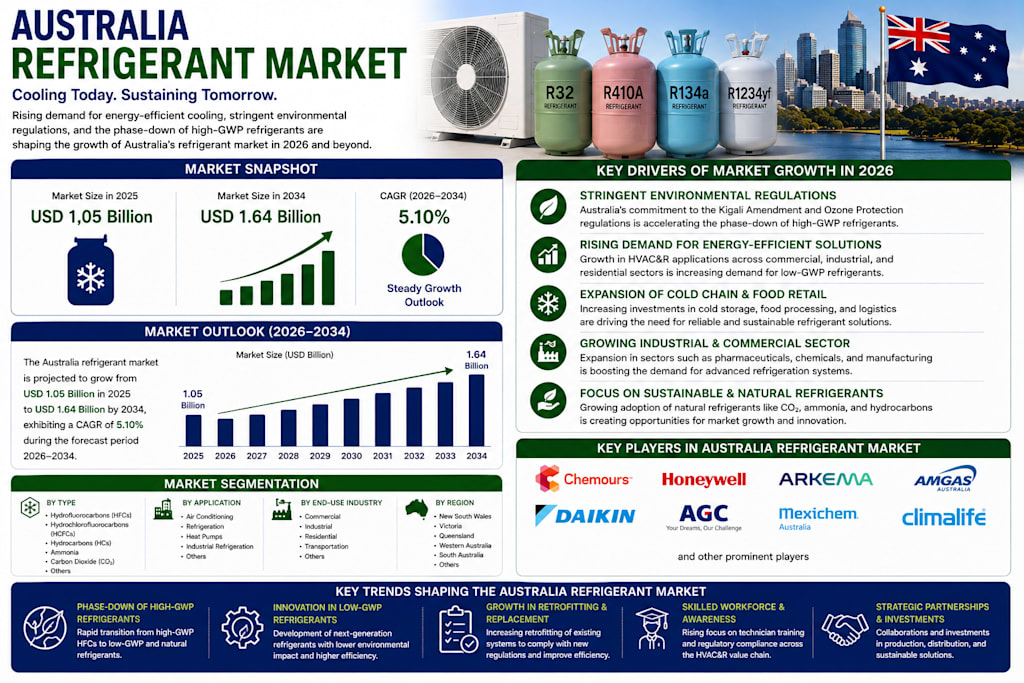
Australia's refrigerant industry is entering a period of robust growth as businesses, consumers, and policymakers prioritize energy efficiency and environmentally responsible cooling solutions. Refrigerants play a vital role in modern life, powering air conditioning systems, refrigeration equipment, cold storage facilities, heat pumps, and industrial cooling applications. As Australia's economy continues to expand and climate conditions drive demand for cooling technologies, the refrigerant market is becoming increasingly important across multiple sectors.
According to IMARC Group, the Australia refrigerant market reached USD 665.9 Million in 2025 and is expected to reach USD 1,419.3 Million by 2034, exhibiting a CAGR of 8.51% during 2026–2034. This strong growth trajectory reflects rising demand for cooling infrastructure, increasing adoption of energy-efficient technologies, and the transition toward low-global-warming-potential (GWP) refrigerants.
The market encompasses a wide range of refrigerant products used in residential, commercial, industrial, and transportation applications. As environmental concerns continue to shape industry standards, companies are investing heavily in next-generation refrigerants that deliver high performance while reducing environmental impact. This shift is creating new opportunities throughout the value chain, from manufacturers and distributors to service providers and equipment suppliers.
Australia's warm climate, urban development projects, and growing commercial infrastructure further support long-term demand for refrigeration and air conditioning systems. Shopping centers, hospitals, data centers, food processing facilities, and logistics hubs all rely on advanced cooling technologies, increasing the importance of refrigerants within the broader economy.
As sustainability becomes a central business priority, the refrigerant industry is expected to play a critical role in helping organizations achieve energy efficiency and emissions reduction goals while maintaining reliable cooling performance.
Evaluate Market Opportunity with the Business Sample Report:
Why the Market Is Growing So Rapidly
One of the strongest growth drivers is rising demand for air conditioning and refrigeration systems. Population growth, urbanization, and increasing temperatures are contributing to greater installation of cooling equipment across residential and commercial sectors. This trend directly supports refrigerant consumption.
Environmental regulations are also reshaping the industry. Governments and regulatory agencies are encouraging the transition from high-GWP refrigerants to environmentally friendly alternatives. As businesses replace older systems and adopt compliant technologies, demand for next-generation refrigerants continues to rise.
The expansion of cold chain infrastructure is another significant contributor to market growth. Food distribution networks, pharmaceutical logistics, and temperature-sensitive supply chains require advanced refrigeration systems to maintain product quality and safety. This creates sustained demand for refrigerants across transportation and storage applications.
Commercial construction activity is further driving market expansion. New office buildings, retail complexes, healthcare facilities, and industrial developments require sophisticated climate control systems. These projects generate ongoing demand for refrigerants and related cooling technologies.
The growing focus on energy efficiency is encouraging businesses and consumers to upgrade aging equipment. Modern refrigeration and air conditioning systems often utilize advanced refrigerants that improve performance while reducing energy consumption. These upgrades support both operational savings and environmental objectives.
Market Segmentation
The Australia refrigerant market can be segmented by:
• Hydrofluorocarbons (HFCs)
• Hydrochlorofluorocarbons (HCFCs)
• Hydrofluoroolefins (HFOs)
• Natural Refrigerants
• Residential Air Conditioning
• Commercial Refrigeration
• Industrial Refrigeration
• Transportation Refrigeration
• Heat Pumps
• Food and Beverage Industry
• Pharmaceutical Industry
• Cold Storage Applications
• Regional Markets
What the Opportunities Are
1. Low-GWP Refrigerant Adoption
The shift toward environmentally friendly refrigerants presents one of the largest opportunities in the market. Companies offering sustainable alternatives can benefit from increasing regulatory compliance requirements and customer demand.
2. Cold Chain Infrastructure Expansion
Growing demand for food preservation and pharmaceutical logistics is driving investments in refrigerated transportation and storage facilities. Businesses serving this sector can capitalize on long-term growth opportunities.
3. Energy-Efficient HVAC Systems
Consumers and businesses are increasingly investing in high-efficiency cooling systems. Manufacturers and service providers focused on energy-saving technologies are well positioned to benefit from this trend.
4. Commercial Building Modernization
Building owners are upgrading HVAC and refrigeration systems to improve sustainability and reduce operating costs. This creates opportunities for refrigerant suppliers, equipment manufacturers, and maintenance providers.
5. Heat Pump Market Growth
Heat pumps are gaining popularity as efficient heating and cooling solutions. Refrigerant producers can benefit from rising adoption across residential, commercial, and industrial applications.
6. Data Center Cooling Solutions
Australia's growing digital economy is increasing demand for data centers, which require advanced cooling systems to maintain operational reliability. Specialized refrigerant applications can support this rapidly expanding segment.
7. Refrigerant Recovery and Recycling Services
As environmental regulations become stricter, demand for refrigerant recovery, reclamation, and recycling services is expected to grow. Businesses offering circular economy solutions can gain a competitive advantage.
Recent News & Developments in Australia Refrigerant Market
• February 2025: Australian environmental authorities introduced initiatives aimed at accelerating the adoption of low-global-warming-potential refrigerants across commercial and industrial sectors. The measures included updated compliance guidelines and support programs designed to encourage environmentally responsible cooling technologies. Industry stakeholders viewed the initiative as a positive step toward reducing emissions while maintaining system performance. The policy is expected to drive investment in next-generation refrigerant solutions.
• June 2025: Several HVAC and refrigeration companies announced investments in advanced cooling technologies and expanded service capabilities throughout Australia. The projects included the deployment of energy-efficient systems utilizing modern refrigerants with improved environmental profiles. Industry experts noted that growing customer demand for sustainable cooling solutions continues to attract significant capital into the sector. These developments are expected to strengthen market competitiveness and innovation.
• September 2025: Australia's refrigeration and air conditioning industry reported increased adoption of high-efficiency cooling systems across commercial buildings, logistics facilities, and food storage operations. Market participants highlighted rising demand for environmentally compliant refrigerants and upgraded infrastructure. Industry data also indicated strong momentum in cold chain expansion projects supporting food and pharmaceutical supply networks. These trends reinforced confidence in the sector's long-term growth outlook.
Why Should You Know About Australia Refrigerant Market?
The Australia refrigerant market sits at the intersection of sustainability, infrastructure development, and technological innovation. As cooling systems become increasingly essential across residential, commercial, industrial, and logistics applications, refrigerants will remain a critical component of modern economic activity. The industry's transition toward environmentally responsible solutions further enhances its strategic importance.
For investors, the market offers exposure to sustainability-driven growth and infrastructure modernization trends. For businesses, it creates opportunities in manufacturing, distribution, servicing, recycling, and technology development. For policymakers, refrigerants play a key role in achieving environmental objectives while supporting economic growth and energy efficiency.
With the market expected to grow from USD 665.9 Million in 2025 to USD 1,419.3 Million by 2034 at a CAGR of 8.51%, Australia's refrigerant industry is positioned for significant expansion. As demand for advanced cooling technologies continues to rise, the sector is set to become an increasingly important contributor to the country's sustainable development and industrial future.
About the Creator
Rashi Sharma
I am a market researcher.
Enjoyed the story? Support the Creator.
Subscribe for free to receive all their stories in your feed.
Comments
There are no comments for this story
Be the first to respond and start the conversation.