
Australia Rainwater Harvesting Market 2026: Water Conservation Initiatives, Sustainable Construction & Climate Resilience Driving Growth
How increasing water scarcity concerns, green building adoption, and government sustainability programs are transforming the Australia rainwater harvesting industry

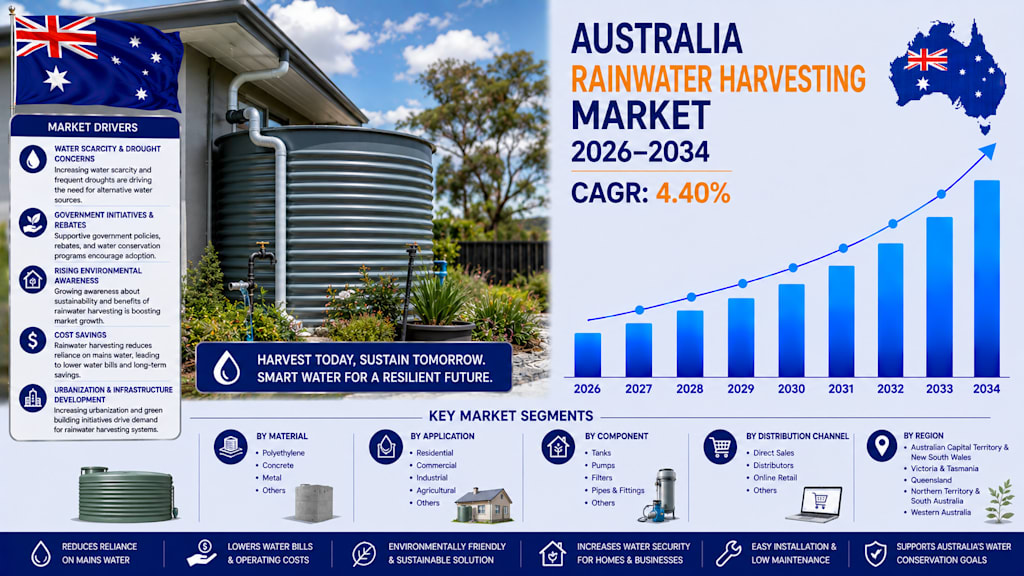
Australia Rainwater Harvesting Market Overview
The Australia rainwater harvesting market is a vital component of the country's water management and sustainability ecosystem, encompassing rainwater collection systems, storage tanks, filtration technologies, conveyance infrastructure, and water reuse solutions deployed across residential, commercial, industrial, and agricultural applications.
According to IMARC Group, the Australia rainwater harvesting market size reached USD 47.1 Million in 2025 and is projected to reach USD 70.9 Million by 2034, exhibiting a compound annual growth rate (CAGR) of 4.40% during 2026–2034.
The market is experiencing steady growth driven by increasing water scarcity concerns, climate variability, expanding sustainable construction activities, growing environmental awareness, and rising demand for alternative water sources. The adoption of rainwater harvesting systems is gaining momentum as households, businesses, and agricultural operators seek cost-effective and sustainable water management solutions.
Key Market Drivers
Rising Water Scarcity and Drought Concerns
Australia continues to experience periodic droughts and water supply challenges across several regions. These conditions are encouraging households, businesses, and public institutions to adopt rainwater harvesting systems to reduce dependence on municipal water supplies and improve water security.
Growing Adoption of Sustainable Building Practices
The increasing popularity of green building certifications and sustainable construction practices is supporting demand for integrated rainwater harvesting systems. Developers are increasingly incorporating water conservation technologies into residential, commercial, and institutional projects.
Government Support for Water Conservation
Government initiatives promoting efficient water usage, environmental sustainability, and resource conservation are encouraging wider adoption of rainwater harvesting solutions across multiple sectors.
Expansion of Agricultural Applications
The agricultural sector is increasingly utilizing rainwater harvesting systems to support irrigation activities, livestock operations, and farm water management. These systems help reduce operational costs while improving resilience against water shortages.
Increasing Environmental Awareness
Consumers and businesses are becoming more conscious of environmental sustainability and responsible resource management. This shift is driving investments in water-saving technologies, including rainwater collection and reuse systems.
Request a Sample Report with the Latest 2026 Data & Forecasts
What the Opportunities Are
Integration with Smart Water Management Systems
The adoption of smart sensors, automated monitoring technologies, and digital water management platforms is creating opportunities for advanced rainwater harvesting solutions that improve operational efficiency and resource optimization.
Growth of Commercial and Industrial Installations
Commercial buildings, manufacturing facilities, educational institutions, and healthcare facilities are increasingly implementing rainwater harvesting systems to reduce water consumption costs and enhance sustainability performance.
Expansion of Urban Water Sustainability Programs
Municipal governments and urban planners are investing in sustainable water infrastructure projects, creating new opportunities for large-scale rainwater harvesting installations.
Rising Demand for Modular Storage Solutions
The growing popularity of compact and modular rainwater storage systems is enabling wider adoption in urban environments where space constraints may limit traditional installations.
Increasing Focus on Climate Resilience
As climate change impacts become more pronounced, organizations and households are investing in resilient water infrastructure solutions that can help mitigate risks associated with changing rainfall patterns and water shortages.
Recent News and Developments
May 2026 : Demand for rainwater harvesting systems continued increasing as households and businesses sought practical solutions to reduce water consumption costs and improve long-term water security.
April 2026 : Developers increasingly incorporated water conservation technologies into residential and commercial construction projects to meet sustainability targets and environmental performance standards.
March 2026 : Agricultural operators expanded investments in rainwater collection infrastructure to support irrigation efficiency and strengthen resilience against drought conditions.
February 2026 : Manufacturers focused on improving storage tank durability, filtration technologies, and system integration capabilities to enhance overall performance and user convenience.
January 2026 : Government agencies continued promoting water conservation initiatives aimed at encouraging adoption of alternative water management solutions across communities and industries.
December 2025 : Growing public awareness regarding environmental sustainability and resource conservation contributed to increased interest in residential rainwater harvesting systems nationwide.
November 2025 : Commercial property owners expanded investments in sustainable infrastructure projects designed to reduce operating costs and improve environmental performance.
2025–2026 (Market Trend) : The Australia rainwater harvesting market is being shaped by increasing concerns regarding water scarcity, expanding sustainable construction activities, growing climate resilience initiatives, and rising environmental awareness. Industry participants are focusing on smart water management technologies, advanced filtration systems, modular storage solutions, and integrated sustainability offerings to strengthen market competitiveness. At the same time, regulatory developments, installation costs, and changing climate conditions continue influencing market dynamics.
Why You Should Know About the Australia Rainwater Harvesting Market?
The Australia rainwater harvesting market is becoming an increasingly important pillar of the country's water conservation, environmental sustainability, and climate adaptation strategy.
With projected growth from USD 47.1 Million in 2025 to USD 70.9 Million by 2034, the market demonstrates solid long-term potential supported by increasing water scarcity concerns, sustainable construction trends, agricultural demand, and growing investments in resilient water infrastructure.
As governments, businesses, and households continue prioritizing water security and environmental sustainability, the rainwater harvesting sector is expected to play a crucial role in supporting Australia's long-term resource management and climate resilience objectives.
About the Creator
Amyra Singh
Market research analyst who loves spotting patterns, digging into data, and turning insights into strategies that help brands grow and stay ahead of the curve.
Enjoyed the story? Support the Creator.
Subscribe for free to receive all their stories in your feed.
Comments
There are no comments for this story
Be the first to respond and start the conversation.