
Australia Rail Transportation Market 2026: Infrastructure Investments, Urban Mobility Expansion & Freight Demand Driving Growth
How railway modernization projects, increasing passenger transportation needs, and expanding freight networks are transforming the Australia rail transportation industry

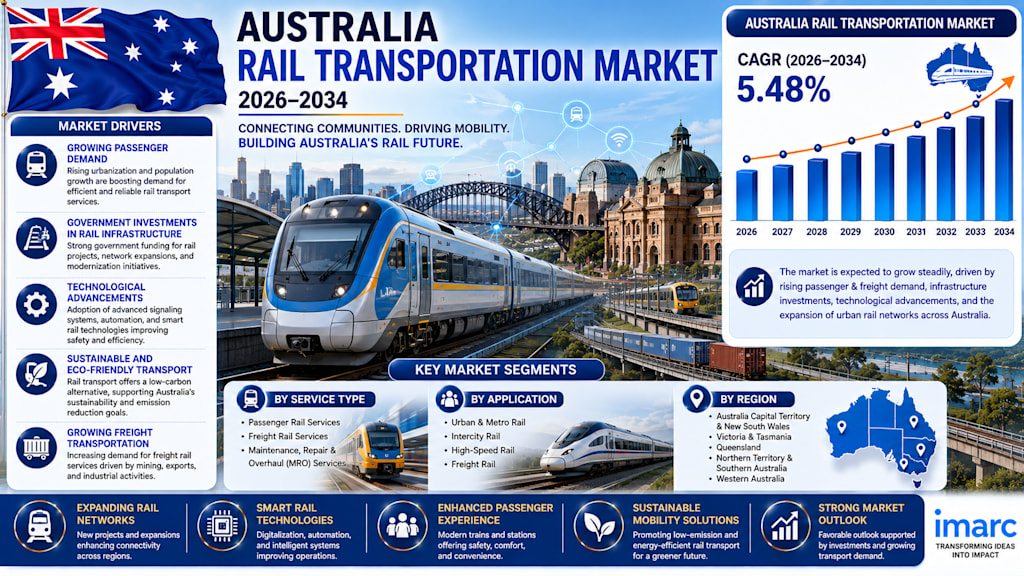
Australia Rail Transportation Market Overview
The Australia rail transportation market is a vital component of the country's transportation infrastructure sector, encompassing passenger rail services, freight rail transportation, metro systems, light rail networks, intercity rail services, and supporting railway infrastructure.
According to IMARC Group, the Australia rail transportation market size reached USD 9.1 Billion in 2025. Looking forward, IMARC Group expects the market to reach USD 15.0 Billion by 2034, exhibiting a growth rate (CAGR) of 5.48% during 2026–2034.
The market is witnessing significant growth driven by increasing investments in railway infrastructure, growing urbanization, rising demand for sustainable transportation solutions, expanding freight transportation requirements, and government initiatives focused on improving public transport networks.
Key Market Drivers
Increasing Railway Infrastructure Investments
Government and private sector investments in railway modernization, network expansion, and new rail projects are supporting long-term market growth.
Growing Urbanization and Population Growth
Expanding urban populations are increasing demand for efficient public transportation systems, including metro rail, commuter rail, and light rail services.
Rising Demand for Sustainable Transportation
Rail transportation is gaining importance as a low-emission and energy-efficient alternative to road and air transport, supporting environmental sustainability goals.
Expansion of Freight Transportation Networks
Growing industrial activity, mining operations, agriculture exports, and intermodal logistics requirements are driving freight rail demand across Australia.
Government Support for Public Transport Development
Public infrastructure programs and transport policies aimed at reducing congestion and improving mobility are strengthening investment in rail transportation systems.
Request a Sample Report with the Latest 2026 Data & Forecasts
What the Opportunities Are
Development of High-Capacity Urban Rail Systems
Major cities are investing in metro and commuter rail projects to address population growth and urban mobility challenges.
Expansion of Freight Rail Infrastructure
Increasing freight volumes are creating opportunities for network upgrades, capacity expansion, and advanced logistics integration.
Adoption of Smart Rail Technologies
Digital signaling systems, predictive maintenance solutions, automation technologies, and real-time monitoring platforms are improving operational efficiency.
Electrification of Rail Networks
Growing emphasis on sustainability is encouraging investments in rail electrification and low-carbon transportation infrastructure.
Integration of Multimodal Transportation Solutions
Rail operators are increasingly integrating services with bus, airport, and logistics networks to enhance transportation efficiency and customer convenience.
Recent News and Developments
June 2026: The New South Wales Government announced a record AUD 2.1 billion rail investment in the 2026–27 budget. The funding includes more than AUD 1 billion for signal and overhead-wire upgrades, expanded train services, and network resilience improvements across Sydney's 14-line, 288-station rail network, which serves more than 1 million passengers daily.
May 2026: The Australian Federal Budget allocated significant funding to major rail projects, including an additional AUD 3.8 billion for the Suburban Rail Loop East project, bringing total federal investment to AUD 6 billion. The budget also included AUD 1.75 billion for national rail freight network upgrades and AUD 659.6 million for high-speed rail development between Sydney and Newcastle.
May 2026: Rail industry organizations welcomed strong government investment in rail infrastructure, including AUD 76.4 million for the Melton Line electrification project in Victoria and AUD 50 million for Sydney–Canberra rail corridor upgrades, aimed at improving passenger connectivity and freight efficiency.
April 2026: Australia's rail infrastructure sector remained in a major expansion phase, with numerous passenger and freight rail projects under construction nationwide to improve connectivity, capacity, and network efficiency.
February 2026: A consortium led by Acciona, CPB Contractors, UGL, SMEC, and WSP secured a AUD 5.75 billion (USD 4 billion) rail construction contract in Queensland. The project will improve rail connectivity between Logan and the Gold Coast and support transportation demand ahead of the 2032 Brisbane Olympic Games.
January 2026: The Australian rail freight transport market reached approximately USD 13.59 billion in 2026. Non-containerized bulk freight accounted for 63.2% of rail freight revenue, while interstate corridors represented 81.5% of market value, highlighting rail's critical role in national supply chains.
January 2026: The Australian Government continued advancing the Inland Rail project, with major construction activities underway and the Beveridge-to-Parkes section remaining on track for completion by late 2027. The government also redirected AUD 1.75 billion toward broader national rail infrastructure upgrades to strengthen freight transportation networks.
January 2026: Infrastructure Australia identified rail modernization, freight rail development, interoperability improvements, and regional rail connectivity as national infrastructure priorities for 2026, supporting long-term growth in passenger and freight rail transportation.
Why You Should Know About the Australia Rail Transportation Market?
The Australia rail transportation market is becoming an increasingly important pillar of the country's transportation, logistics, and infrastructure development sectors.
With projected growth from USD 9.1 Billion in 2025 to USD 15.0 Billion by 2034, at a CAGR of 5.48%, the market demonstrates strong long-term potential supported by infrastructure investments, urbanization, freight transportation growth, and sustainability initiatives.
As governments, rail operators, and infrastructure developers continue investing in network modernization, smart rail technologies, electrification projects, and capacity expansion, the sector is expected to play a critical role in shaping the future of mobility and transportation across Australia.
About the Creator
Amyra Singh
Market research analyst who loves spotting patterns, digging into data, and turning insights into strategies that help brands grow and stay ahead of the curve.
Enjoyed the story? Support the Creator.
Subscribe for free to receive all their stories in your feed.
Comments
There are no comments for this story
Be the first to respond and start the conversation.