
Australia Radiofrequency Ablation Device Market to Reach US$176.63 Million by 2033 as Minimally Invasive Treatments Gain Momentum
Rising prevalence of chronic diseases, increasing demand for minimally invasive procedures, advances in radiofrequency ablation technologies, and supportive healthcare infrastructure are driving strong growth in Australia's radiofrequency ablation device market.

Radiofrequency Ablation Is Transforming Modern Medical Treatment in Australia
Healthcare in Australia continues to evolve through technologies that improve patient outcomes while reducing recovery time and hospital stays. Among the most significant advances is radiofrequency ablation (RFA), a minimally invasive treatment that uses controlled heat energy to destroy abnormal tissue without the need for extensive surgery.
Radiofrequency ablation has become an important treatment option across cardiology, oncology, pain management, gynecology, and cosmetic medicine. As hospitals increasingly prioritize minimally invasive procedures and patients seek faster recovery with fewer complications, demand for advanced RFA devices continues to grow throughout Australia.
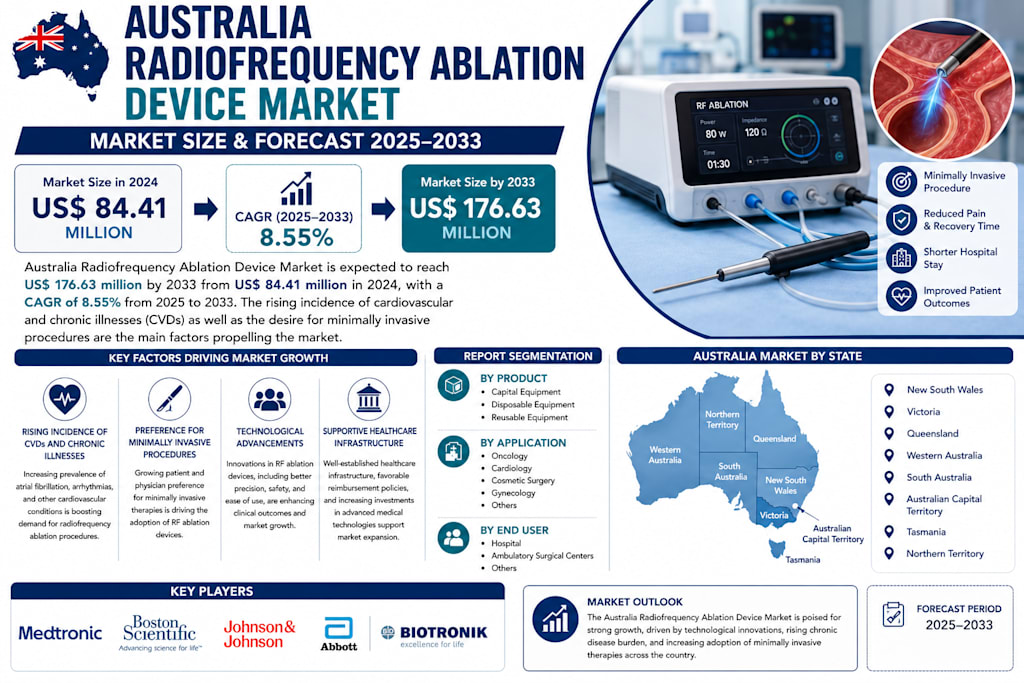
According to the latest market outlook, the Australia Radiofrequency Ablation Device Market is expected to grow from US$84.41 million in 2024 to US$176.63 million by 2033, registering a compound annual growth rate (CAGR) of 8.55% during 2025–2033. Rising chronic disease prevalence, healthcare modernization, and continuous technological innovation continue supporting long-term market expansion.
Understanding Radiofrequency Ablation Devices
Radiofrequency ablation is a minimally invasive medical procedure that uses high-frequency electrical energy to generate heat and precisely destroy abnormal or diseased tissue.
The procedure is commonly performed using specialized catheters, electrodes, or probes that deliver controlled thermal energy while preserving surrounding healthy tissue.
Radiofrequency ablation is widely used to treat cardiac arrhythmias, chronic pain conditions, liver tumors, kidney tumors, lung cancer, thyroid nodules, gynecological disorders, and selected cosmetic conditions.
Compared with conventional surgery, RFA generally results in smaller incisions, reduced blood loss, shorter hospital stays, faster recovery, and lower complication rates.
Rising Chronic Diseases Continue Driving Market Growth
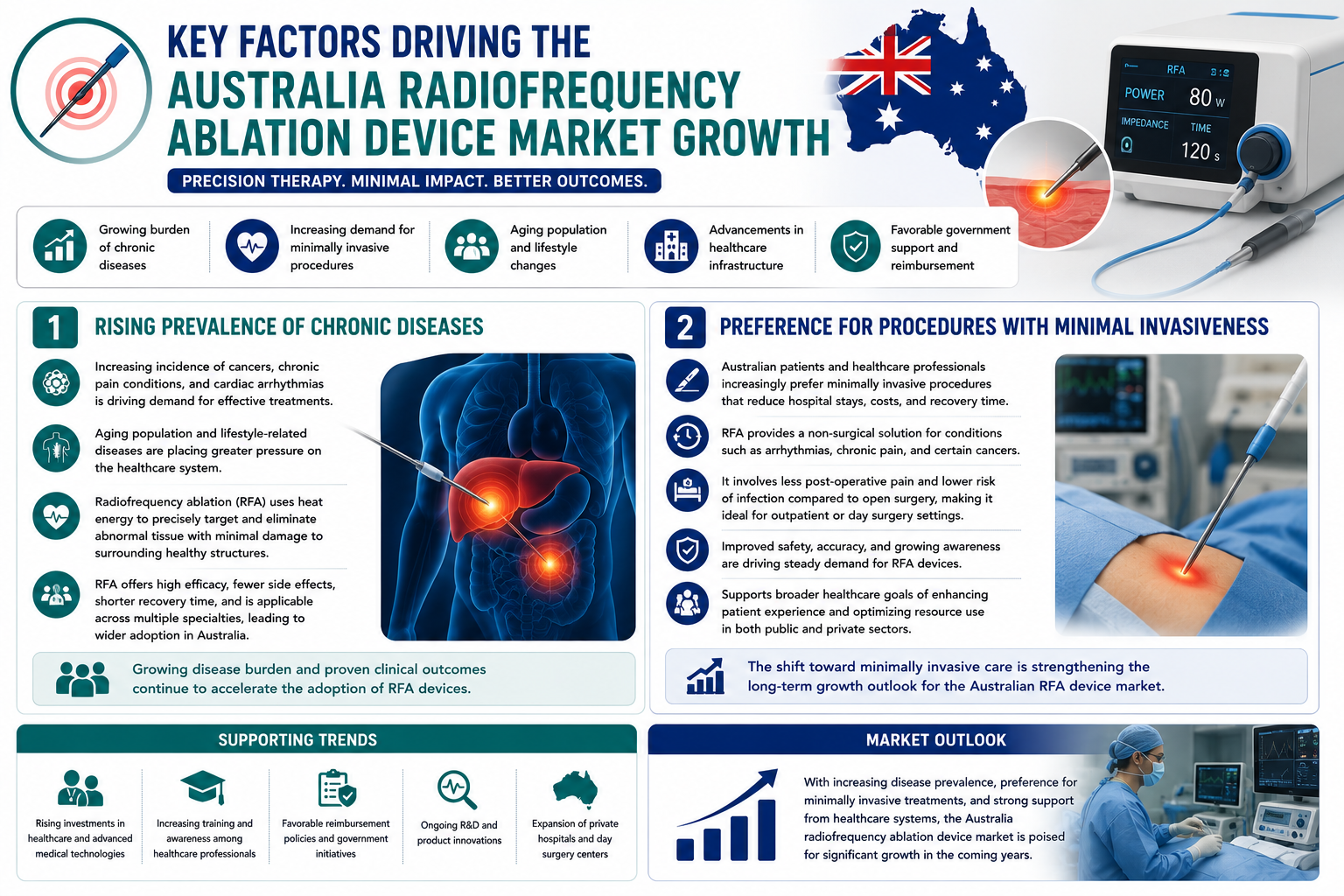
One of the strongest factors supporting market expansion is the increasing prevalence of chronic diseases throughout Australia.
Cardiovascular disease, chronic pain disorders, cancer, and age-related medical conditions continue placing significant pressure on healthcare services.
Many of these conditions can now be effectively treated using radiofrequency ablation, providing patients with safer and less invasive alternatives to conventional surgery.
Australia's aging population further contributes to rising demand, as older adults are more likely to experience chronic diseases requiring advanced therapeutic interventions.
Growing disease prevalence is expected to sustain demand for RFA technologies throughout the forecast period.
Preference for Minimally Invasive Procedures Accelerates Adoption
Patients and healthcare providers increasingly favor minimally invasive procedures that reduce physical trauma and accelerate recovery.
Radiofrequency ablation aligns closely with these objectives by offering effective treatment while minimizing postoperative pain, infection risk, and hospitalization.
Many RFA procedures can be performed on an outpatient basis, allowing patients to return to normal activities much sooner than after traditional surgery.
This growing preference for minimally invasive healthcare continues encouraging hospitals and specialty clinics across Australia to expand investment in radiofrequency ablation technologies.
Advanced Healthcare Infrastructure Supports Market Expansion
Australia's well-developed healthcare system provides an excellent foundation for adopting advanced medical technologies.
Public hospitals, private healthcare providers, ambulatory surgical centers, and specialty clinics increasingly invest in sophisticated radiofrequency ablation equipment to improve patient care.
Government healthcare funding, favorable reimbursement policies, and continued investment in modern medical infrastructure further encourage technology adoption.
Collaboration between hospitals, research institutions, and international medical device manufacturers also accelerates the introduction of innovative treatment solutions throughout the country.
Technological Innovation Improves Clinical Outcomes
Rapid advances in medical technology continue enhancing the capabilities of modern radiofrequency ablation systems.
Manufacturers are introducing highly flexible catheters, AI-assisted navigation platforms, robotic guidance systems, improved imaging technologies, and real-time temperature monitoring.
These innovations improve procedural accuracy while reducing complications and increasing treatment success.
Artificial intelligence also assists physicians by optimizing treatment planning and supporting more precise tissue targeting during complex procedures.
Continuous innovation remains one of the industry's most important growth drivers.
Cardiology Remains a Major Application Area
Cardiology represents one of the largest application segments for radiofrequency ablation devices.
RFA is widely used to treat atrial fibrillation, supraventricular tachycardia, atrial flutter, and other cardiac rhythm disorders by eliminating abnormal electrical pathways within the heart.
As cardiovascular disease remains one of Australia's leading health challenges, demand for catheter-based ablation procedures continues increasing.
Improved success rates and reduced recovery times have established RFA as a preferred treatment option for many cardiac arrhythmias.
Oncology Applications Continue Expanding
Cancer treatment represents another rapidly growing application for radiofrequency ablation.
RFA enables physicians to destroy localized tumors in organs including the liver, kidneys, lungs, and bones without requiring extensive surgical procedures.
The technique is particularly valuable for patients who are not suitable candidates for conventional surgery because of age or underlying medical conditions.
Growing cancer incidence and increasing preference for minimally invasive oncology treatments continue supporting this important market segment.
Hospitals Dominate the End-User Segment
Hospitals remain the largest end users of radiofrequency ablation devices in Australia.
Large healthcare institutions possess advanced imaging systems, specialized operating facilities, and multidisciplinary medical teams capable of performing complex ablation procedures safely.
Hospitals also serve as important centers for physician training, clinical research, and adoption of emerging technologies.
Growing investment in tertiary care facilities continues strengthening hospital demand for advanced RFA systems.
Ambulatory Surgical Centers Continue Growing
Ambulatory surgical centers are becoming increasingly important within the Australian RFA market.
Many minimally invasive ablation procedures can now be completed safely without overnight hospitalization.
Outpatient treatment offers lower healthcare costs, improved patient convenience, and more efficient use of hospital resources.
As procedural technology continues improving, ambulatory surgical centers are expected to perform an increasing proportion of radiofrequency ablation procedures.
High Equipment Costs Remain a Challenge
Despite its clinical advantages, radiofrequency ablation technology requires significant financial investment.
Capital equipment, disposable catheters, maintenance, software upgrades, and specialized operating facilities contribute to relatively high treatment costs.
Smaller hospitals, particularly in regional and rural Australia, may face financial constraints that delay equipment purchases.
Although reimbursement policies continue improving, affordability remains an important consideration for healthcare providers.
Specialized Training Limits Wider Adoption
Successful radiofrequency ablation procedures require extensive physician expertise and specialized clinical training.
Cardiologists, pain specialists, oncologists, and interventional radiologists must receive comprehensive education before independently performing complex ablation procedures.
Access to advanced training opportunities remains more limited outside Australia's major metropolitan healthcare centers.
Expanding education programs and standardized certification pathways will remain essential for supporting broader nationwide adoption.
Regional Markets Continue Supporting Growth
New South Wales remains Australia's largest market for radiofrequency ablation devices due to its advanced hospitals, leading medical research institutions, and strong adoption of minimally invasive procedures.
Victoria continues experiencing robust market growth through its extensive healthcare infrastructure, specialized outpatient centers, and active participation in clinical research and physician education.
Queensland is steadily expanding its market as healthcare investment, chronic disease prevalence, and demand for minimally invasive procedures continue increasing across both metropolitan and regional healthcare facilities.
Together, these states continue leading innovation and adoption of radiofrequency ablation technologies throughout Australia.
Innovation Will Shape the Future of Radiofrequency Ablation
The future of Australia's radiofrequency ablation market will be driven by artificial intelligence, robotic-assisted interventions, advanced imaging technologies, and precision medicine.
Manufacturers continue developing smarter catheter systems, AI-assisted navigation platforms, real-time treatment monitoring, and integrated digital healthcare solutions that improve procedural safety and clinical outcomes.
Future innovations are expected to expand RFA applications across additional medical specialties while improving accessibility and treatment efficiency.
As minimally invasive medicine continues advancing, radiofrequency ablation will become an increasingly important component of Australia's modern healthcare system.
Final Thoughts
Australia's radiofrequency ablation device market is entering a period of sustained expansion as healthcare providers increasingly adopt minimally invasive technologies capable of improving patient outcomes while reducing recovery times.
The projected growth from US$84.41 million in 2024 to US$176.63 million by 2033, supported by an 8.55% CAGR, reflects rising chronic disease prevalence, technological innovation, expanding healthcare infrastructure, and increasing demand for precision medical treatments.
Although equipment costs and specialist training remain important challenges, continued advances in AI-assisted navigation, robotic intervention, catheter technology, and healthcare investment position Australia's radiofrequency ablation device industry for strong long-term growth. As minimally invasive procedures continue becoming the preferred standard of care, radiofrequency ablation technologies are expected to play an increasingly important role across the country's healthcare system.
About the Creator
Enjoyed the story? Support the Creator.
Subscribe for free to receive all their stories in your feed.
Comments
There are no comments for this story
Be the first to respond and start the conversation.