
Australia Printer Market Set for Strong Growth as Smart Printing and Digital Transformation Reshape Business Operations
From multifunction devices and cloud-connected printers to sustainable printing solutions, Australia's printer industry is evolving to meet the needs of modern businesses and consumers.

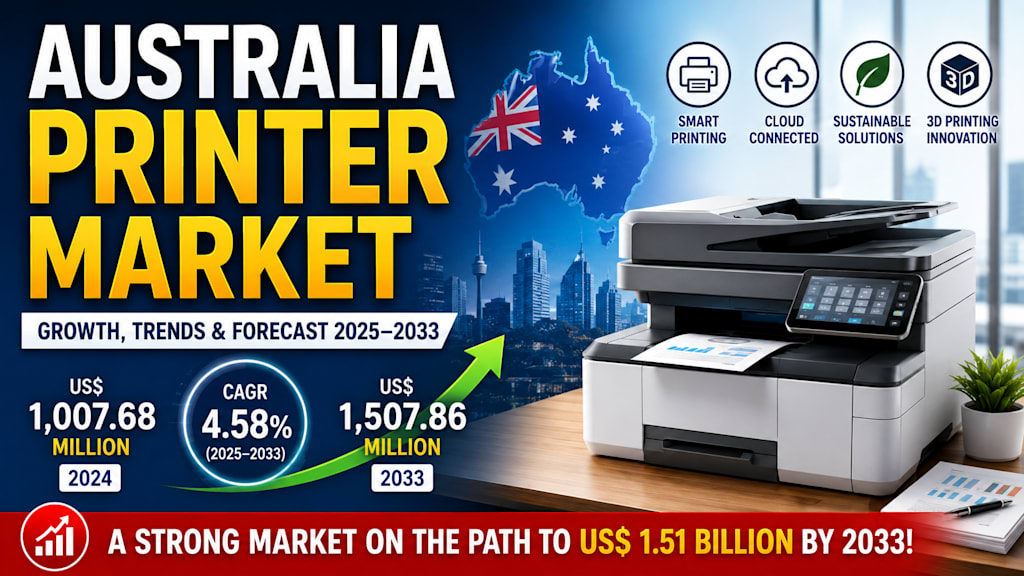
Australia Printer Market Poised for Expansion Through 2033
Australia's printer industry is entering a new phase of growth driven by digital transformation, workplace modernization, and increasing demand for flexible printing solutions. While many predicted that digitalization would completely eliminate the need for printers, the reality has been quite different. Businesses, educational institutions, healthcare facilities, government organizations, and households continue to rely on printing technologies for various operational requirements.
According to Renub Research, the Australia Printer Market is projected to grow from US$ 1,007.68 million in 2024 to US$ 1,507.86 million by 2033, expanding at a CAGR of 4.58% during 2025–2033.
The market's expansion reflects changing workplace dynamics, increasing demand for multifunction devices, technological advancements, and a growing emphasis on productivity and sustainability.
As organizations continue investing in digital infrastructure and smart office ecosystems, printers are evolving from simple output devices into integrated productivity tools capable of supporting modern business operations.
The Evolution of Printing in Australia
The Australian printing landscape has changed significantly over the past decade. Traditional standalone printers are gradually being replaced by intelligent multifunction devices that combine printing, scanning, copying, cloud connectivity, and document management capabilities.
The rise of remote and hybrid work models has accelerated demand for compact and efficient printing solutions suitable for both commercial and residential environments. Businesses now require devices capable of supporting decentralized workforces while maintaining operational efficiency.
Modern printers offer features such as:
Wireless printing
Cloud integration
Mobile device compatibility
Remote management
Enhanced cybersecurity
Automated workflows
These capabilities have transformed printers into critical components of workplace productivity systems.
Government Support Accelerating Market Growth
Australia's commitment to digital transformation is creating favorable conditions for the printer industry.
Government initiatives encouraging technology adoption, innovation, and modernization are helping businesses invest in advanced office infrastructure. Various programs aimed at improving digital capabilities across industries are indirectly supporting the adoption of next-generation printing technologies.
Organizations are increasingly replacing outdated printing equipment with modern devices that improve workflow efficiency and reduce operational costs.
The government's broader digital economy strategy has also encouraged businesses to invest in smart technologies, including cloud-enabled printing systems and automated document management solutions.
As a result, printer manufacturers are introducing innovative products designed specifically to meet the evolving needs of Australian businesses.
Personalized and On-Demand Printing Driving New Opportunities
Consumer expectations are changing rapidly across industries. Personalization has become a major trend, influencing everything from packaging and marketing materials to promotional products and event merchandise.
Digital printing technologies have made customized printing more accessible and cost-effective than ever before.
Businesses can now produce:
Personalized marketing materials
Customized packaging
Limited-edition products
Event-specific promotional items
Targeted advertising collateral
Unlike traditional printing methods that required large production runs, modern digital printers enable short-run production while maintaining exceptional quality.
This flexibility is creating substantial opportunities for commercial printers and businesses looking to offer highly customized products and services.
As personalization continues gaining importance across retail, advertising, and manufacturing sectors, demand for advanced printing solutions is expected to increase significantly.
Businesses Investing in Multifunction Printing Solutions
Australian organizations are increasingly investing in multifunction printers (MFPs) that streamline office operations and reduce costs.
These devices provide multiple functions within a single system, including:
Printing
Scanning
Copying
Faxing
Cloud storage integration
The ability to perform several tasks from one machine helps organizations improve productivity while reducing equipment and maintenance expenses.
Many businesses are also implementing managed print services (MPS), allowing them to optimize printing infrastructure and monitor usage more effectively.
Modern multifunction printers provide detailed analytics, enabling organizations to identify inefficiencies and reduce waste.
The growing popularity of these devices is becoming one of the most important drivers of market expansion throughout Australia.
Rise of Smart Printing Technologies
Smart technology integration is transforming the printer industry.
Today's advanced printers are increasingly equipped with:
Artificial intelligence capabilities
Predictive maintenance systems
Remote diagnostics
Automated supply replenishment
Cloud-based management platforms
These innovations help organizations reduce downtime and improve operational efficiency.
Cloud printing, in particular, has become highly attractive to businesses with remote employees. Workers can securely print documents from virtually any location using smartphones, tablets, or laptops.
This flexibility supports hybrid work environments while maintaining business continuity and security standards.
Manufacturers that successfully integrate intelligent features into their products are expected to gain significant competitive advantages over the coming years.
Sustainability Becoming a Key Purchasing Factor
Environmental responsibility is becoming increasingly important in Australia's printer market.
Businesses and consumers alike are seeking eco-friendly solutions that reduce environmental impact without compromising performance.
Manufacturers are responding by developing:
Energy-efficient printers
Recyclable cartridges
Sustainable packaging
Waste reduction technologies
Low-emission printing systems
Many organizations are also implementing print management policies designed to reduce unnecessary printing and paper consumption.
Sustainability initiatives not only help protect the environment but also reduce operating costs, making them attractive from both financial and corporate responsibility perspectives.
As environmental regulations continue evolving, sustainable printing technologies are expected to play a larger role in purchasing decisions.
Industrial and Commercial Sectors Remain Major Revenue Contributors
The commercial sector continues to represent a substantial portion of Australia's printer market.
Industries relying heavily on printing include:
Education
Healthcare
Banking
Government
Legal services
Manufacturing
Retail
Commercial organizations require reliable, high-volume printing systems capable of handling large workloads efficiently.
Meanwhile, industrial printing applications are expanding rapidly. Advanced printing technologies are being used for:
Product labeling
Packaging
Manufacturing documentation
Industrial design
Prototyping
The growth of industrial automation and smart manufacturing is creating additional opportunities for specialized printing solutions.
3D Printing Opening New Frontiers
One of the most exciting developments in the printer market is the growing adoption of 3D printing technologies.
Australian businesses across industries are exploring additive manufacturing applications for:
Product development
Rapid prototyping
Medical devices
Construction components
Aerospace parts
Educational programs
3D printing offers significant advantages in terms of design flexibility, cost efficiency, and reduced material waste.
As technology becomes more affordable and accessible, adoption rates are expected to increase further, creating a valuable growth segment within the broader printer industry.
Challenges Facing the Australia Printer Market
Despite positive growth prospects, the industry faces several challenges.
Supply Chain Disruptions
Global supply chain disruptions continue impacting printer manufacturers and distributors.
Shortages of semiconductors and other critical electronic components have caused production delays and inventory constraints.
Higher shipping costs and transportation bottlenecks have further complicated market conditions.
Manufacturers are increasingly diversifying supplier networks and investing in supply chain resilience to minimize future disruptions.
Rapid Technological Change
The pace of innovation presents another challenge.
Businesses must continuously evaluate and upgrade printing infrastructure to remain competitive.
For manufacturers, maintaining technological leadership requires substantial investments in research and development.
Organizations that fail to adapt risk falling behind as new features and capabilities become industry standards.
Competitive Landscape Intensifying
The Australian printer market remains highly competitive, with global technology leaders investing heavily in innovation and customer support.
Major market participants include:
Canon Inc.
HP Inc.
Xerox Corporation
Seiko Epson Corporation
FUJIFILM Corporation
Fujitsu Limited
Panasonic Corporation
Toshiba Corporation
Honeywell International Inc.
Hitachi Ltd.
Competition is increasingly centered around software integration, cloud connectivity, sustainability, cybersecurity, and user experience rather than hardware specifications alone.
Manufacturers capable of delivering comprehensive printing ecosystems are likely to achieve stronger market positions during the forecast period.
10 Recent Developments from Leading Printer Industry Companies
1. Canon Inc.
Canon expanded its portfolio of business inkjet and production printing solutions, focusing on enhanced automation and workflow optimization for commercial customers.
2. HP Inc.
HP strengthened its hybrid workplace strategy by introducing smarter cloud-connected printing solutions with advanced security capabilities.
3. Seiko Epson Corporation
Epson continued investing in Heat-Free technology printers designed to reduce energy consumption and support sustainability initiatives.
4. Xerox Corporation
Xerox expanded AI-powered workflow automation solutions to improve document management and business productivity.
5. FUJIFILM Corporation
FUJIFILM enhanced its digital printing portfolio through advanced production printing technologies targeting commercial print providers.
6. Toshiba Corporation
Toshiba introduced upgraded multifunction systems featuring enhanced cloud integration and cybersecurity protections.
7. Panasonic Corporation
Panasonic continued developing smart office technologies that support remote work and digital collaboration environments.
8. Honeywell International Inc.
Honeywell expanded industrial printing and labeling technologies to support logistics, warehousing, and supply chain operations.
9. Fujitsu Limited
Fujitsu accelerated digital transformation solutions incorporating document management and workflow automation capabilities.
10. Hitachi Ltd.
Hitachi strengthened investments in intelligent industrial solutions that integrate printing technologies with broader digital infrastructure.
Final Thoughts
Australia's printer industry is demonstrating remarkable resilience and adaptability in an increasingly digital world. Rather than becoming obsolete, printers are evolving into intelligent, connected, and sustainable business tools that support modern workplace requirements.
With the market expected to reach US$ 1.51 billion by 2033, opportunities are emerging across commercial, industrial, and residential segments. Demand for multifunction devices, cloud-enabled printing, customized printing services, and environmentally responsible technologies will continue shaping industry growth.
As organizations prioritize efficiency, flexibility, and sustainability, printer manufacturers that embrace innovation and customer-centric solutions will be best positioned to capitalize on Australia's growing market potential.
The next decade promises a transformation in how printing technologies are designed, deployed, and integrated into everyday business operations—making the Australia Printer Market one of the most dynamic segments within the broader office technology industry.
About the Creator
Enjoyed the story? Support the Creator.
Subscribe for free to receive all their stories in your feed.
Comments
There are no comments for this story
Be the first to respond and start the conversation.