
Australia Printed Electronics Market: Shaping the Next Generation of Smart Manufacturing
Rapid innovation in flexible electronics, wearable technology, and sustainable manufacturing is driving Australia's printed electronics market toward remarkable long-term growth.

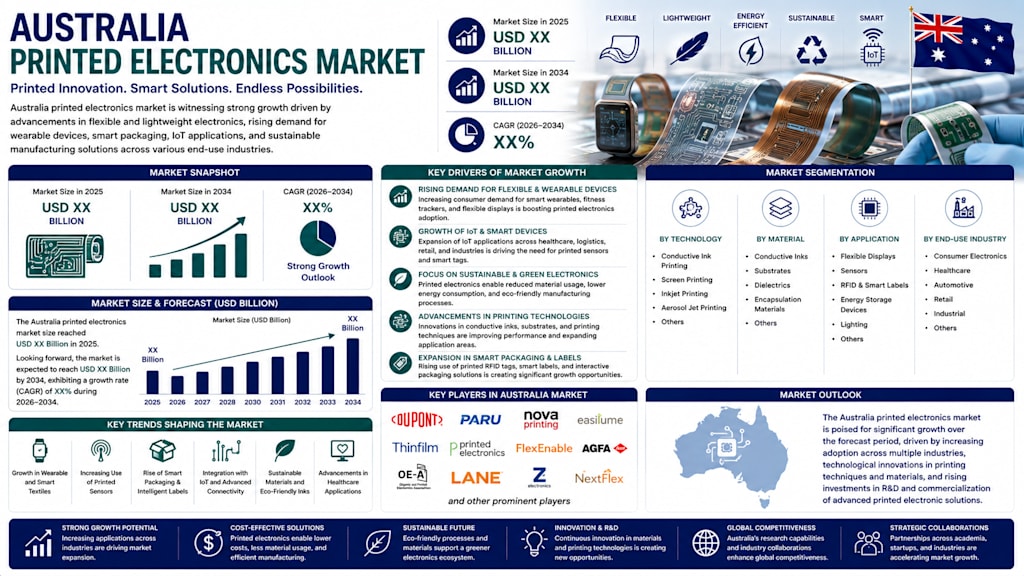
The Australia printed electronics market is entering an exciting phase of technological advancement, offering innovative solutions across healthcare, consumer electronics, automotive, industrial automation, and smart packaging. As industries increasingly seek lightweight, flexible, and cost-effective electronic components, printed electronics are becoming a preferred alternative to conventional manufacturing methods.
According to IMARC Group, the Australia printed electronics market reached USD 1,866.4 Million in 2025 and is projected to reach USD 5,315.1 Million by 2034, exhibiting a CAGR of 11.96% during 2026–2034. This impressive growth reflects rising investments in advanced manufacturing technologies, increasing research activities, and the growing adoption of flexible electronic devices throughout Australia.
The market covers several important segments, including materials, technology, devices, and regions, demonstrating the broad application potential of printed electronics across multiple industries.
Why the Market Is Growing So Rapidly
One of the strongest growth drivers is Australia's increasing investment in advanced manufacturing and next-generation electronics. Printed electronics enable manufacturers to produce thinner, lighter, and more energy-efficient components while reducing production costs and material waste. As companies continue modernizing their manufacturing capabilities, printed electronics are becoming an integral part of future production strategies.
Another major factor is the expanding adoption of wearable healthcare devices and smart medical technologies. Flexible sensors, biosensors, and printed circuits are making healthcare monitoring more comfortable, accurate, and affordable. The growing emphasis on preventive healthcare and remote patient monitoring is creating significant opportunities for printed electronic components that combine flexibility with high performance.
Sustainability is also accelerating market growth. Compared to conventional electronics manufacturing, printed electronics often require fewer raw materials, consume less energy, and generate lower production waste. As environmental regulations become more important and businesses prioritize sustainable operations, manufacturers are increasingly exploring printed electronic technologies to improve efficiency while supporting environmental goals.
The rapid expansion of the Internet of Things (IoT), smart packaging, connected devices, and industrial automation is further strengthening market demand. Printed sensors, RFID tags, flexible displays, and intelligent labels are becoming essential for supply chain management, logistics, retail, and manufacturing. As digital transformation continues across Australian industries, printed electronics provide practical solutions that support connectivity and real-time data collection.
Continuous research and innovation also play an essential role in market expansion. Universities, research organizations, and technology companies are developing advanced conductive inks, printable semiconductors, flexible substrates, and improved production techniques that continue expanding commercial applications throughout the country.
What the Opportunities Are
1. Expansion of Smart Healthcare Solutions
Growing demand for wearable medical devices creates strong opportunities for manufacturers developing flexible sensors, health monitoring patches, and diagnostic technologies that improve patient care while reducing healthcare costs.
2. Smart Packaging Innovation
Retailers and consumer brands are increasingly adopting intelligent packaging solutions that integrate printed sensors, RFID technology, and interactive features. This trend opens new revenue opportunities for packaging manufacturers and technology providers.
3. Automotive Electronics
Modern vehicles require lightweight electronic systems, flexible lighting solutions, smart interior controls, and advanced sensing technologies. Printed electronics can significantly improve manufacturing efficiency while supporting next-generation electric and autonomous vehicles.
4. Renewable Energy Applications
Printed photovoltaic technologies and flexible solar cells offer new possibilities for renewable energy generation. Continued investment in clean energy infrastructure positions Australia as an attractive market for innovative printed energy solutions.
5. Industrial Internet of Things (IIoT)
Factories are increasingly deploying connected sensors to monitor equipment performance, maintenance schedules, and operational efficiency. Printed electronics enable cost-effective deployment of these sensing technologies across large industrial environments.
6. Consumer Electronics Manufacturing
Flexible displays, smart clothing, foldable devices, and next-generation wearable products continue expanding worldwide. Australian companies participating in these value chains can benefit from growing domestic and international demand.
7. Research Commercialization
Australia's strong research ecosystem provides opportunities to commercialize emerging printed electronic technologies. Collaboration between universities, startups, and established manufacturers can accelerate innovation while attracting investment into high-value manufacturing.
Research organizations and industry participants have continued investing in printed electronics technologies, focusing on improving flexible circuit manufacturing, conductive materials, and commercial-scale production capabilities.
Companies across healthcare, packaging, and industrial automation have expanded their exploration of printed electronic applications to improve product functionality, operational efficiency, and sustainability.
Growing interest in advanced manufacturing, digital transformation, and flexible electronic solutions continues to strengthen long-term market prospects, encouraging further investment in research, innovation, and commercialization activities.
Why Should You Know About Australia Printed Electronics Market?
Printed electronics represent much more than a technological advancement—they signal a transformation in how electronic products will be designed, manufactured, and integrated into everyday life. From wearable healthcare devices and intelligent packaging to smart factories and renewable energy systems, this technology is creating entirely new business models while improving sustainability and production efficiency.
For investors, the market offers exposure to one of the fastest-growing segments within advanced manufacturing. For businesses, it presents opportunities to develop innovative products that meet evolving customer expectations. For policymakers, supporting printed electronics can strengthen Australia's manufacturing competitiveness, encourage research commercialization, and contribute to long-term economic growth.
With the market expected to grow from USD 1,866.4 Million in 2025 to USD 5,315.1 Million by 2034 at a CAGR of 11.96%, Australia's printed electronics industry is well positioned to become a key pillar of the country's future innovation economy.
About the Creator
Rashi Sharma
I am a market researcher.
Enjoyed the story? Support the Creator.
Subscribe for free to receive all their stories in your feed.
Comments
There are no comments for this story
Be the first to respond and start the conversation.