
Australia Power Grids Market 2026: Renewable Energy Integration, Smart Grid Technologies & Infrastructure Modernization Driving Growth
How grid digitalization, clean energy expansion, and investments in resilient electricity networks are transforming the Australia power grids industry

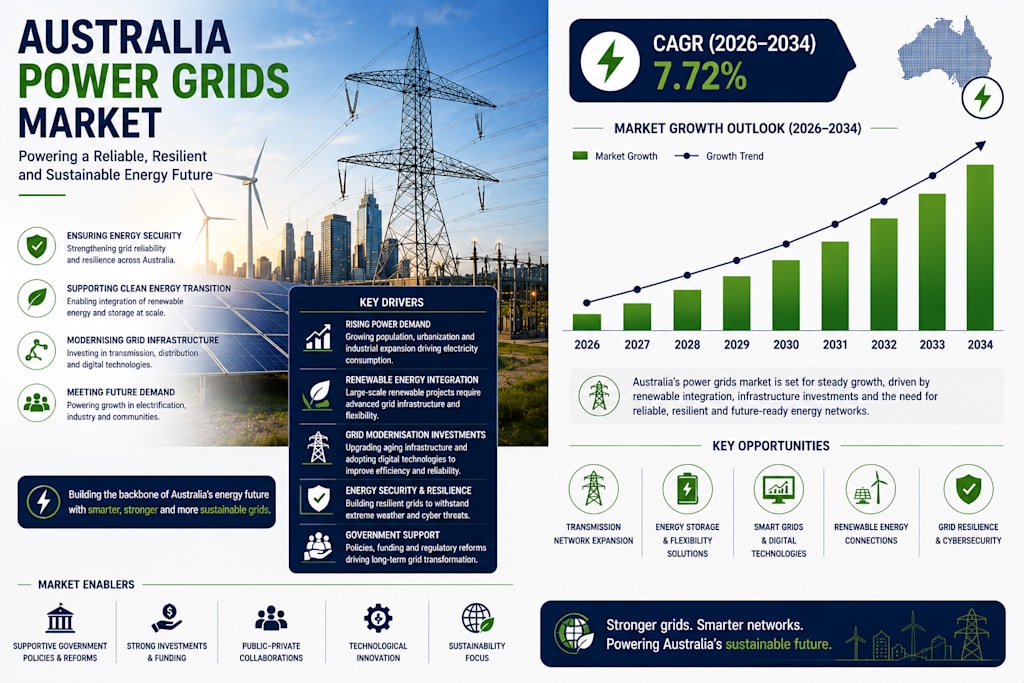
Australia Power Grids Market Overview
The Australia power grids market is a vital component of the country’s energy and utility infrastructure, encompassing power generation networks, transmission lines, distribution systems, smart grid technologies, and consumer electricity delivery systems.
According to IMARC Group, the Australia power grids market size reached USD 7.5 Billion in 2025 and is projected to reach USD 15.0 Billion by 2034, exhibiting a compound annual growth rate (CAGR) of 7.72% during 2026–2034.
The market is witnessing strong growth driven by increasing renewable energy integration, grid modernization initiatives, government support for clean energy infrastructure, growing electricity demand, rising urbanization, and the adoption of advanced digital grid management technologies.
Key Market Drivers
Growing Integration of Renewable Energy Sources
Australia’s transition toward solar, wind, and other renewable energy sources is creating demand for advanced grid infrastructure capable of managing variable power generation and maintaining network stability.
Grid Modernization and Infrastructure Upgrades
Utilities and energy operators are increasingly investing in smart meters, automated control systems, real-time monitoring technologies, and digital infrastructure to improve operational efficiency and grid reliability.
Government Policies Supporting Energy Transition
Federal and state government initiatives aimed at increasing renewable energy adoption and reducing emissions are encouraging investments in transmission networks, grid expansion projects, and modern electricity infrastructure.
Rising Urbanization and Electricity Demand
Population growth and urban expansion across major Australian cities are increasing electricity consumption, creating the need for higher-capacity and more resilient power networks.
Increasing Adoption of Distributed Energy Resources
The growing deployment of rooftop solar systems, battery storage technologies, and community energy projects is accelerating the transformation of traditional electricity networks toward decentralized grid models.
Request a Sample Report with the Latest 2026 Data & Forecasts
What the Opportunities Are
Expansion of Smart Grid Technologies
The adoption of IoT-enabled sensors, artificial intelligence, predictive analytics, and automated grid management systems is creating significant opportunities for infrastructure modernization and efficiency improvements.
Development of Climate-Resilient Grid Infrastructure
Growing concerns regarding bushfires, floods, heatwaves, and other climate-related disruptions are encouraging investments in resilient transmission and distribution infrastructure.
Growth of Community Energy and Microgrid Projects
Increasing interest in decentralized energy generation and local energy sharing systems is creating opportunities for microgrid deployment and community-led power initiatives.
Rising Investments in Renewable Energy Zones
Large-scale renewable energy developments and transmission expansion projects are supporting demand for new grid connections, substations, and energy transport infrastructure.
Increasing Electrification Across Industries
The adoption of electric vehicles, industrial electrification, and digital infrastructure expansion is creating additional demand for reliable and scalable electricity networks.
Recent News and Developments
May 2026: The Australia power grids market continued expanding as utilities accelerated investments in smart grid technologies, transmission upgrades, and renewable energy integration projects to support the country's ongoing energy transition.
May 2026 : Grid operators increasingly focused on digital transformation initiatives, including advanced monitoring systems, automated control technologies, and real-time energy management solutions to improve network efficiency and reliability.
April 2026 : Renewable energy integration remained a major industry priority as growing solar and wind generation capacity required expanded transmission infrastructure and enhanced grid flexibility.
March 2026 : Community energy projects, distributed generation systems, and microgrid deployments continued gaining momentum across regional and remote areas, supporting greater energy independence and resilience.
February 2026 : Infrastructure resilience initiatives expanded nationwide as utilities strengthened transmission and distribution networks to mitigate the impact of climate-related disruptions and extreme weather events.
January 2026 : Government-backed infrastructure programs and renewable energy development strategies continued encouraging investment in electricity transmission corridors and grid modernization projects.
December 2025 : The Australian Energy Market Operator (AEMO) continued emphasizing the importance of long-term grid expansion and modernization to accommodate growing electricity demand and renewable energy capacity additions.
November 2025 : Utilities increased investments in advanced energy management systems, battery storage integration, and digital infrastructure to improve operational performance and support future energy requirements.
2025–2026 (Market Trend) : The Australia power grids market is being shaped by renewable energy integration, decentralized power generation, smart grid deployment, climate resilience planning, and rising electricity demand. Utilities and infrastructure providers are increasingly investing in digital technologies, transmission expansion projects, energy storage integration, and advanced grid management systems to improve reliability and operational efficiency. At the same time, infrastructure funding requirements, regulatory compliance, cybersecurity concerns, and climate-related risks continue influencing market development and investment strategies.
Why You Should Know About the Australia Power Grids Market?
The Australia power grids market is becoming an increasingly important pillar of the country’s energy transition, infrastructure modernization, and long-term economic development strategy.
With projected growth from USD 7.5 Billion in 2025 to USD 15.0 Billion by 2034, the market demonstrates strong long-term potential supported by renewable energy adoption, grid modernization initiatives, urbanization, and increasing electricity consumption.
As utilities, governments, and infrastructure providers continue investing in smart grid technologies, transmission expansion projects, decentralized energy systems, and climate-resilient infrastructure, the sector is expected to play a critical role in shaping the future of Australia’s energy ecosystem.
About the Creator
Amyra Singh
Market research analyst who loves spotting patterns, digging into data, and turning insights into strategies that help brands grow and stay ahead of the curve.
Enjoyed the story? Support the Creator.
Subscribe for free to receive all their stories in your feed.
Comments
There are no comments for this story
Be the first to respond and start the conversation.