
Australia Power Grids Market 2026: Renewable Energy Integration, Grid Modernization & Smart Infrastructure Driving Growth
How clean energy expansion, transmission network upgrades, and digital grid technologies are transforming the Australia power grids industry

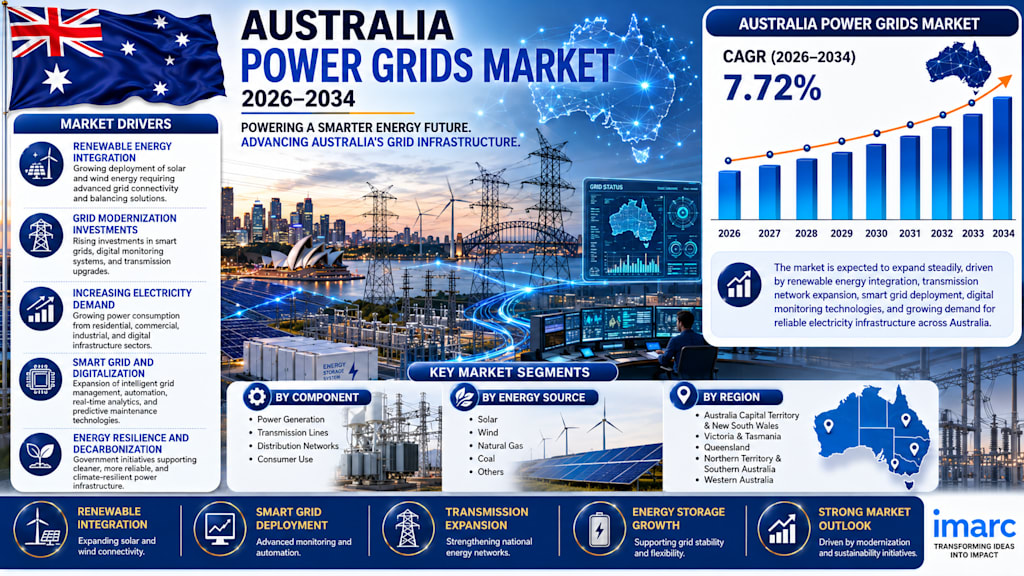
Australia Power Grids Market Overview
The Australia power grids market is a critical component of the country's energy infrastructure sector, encompassing transmission networks, distribution systems, substations, smart grid technologies, grid automation solutions, and electricity management systems.
According to IMARC Group, the Australia power grids market size reached USD 7.5 Billion in 2025. Looking forward, the market is expected to reach USD 15.0 Billion by 2034, exhibiting a growth rate (CAGR) of 7.72% during 2026–2034.
The market is experiencing substantial growth driven by increasing renewable energy integration, modernization of aging grid infrastructure, rising electricity demand, government investments in energy transition projects, and the growing adoption of smart grid technologies.
Key Market Drivers
Growing Integration of Renewable Energy Sources
The rapid deployment of solar, wind, and other renewable energy projects is increasing the need for advanced grid infrastructure capable of managing variable power generation.
Grid Modernization Initiatives
Utilities and government agencies are investing in upgrading transmission and distribution networks to improve reliability, efficiency, and resilience.
Rising Electricity Demand
Population growth, urban development, industrial expansion, and electrification trends are contributing to increased electricity consumption across Australia.
Adoption of Smart Grid Technologies
The implementation of digital monitoring systems, advanced metering infrastructure, automation technologies, and real-time grid management solutions is enhancing operational performance.
Government Support for Energy Transition
National and regional energy policies aimed at reducing emissions and supporting renewable energy adoption are driving investments in power grid infrastructure.
Request a Sample Report with the Latest 2026 Data & Forecasts
What the Opportunities Are
Expansion of Energy Storage Integration
The growing deployment of battery energy storage systems presents significant opportunities for grid operators and infrastructure providers.
Development of Smart Grid Infrastructure
Utilities are increasingly investing in intelligent grid technologies that improve efficiency, reliability, and demand management capabilities.
Growth of Electric Vehicle Infrastructure
The expansion of electric vehicle charging networks is creating opportunities for grid enhancements and capacity upgrades.
Increasing Investment in Transmission Networks
Large-scale renewable energy projects require new transmission infrastructure to connect generation assets with population centers.
Adoption of Advanced Grid Analytics
Artificial intelligence, predictive maintenance, and data-driven grid management solutions offer opportunities to improve operational efficiency and reduce downtime.
Recent News and Developments
June 2026: The Australian Energy Market Commission (AEMC) proposed major electricity market reforms aimed at improving grid efficiency and fairness as rooftop solar, batteries, and electric vehicles increasingly reshape Australia's power grid. The reforms are projected to save consumers up to AUD 6 billion over 15 years while supporting modernization of the electricity network.
June 2026: Australia's rapidly expanding data center sector placed growing pressure on electricity networks. Industry estimates indicated that data centers could account for approximately 6% of Australia's electricity consumption by 2029–30, increasing the need for grid upgrades, transmission capacity, and renewable energy integration.
June 2026: The Australian Energy Market Operator (AEMO) disclosed that 11 major data center projects totaling 5.4 GW of power demand were progressing through the National Electricity Market connection process, highlighting rising demand for grid infrastructure and transmission capacity.
May 2026: Under the Australian Government's Rewiring the Nation program, up to AUD 3 billion was allocated to modernize Western Australia's electricity networks, while Victoria received support of up to AUD 2.25 billion for Renewable Energy Zones and the Victoria–New South Wales Interconnector (VNI West). An additional AUD 250 million was allocated for Northern Territory grid upgrades.
May 2026: Clean Energy Council data showed that renewable energy generated 43% of Australia's electricity in 2025, up from 39% in 2024. Home battery installations increased by 260%, while utility-scale battery capacity grew by 233%, accelerating the transformation of Australia's power grid.
April 2026: Grid transition reports highlighted that renewables supplied approximately 47% of National Electricity Market (NEM) generation during Q1 2026, reaching record levels as solar, wind, and battery storage played a larger role in electricity supply.
February 2026: Australia's transmission sector continued expanding to accommodate renewable energy projects. Industry studies identified high-voltage direct current (HVDC) technology as a key solution for increasing transmission capacity, reducing losses, and improving long-distance power transfer efficiency across the national grid.
January 2026: Australia surpassed 4 million rooftop solar installations, with approximately one in three homes equipped with solar systems. The growing volume of distributed generation continued driving investment in grid modernization, energy storage, and smart network technologies.
Why You Should Know About the Australia Power Grids Market?
The Australia power grids market is becoming an increasingly important pillar of the country's energy transition, infrastructure development, and sustainability strategy.
With projected growth from USD 7.5 Billion in 2025 to USD 15.0 Billion by 2034, at a CAGR of 7.72%, the market demonstrates strong long-term potential supported by renewable energy integration, grid modernization initiatives, rising electricity demand, and smart infrastructure investments.
As utilities, technology providers, and government agencies continue investing in advanced transmission networks, digital grid solutions, energy storage integration, and resilient electricity infrastructure, the sector is expected to play a critical role in shaping Australia's future energy ecosystem.
About the Creator
Amyra Singh
Market research analyst who loves spotting patterns, digging into data, and turning insights into strategies that help brands grow and stay ahead of the curve.
Enjoyed the story? Support the Creator.
Subscribe for free to receive all their stories in your feed.
Comments
There are no comments for this story
Be the first to respond and start the conversation.