
Australia Power Cable Accessories Market: Grid Modernisation, Renewable Surge & Energy Transition
How AEMO's 6,000km transmission blueprint, a $242bn infrastructure pipeline and the rise of EV infrastructure are driving critical component demand across Australia

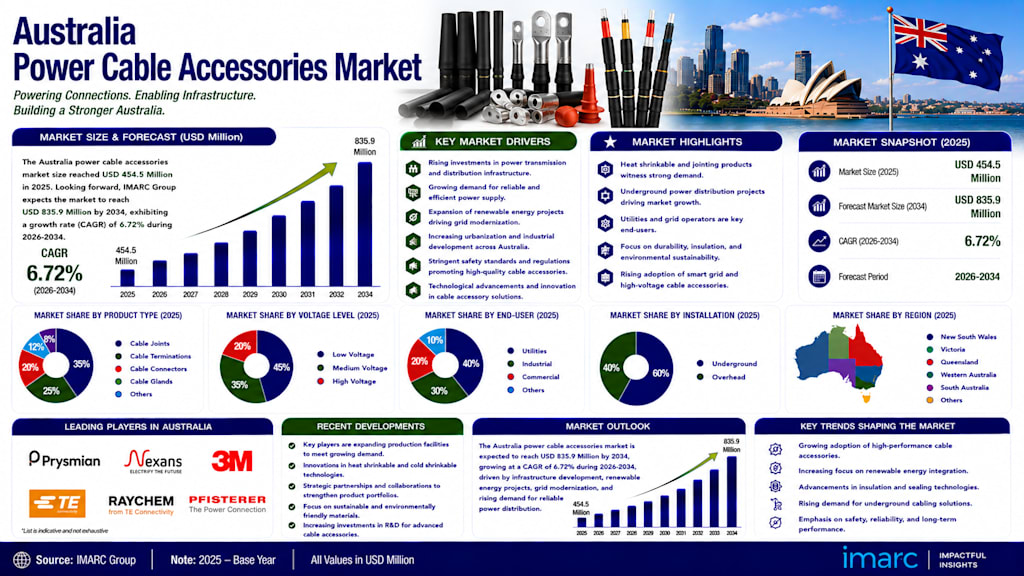
The Australia power cable accessories market is quietly but assertively entering a period of sustained expansion, fuelled by the country's most ambitious energy transition in a generation. Power cable accessories — encompassing cable joints, terminations, connectors, cleats and insulating materials — are the critical enablers of electrical network reliability, deployed across renewable energy zones, subsea interconnectors, underground urban networks and EV charging hubs to ensure safe, durable and high performance power transmission. According to IMARC Group, the Australia power cable accessories market size reached USD 454.5 Million in 2025 and is projected to reach USD 835.9 Million by 2034, exhibiting a compound annual growth rate (CAGR) of 6.72% during 2026 2034. As the nation pivots toward net zero emissions, power cable accessories have been propelled from a niche industrial afterthought to a foundational pillar of energy security and grid resilience.
What's Driving Market Growth?
Renewable Energy Surge & Grid Modernisation Imperative. The single most powerful growth catalyst is Australia's rapid renewable energy build out. As of February 2025, renewables contributed approximately 44% of electricity in the National Electricity Market, with over 49 GW of new solar, wind and battery projects in the connection pipeline. This shift from centralised fossil fuel power to distributed and variable renewable sources is fundamentally reshaping how electricity networks are designed and maintained. Integrating these sources requires a new generation of power cable accessories — flexible terminations, durable joints and advanced connectors — capable of managing fluctuating loads, ensuring reliability across sprawling transmission distances and withstanding the harsh, weathered conditions of regional Australia. This push coincides with the modernisation of aging grid infrastructure, creating demand for smart, automation ready components that support real time monitoring and fault detection.
Massive Infrastructure Pipeline & Transmission Blueprint. Australia is laying down a historic volume of new transmission infrastructure. The Australian Energy Market Operator's (AEMO) Draft 2026 Integrated System Plan (ISP) identifies the need for a further 6,000 kilometres of new transmission lines, the backbone of the electricity system, to be added to the existing 44,000 km network. Transmission investments alone, estimated at around $9 billion**, are expected to repay their costs, save consumers an additional $22 billion in avoided costs and deliver emissions reductions valued at $2 billion. This is not a solitary effort. Infrastructure Australia's 2025 report notes the national infrastructure pipeline has swelled to an unprecedented **$242 billion, with investment in utilities, particularly energy transmission projects, expected to more than double to $36 billion over the next five years.
Urbanisation & the Rise of Underground Cabling. As Australia's major cities grow in density, the complexity of their electrical infrastructure intensifies. To address space limitations and improve safety, underground cabling has become the preferred standard in new metropolitan developments. This shift directly drives demand for cable accessories designed to withstand challenging underground conditions — joints, connectors and terminations that offer water resistance, long term corrosion protection and low maintenance operation. Urban expansion, particularly in Sydney, Melbourne and Brisbane, is paralleled by a surge in digital infrastructure and high density residential data buildings, all of which depend on reliable, high quality underground networks.
EV Charging Network Expansion. The rapid rollout of electric vehicle infrastructure is creating another significant demand vector for power cable components. As of mid 2024, Australia's high power public EV charging infrastructure surged nearly 90%, with 1,059 locations and 1,849 fast chargers now operational. This rapid expansion demands high performance cable accessories capable of handling high current loads and ensuring long term safety in public and commercial facilities. Each new charging hub, from urban fast charging stations to regional highway sites, relies on the same suite of components that traditional substations and distribution networks require.
Market Segmentation & Key Insights
By Product Type, the market is categorised into cable connectors, cable terminations, cable joints and insulating materials. Cable connectors maintain their leadership due to the inherent versatility of plug and play connections across diverse electrical configurations. Cable terminations and joints constitute the other main pillars, ensuring the integrity and continuity of transmission and distribution lines. By Voltage Range, the market is segmented into low, medium and high voltage (including extra high voltage). Low voltage generates the largest revenue, driven by its dominance in residential, commercial and light industrial applications. High and extra high voltage segments experience the fastest growth, underpinned by multi billion dollar transmission interconnector projects.
By End Use Industry, the primary verticals are power generation, transmission & distribution (T&D), oil & gas, mining, renewables and construction. T&D captures the largest share, reflecting the scale of grid wide upgrades and new transmission builds. The renewables sub segment is experiencing the most rapid acceleration, propelled by the connection of utility scale wind and solar farms to the National Electricity Market (NEM). By Region, major markets include New South Wales & ACT, Victoria & Tasmania, Queensland, Northern Territory & Southern Australia and Western Australia. NSW & ACT currently lead, supported by the state's substantial investment in transmission acceleration and Renewable Energy Zones (REZs).
What the Opportunities Are?
AI Enabled Smart Monitoring for Critical Transmission Assets. The integration of artificial intelligence and real time sensing represents a frontier growth avenue. As the grid evolves into a more responsive, intelligent system, accessories that support real time data collection on thermal cycling, partial discharge and mechanical stress are becoming essential. Manufacturers embedding fibre optic sensors and edge analytics into joints and terminations could unlock premium price points and long term service contracts for Australia's most critical transmission corridors. As of February 2025, this market is driven by utilities seeking to defer capital expenditure through predictive maintenance and prevent costly, system wide outage events in aging infrastructure.
Sovereign Manufacturing & Supply Chain Resilience. Australia's current reliance on imported cable accessory components, particularly high voltage specialist items, has exposed supply chain vulnerabilities. There is a strong opportunity for domestic investment in localised production, especially for medium voltage joints and network protection accessories. Local manufacturing is strategically beneficial due to the heavy logistical costs of shipping bulky steel hardware and the need for rapid delivery to infrastructure projects under strict deadlines.
Customised Solutions for Harsh Industrial Conditions. Australia's mining, oil & gas and outdoor renewables sectors continue to push equipment to the limits of endurance. There is a sustained need for accessories with enhanced technical specifications: extreme vibration resistance for mining sites, fire retardant properties for oil & gas facilities and enhanced insulation for coastal wind farms. Companies that offer niche, environment specific product lines, backed by rigorous industry certifications, will capture high margin contracts and secure loyalty from industrial procurement teams.
EV Ready Distribution Network Upgrades. The rise of high power public EV charging is not merely about constructing new stations; it demands a substantial uplift of the distribution networks that feed them. The 1,849 fast chargers that came online by mid 2024 represent only the first phase of a sustained multi year upgrade programme. This creates a consistent, volume driven need for low and medium voltage connectors, termination kits and protection components.
Modular & Pre fabricated Accessory Systems for Expedited Construction. With high labour costs and a critical shortage of qualified electrical technicians in Australia, there is increasing demand for modular accessory systems designed for simple, error proof installation. These pre fabricated kits, which include integrated components such as stress cones, insulating tubes and earth connections, reduce on site assembly time. As megaprojects face tight commissioning deadlines, this remains a standout growth segment.
Recent News and Developments in Australia Power Cable Accessories Market
December 2025: AEMO released its Draft 2026 Integrated System Plan, laying out the engineering blueprint to connect Australia's transition to renewable energy. It reaffirmed the necessity for approximately 6,000 kilometres of new transmission infrastructure and outlined a pipeline of projects worth $9 billion, balancing consumer cost pressures with ambitious emissions targets.
November 2025: Infrastructure Australia announced the national infrastructure pipeline has surged to an unprecedented **$242 billion**, catalysed by $30 billion in fresh state and federal government investment over the preceding year. The report singled out energy transmission as the fastest growing segment, with a projected near doubling of utility investment to $36 billion in the coming half decade.
June 2025: The New South Wales government committed an additional $2.1 billion to its Transmission Acceleration Facility to fast track new poles, wires and substations to connect the state's five Renewable Energy Zones (REZs) to the main electricity network.
March 2025: Transmission grid operators were reported to have consumed a large backlog of underground and high voltage cable accessories components. This was driven by the sheer number of interconnection projects (such as the VNI West and Marinus Link interconnectors) moving into advanced planning or active construction stages, placing sustained demand on global supply chains.
Why Should You Know About Australia Power Cable Accessories Market?
You should know about this market because it captures how national energy transformation, state backed infrastructure spending and technology driven grid modernisation intersect to create enduring, multi year demand for components that are often overlooked but absolutely indispensable. Power cable accessories are no longer just basic connectors — they are mission critical products whose performance, durability and intelligence dictate the reliability of the electricity that powers Australia's homes, industries and data centres.
For investors, the market offers exposure to a stable growth electrical infrastructure category anchored in AEMO's regulatory blueprint, the $242 billion national pipeline and the structural shift away from centralised thermal generation. The projected CAGR of 6.72% reflects confident alignment with government backed capital works, while higher growth sub segments — including AI enabled monitoring systems, sovereign manufacturing for grid components, harsh environment industrial accessories and EV network upgrade solutions — offer differentiated upside. For procurement specialists, electrical engineers and infrastructure investors, understanding the segmentation between jointing, termination and connector kits, the performance requirements for Australia's unique climate, and the emerging role of intelligent monitoring systems helps shape resilient supply chain and capital allocation strategies. In essence, the Australia power cable accessories market captures how high voltage engineering, digital grid intelligence and policy driven decarbonisation converge — making it a compelling area for investors, technology partners and supply chain strategists seeking smarter approaches to electrical reliability, renewable integration and long term infrastructure performance.
About the Creator
Thomas
Market Research Analyst | Industry Trends & Forecasting | Turning market data into clear, actionable business insights across global sectors.
Enjoyed the story? Support the Creator.
Subscribe for free to receive all their stories in your feed.
Comments
There are no comments for this story
Be the first to respond and start the conversation.