
Australia Polyethylene Terephthalate Market: Circular Economy Shift, Sustainable Packaging & Advanced Recycling
How container deposit schemes, rPET mandates and fibre bottle innovation are driving Australia's PET transformation

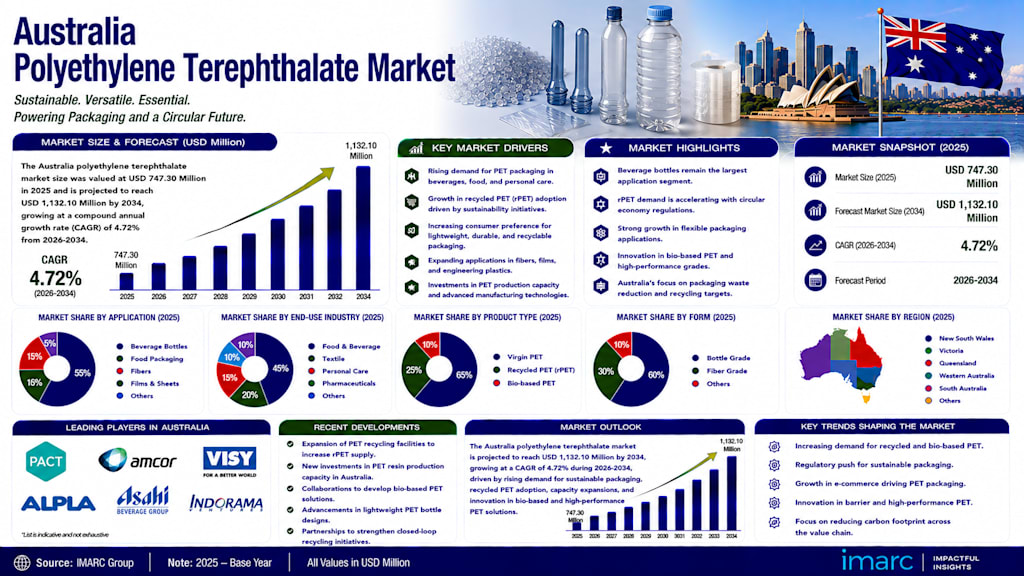
The Australia polyethylene terephthalate (PET) market is undergoing a profound and sustainable transformation, as beverage manufacturers, packaging converters, governments and consumers increasingly prioritise infinite recyclability, reduced carbon footprints and circular economy principles. PET — one of the world's most versatile thermoplastics — is deployed across beverage bottles, food containers, synthetic fibres and industrial strapping applications to deliver lightweight strength, barrier protection and unmatched recyclability compared with alternative polymers. According to IMARC Group, the Australia polyethylene terephthalate (PET) market size reached USD 747.30 Million in 2025 and is projected to reach USD 1,132.10 Million by 2034, exhibiting a compound annual growth rate (CAGR) of 4.72% during 2026–2034. As Australia accelerates toward a 70 per cent plastic packaging recycling or composting target by 2025 under the National Plastics Plan, PET has emerged as the leading circular polymer for packaging manufacturers and consumer goods companies seeking to meet ambitious sustainability commitments.
What's Driving Market Growth?
Container Deposit Schemes (CDS) Driving rPET Recovery and Supply. Australia's Container Deposit Schemes — operating across New South Wales, Queensland, Western Australia, South Australia, the Australian Capital Territory and Victoria — are fundamentally reshaping the PET value chain. The CDS framework delivers financial incentives that drive collection rates, generating high quality, lightweight post consumer bales suitable for closed loop bottle to bottle recycling. Victoria's CDS, implemented in November 2023, collected 1 billion eligible drink containers in its first year, resulting in AUD 950,000 being donated to community organizations. From mid-2026, the scheme will expand to accept any beverage container up to 3 litres, including wine bottles, spirit bottles, plain milk containers, and sachets — one of the broadest expansions in Australia. In NSW, approximately 66 per cent of PET redeemed in FY25 through the scheme is now being remanufactured into recycled PET (rPET), demonstrating proven container recovery at scale.
Mandatory Recycled Content Regulations and Corporate Commitments. Australia's National Plastics Plan (2021) includes a Phased Approach for Recycled Content in PET Beverage Containers, with major beverage manufacturers and bottled water producers required to use increasing recycled content in PET containers. The Australian Packaging Covenant Organisation (APCO) has committed to making all packaging 100% recyclable, reusable, or compostable by 2025, prompting beverage and FMCG companies to enhance their way toward rPET bottles. Major retailers are demonstrating strong progress: in 2025, 86% of Woolworths' own brand packaging was designed for recyclability, and the average recycled content across its own brand packaging was 52%. The APCO target for recycled content in food packaging is set to increase from 30 per cent to 50 per cent by 2025.
Domestic Recycling Infrastructure Scaling National Capacity. Australia is witnessing a wave of investment in recycling technologies to increase domestic rPET production capacity. The Circular Plastics Australia (PET) plant, a facility worth USD 50 million in Melbourne, began operations in November 2023, recycling the equivalent of up to one billion 600ml PET plastic beverage bottles annually into high-quality food-grade resin. Between their two facilities, Circular Plastics Australia has more than doubled the amount of locally sourced and recycled PET (rPET) produced in Australia – from around 30,000 tonnes currently to more than 70,000 tonnes per annum. The Clean Energy Finance Corporation committed $16.5 million in debt finance towards the first Circular Plastics Australia recycling facility in Albury, New South Wales, with an additional $16.5 million from the Commonwealth Bank of Australia.
Consumer Preference for Sustainable Packaging. Evolving consumer consciousness and shifting perceptions around plastic waste are accelerating the transition toward PET packaging with verifiable environmental credentials. Brands across the beverage, personal care and household categories are increasingly adopting 100 per cent recycled PET (rPET) packaging as a competitive differentiator. In 2025, Coles Group released its Sustainability Report showing progress in reducing packaging waste, with particular improvements in plastic packaging. The transition of commercial industries toward green packaging standards further increases demand for sustainable solutions in both retail and industrial use.
Market Segmentation & Key Insights
By Type, the market is divided into virgin and recycled. Virgin PET dominates the market with a share of 63.8% in 2025, owing to its superior clarity, strength, and compliance with stringent food grade safety standards essential for beverage bottles and premium packaging applications across Australia. However, recycled PET is the fastest growing segment, driven by sustainability mandates and brand commitments.
By Application, rigid packaging leads the market with a share of 52.4% in 2025, driven by widespread use in beverage bottles, food containers, and personal care product packaging, supported by growing consumer preferences for durable and recyclable materials.
By Region, Australia Capital Territory & New South Wales represents the largest region with 34.9% share in 2025, supported by the concentration of major manufacturing facilities, robust container deposit infrastructure, and significant government investment in recycling modernization programs.
What the Opportunities Are?
Fibre Bottle Technology for Compostable Composite Packaging. Innovation in fibre bottle technology presents a significant opportunity to reduce virgin PET consumption while maintaining high quality liquid packaging performance. Packamama, a UK based eco friendly wine bottle packaging company, was awarded a AU$1 million government grant to decarbonise Australian wine packaging. A 2025 Life Cycle Assessment found that Packamama bottles can cut emissions by up to 56 per cent and that exporting wine in Packamama bottles produces 32 per cent less CO₂ than bulk export, proving a major opportunity to decarbonise Australia's 1.5 billion bottle a year sector while protecting jobs in Australia. Packamama collaborated with Aldi in 2024 to launch flat wine bottles made from recycled PET, said to remove 42 tonnes of bottle weight for their first launch.
Advanced Mechanical and Chemical Recycling Technologies. Australian research institutions are developing breakthrough technologies to improve recycling efficiency. Monash University engineers have developed a new filtering material that could make plastic recycling cheaper, efficient and environmentally friendly by improving the recovery and reuse of valuable chemicals during processing. Published in the Chemical Engineering Journal, the study focuses on improving glycolysis — a chemical recycling process where PET plastics are broken down using a liquid chemical — enabling the recovery and reuse of valuable compounds. The technology could eventually be applied across a broad range of PET waste streams, including packaging, trays, bottles and textiles.
Lightweighting and Eco Design Innovation. Sidel has introduced StarLITE-R STILL, a new bottle base designed for high speed production of 100 per cent recycled PET (rPET) bottles for water, juices, milk, and edible oils in sizes ranging from 0.25L to 2.5L. Integrated Plastics' achievement of an Integrally Moulded Handle creating a single material PET or rPET bottle has been recognised with two Worldstar 2025 Awards for Packaging excellence: one from South Africa and the second from Australia and New Zealand. Throughout 2025, Nu Pure Beverages progressed lightweighting initiatives to continue to reduce plastic use and transport related emissions while maintaining bottle integrity, safety, and fitness for performance — reinforcing that sustainability and quality go hand in hand.
Expansion of Chemical Recycling and Enzyme Technology. Samsara Eco has opened a commercial scale plant in New South Wales using AI developed enzymes to recycle waste textiles and plastics. The technology extracts nylon, polyester and PET polymers from waste textiles and plastic, before using enzymes to break them down into monomers for reuse in new products. Additionally, Erema has partnered with BlockTexx to scale up textile recycling, with their first plant in Australia processing 10,000 tonnes per annum, and a second 50,000 ton facility in planning.
Circular Economy and Closed Loop Packaging Systems. The two Circular Plastics Australia facilities have now recycled 3.5 billion PET bottles so far, with the recycled material being kept in the circular economy by joint venture partners who use it to manufacture new beverage bottles and packaging. Pact Group has a target to average 30% recycled content across the company's plastics portfolio by 2025 and eliminate all problem packaging. Cleanaway provides the PET feedstock through its waste collection and sorting network, while Pact manages and operates the plants.
Recent News and Developments in Australia Polyethylene Terephthalate Market
May 2026: Researchers at Monash University published a breakthrough study in the Chemical Engineering Journal on a new filtering material that could make chemical recycling cheaper, efficient and environmentally friendly by improving the recovery of valuable chemicals from PET waste streams.
April 2026: Coles Group released its 2025 Sustainability Report, highlighting progress in reducing packaging waste, with particular improvements in plastic packaging. Plastics and packaging were identified as top 10 material sustainability issues for 2025.
March 2026: The NSW container deposit scheme reported that approximately 66 per cent of PET redeemed in FY25 through the scheme is now being remanufactured into recycled PET, demonstrating effective circularity in action.
December 2025: Packamama was awarded an AU$1 million government grant to decarbonise Australian wine packaging. A 2025 LCA found that Packamama bottles can cut emissions by up to 56 per cent.
November 2025: Costa Group partnered with Coles and Opal in a large scale trial to replace rPET plastic punnets with recyclable cardboard packaging for Perino tomatoes across Coles' Victorian stores.
September 2025: Samsara Eco opened a commercial scale plant in New South Wales using AI developed enzymes to recycle waste textiles and plastics, extracting PET polymers from waste for reuse.
July 2025: Woolworths reported that 86% of its own brand packaging was designed for recyclability, with average recycled content across its own brand packaging reaching 52%.
February 2025: Sidel launched StarLITE-R STILL, a new bottle base designed for high speed production of 100% rPET bottles for water, juices, milk, and edible oils.
Why Should You Know About Australia Polyethylene Terephthalate Market?
You should know about this market because it illustrates how container deposit legislation, recycled content mandates and advanced recycling technologies intersect to create steady growth opportunities in a mission critical segment of Australia's circular economy. PET is no longer a linear take make dispose plastic facing regulatory phase out — it has become a model circular polymer with demonstrated bottle to bottle recyclability, established CDS collection infrastructure and booming domestic rPET processing capacity that reduces reliance on imported recycled materials.
For investors, the PET market offers exposure to a stable growth industrial category anchored in Australia's ambitious packaging targets, multi jurisdiction container deposit schemes and accelerating brand commitments to closed loop circularity. The projected CAGR of 4.72% reflects steady baseline demand, while higher growth sub segments — including rPET processing infrastructure (70,000 tonnes of annual rPET production), fibre bottle technology trials and chemical recycling innovations — offer differentiated upside potential.
For packaging manufacturers, brand owners, recycling technology providers and supply chain planners, understanding PET segmentation, CDS economics, recycled content compliance pathways and emerging advanced recycling technologies helps shape intelligent investment decisions, product development roadmaps and strategic sourcing that deliver measurable circularity, cost efficiency and regulatory compliance outcomes.
In essence, the Australia polyethylene terephthalate market captures how policy enforcement, infrastructure investment and materials science converge — making it a compelling area for innovators, investors and organisations seeking smarter approaches to plastic circularity, packaging decarbonisation and sustainable growth in Australia's evolving resource recovery landscape.
About the Creator
Thomas
Market Research Analyst | Industry Trends & Forecasting | Turning market data into clear, actionable business insights across global sectors.
Enjoyed the story? Support the Creator.
Subscribe for free to receive all their stories in your feed.
Comments
There are no comments for this story
Be the first to respond and start the conversation.