
Australia Polyethylene Terephthalate Market 2026: Circular Economy Shift, Sustainable Packaging & Advanced Recycling
How container deposit schemes, rPET mandates and fibre bottle innovation are driving Australia's PET transformation

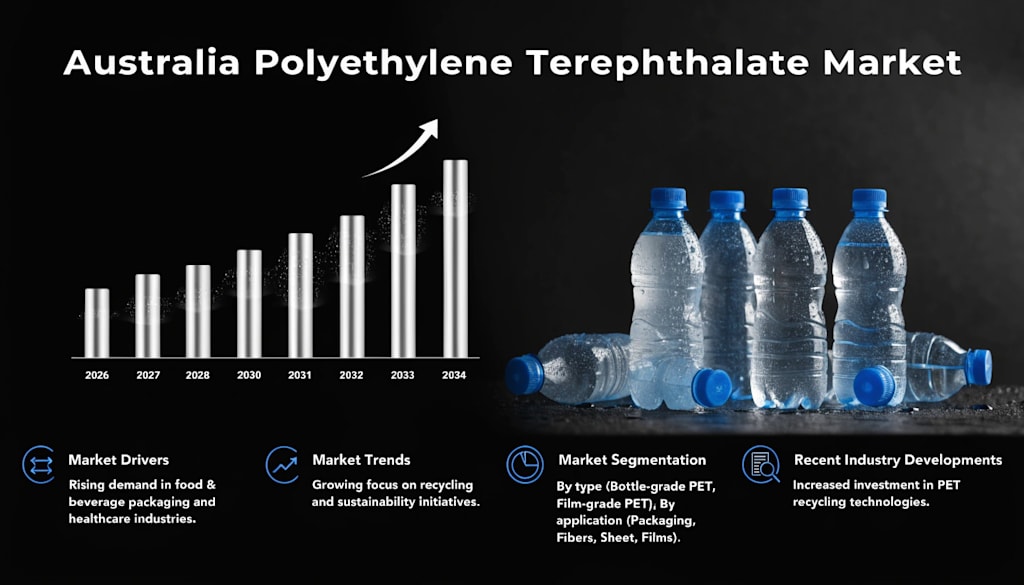
The Australia polyethylene terephthalate (PET) market is undergoing a profound and sustainable transformation, as beverage manufacturers, packaging converters, governments and consumers increasingly prioritise infinite recyclability, reduced carbon footprints and circular economy principles. PET—one of the world's most versatile thermoplastics—is deployed across beverage bottles, food containers, synthetic fibres and industrial strapping applications to deliver lightweight strength, barrier protection and unmatched recyclability compared with alternative polymers. According to IMARC Group, the market size reached USD 747.30 Million in 2025 and is projected to reach USD 1,132.10 Million by 2034, exhibiting a compound annual growth rate (CAGR) of 4.72% during 2026–2034. As Australia accelerates toward a 70 per cent plastic packaging recycling or composting target by 2025 under the National Plastics Plan, PET has emerged as the leading circular polymer for packaging manufacturers and consumer goods companies seeking to meet ambitious sustainability commitments.
What's Driving Market Growth?
Container Deposit Schemes (CDS) Driving rPET Recovery and Supply. Australia's Container Deposit Schemes—operating across New South Wales, Queensland, Western Australia, South Australia, the Australian Capital Territory and now Victoria (launched November 1, 2023) —are fundamentally reshaping the PET value chain. The CDS framework delivers financial incentives that drive collection rates of beverage containers to exceed 80 per cent across participating jurisdictions, generating high quality, lightweight post consumer bales suitable for closed loop bottle to bottle recycling. Victoria's CDS collected an average of 9 million containers daily in its first full year and paid A$131 million in refunds to the public, demonstrating proven container recovery at scale. The program also collected 131 million containers via reverse vending machines, reinforcing the infrastructure required to capture post consumer waste and return it into the manufacturing supply chain.
Mandatory Recycled Content Regulations and Corporate Commitments. Australia's National Plastics Plan (2021) includes a Phased Approach for Recycled Content in PET Beverage Containers, with major beverage manufacturers and bottled water producers required to use 20 per cent recycled content in PET containers from 2021, increasing to 70 per cent by 2025. Asahi Beverages, Coca Cola Europacific Partners and others have made significant investments in securing rPET supply, including soft commitments offtake agreements that create stable revenue streams for recycling infrastructure development. While the government's overall 2025 packaging targets are currently off track, the specific PET beverage container recycled content framework remains a key driver of rPET investment.
Consumer Preference for Sustainable Packaging. Evolving consumer consciousness and shifting perceptions around plastic waste are accelerating the transition toward PET packaging with verifiable environmental credentials. Brands across the beverage, personal care and household categories are increasingly adopting 100 per cent recycled PET (rPET) packaging as a competitive differentiator to demonstrate authentic sustainability commitment. Woolworths Group's removal of single use plastic tableware and bamboo cutlery by the end of 2025 from its Everyday range, replacing these with recycled plastic, glass and other sustainable materials, illustrates the retail sector's response to plastic pollution concerns and consumer demand for circular packaging.
Advanced Recycling Infrastructure Scaling National Capacity. Australia is witnessing a wave of investment in recycling technologies to increase domestic rPET production capacity. Visy unveiled plans to build a A$65 million recycled PET (rPET) washing and processing plant in Melbourne's west, scheduled for commissioning in mid 2026. The facility will have the capacity to process more than 25,000 tonnes of PET bottles annually and produce over 19,000 tonnes of clear recycled food grade PET flakes per year — enough to fill approximately 1 billion 600ml soft drink bottles. In 2022, Cleanaway, Asahi Beverages, Pact Group and Coca Cola Europacific Partners opened a multi million dollar PET recycling facility in Albury Wodonga capable of processing the equivalent of 1 billion 600ml PET bottles annually into food grade recycled pellets, with material supplied directly back to beverage manufacturers.
Market Segmentation & Key Insights
By Product Type, the market includes clear PET and coloured PET. Clear PET dominates the market with a share of 59.4% in 2025, driven by its widespread application in beverage bottling, food packaging and pharmaceutical containers where product visibility and aesthetic appeal are essential. The segment's dominance is reinforced by the high value of clear PET bales in recycling markets, as clear material commands premium prices compared to mixed colour fractions.
By Application, major segments include bottles, films and sheets, fibres, strapping and others. Bottles represent the largest and fastest growing segment, accounting for approximately 70% of total market volume, driven by sustained demand for bottled water, carbonated soft drinks, juices and sports beverages.
By End Use Industry, key sectors include food and beverages, pharmaceuticals, personal care and household products, automotive, textiles and others. Food and beverages dominate PET consumption due to the material's exceptional barrier properties, lightweight transportation economics and widespread container deposit scheme compatibility.
By Region, major markets include New South Wales & ACT, Victoria & Tasmania, Queensland, Northern Territory & South Australia, and Western Australia. New South Wales and Victoria represent the largest markets due to concentrated manufacturing activity, dense population distribution and mature container deposit infrastructure.
What the Opportunities Are?
Fibre Bottle Technology for Compostable Composite Packaging. Innovation in fibre bottle technology presents a significant opportunity to reduce virgin PET consumption while maintaining high quality liquid packaging performance. Pulpex, a sustainable packaging technology company, is commercialising a pulp based bottle manufactured from sustainable wood pulp and food safe barrier materials that is both recyclable in standard paper streams and home compostable. Coca Cola Europacific Partners Australia is among the customers trialling the technology. Brands such as Diageo, Unilever and PepsiCo have signed agreements with Pulpex related to various product categories, signalling growing commercial momentum and transferring half a billion dollars in potential revenue from virgin PET to fibre based solutions.
Da Vinci Mechanical Recycling for Multi Layer PET Waste. Australian recycling technology represents a frontier opportunity for value capture from previously unrecyclable PET waste. Mechanical recycling company Close the Loop Group has developed the Da Vinci technology, specifically designed to process multi layer plastic packaging that accounts for nearly 17 per cent of Australian plastic waste. This includes the difficult to recycle stand up pouches that previously required extremely high temperature industrial washing to degrade PET polyester and polyolefins. Close the Loop partners with Recycur, TotalEnergies Corbion and iQ Renew to turn these plastics into high value applications. Recycur CEO David Alexander notes: "Our process ensures that the resulting material not only meets high-quality standards but also offers low-carbon footprint solutions for forward thinking brand owners".
Expansion into Industrial Filament and 3D Printing. While terrestrial filament manufacturing remains nascent, the Australian space sector is actively developing recycling systems for PET waste in space applications to support long duration missions. The Australian Space Agency and NASA are collaborating on technologies to recycle polyethylene terephthalate (PET) into 3D printer filament, a capability essential for manufacturing spare parts on orbit. This creates terrestrial technology transfer opportunities for advanced filament production that could serve domestic additive manufacturing markets.
Lightweighting and Design for Recyclability Consultancy. As recycled content mandates and container deposit schemes expand, brands require technical expertise to redesign packaging for optimal recyclability. Lightweighting opportunities—reducing the gram weight of PET bottles and containers—simultaneously lower carbon emissions, reduce material costs and improve recycling economics. Consultancies offering Design for Recyclability services, including compatibility assessments with existing MRF sorting infrastructure, identification of problematic packaging elements (including adhesives, labels and sleeve materials) and material substitution recommendations, capture growing compliance driven demand.
Advanced Sorting Technologies for High Purity rPET Fractions. The Australian Recycling and Recovery Centre (ARRC) in South Australia's Kilburn, part of Australian Recycling and Recovery's A$25 million facility, is building capacity to sort material types at scale. Magnetic sorting technologies capable of separating PET from PVC and other contaminants, airborne optical sorters and near infrared (NIR) sensors represent investment opportunities for technology providers seeking to supply Australia's rapidly expanding recycling infrastructure market.
Recent News and Developments in Australia Polyethylene Terephthalate Market
June 2025: The Victorian Container Deposit Scheme collected its 1 billionth container just 20 months after launch, paying A$100 million in refunds to the public. Environment Minister Steve Dimopoulos noted the milestone demonstrates Victorians' embrace of the program and their personal role in creating a cleaner environment.
March 2025: The NSW Environmental Protection Agency released its Draft Plastics Plan for public consultation, building on NSW Plastics Action Plan commitments, including a 2025 target for 70 per cent of plastic packaging recycled or composted. The draft addresses opportunities to meet national packaging targets and create a circular economy for plastics, including PET.
November 2025: Global plastic to paper packaging innovator Pulpex announced the appointment of Paul Foreman as Chief Commercial Officer. Foreman's background includes senior roles at Smurfit Kappa and DS Smith, with the company's fibre bottle technology being trialled by Coca Cola Europacific Partners Australia.
September 2025: Draig, an Australian plastic recycling technology company majority owned by LanzaTech, announced a partnership with Panda🐨 Australia. The collaboration will see Draig supply recycled plastic resin to Panda for water bottle production, leveraging Draig's deconstruction technology to supplement Australian rPET supply and address demand from Australian beverage customers.
October 2025: The Western Australian Waste Authority announced that from October 2026, licensed WA recyclers would be required to accept glass, aluminium, steel, PET and HDPE plastic containers regardless of whether a refund is payable, strengthening container deposit scheme integrity.
September 2025: Visy unveiled plans for a A$65 million recycled PET (rPET) washing and processing plant in Melbourne's west, scheduled for commissioning in mid 2026. The facility will process more than 25,000 tonnes of PET bottles annually, producing over 19,000 tonnes of clear recycled food grade PET flakes per year—enough to fill approximately 1 billion 600ml soft drink bottles.
February 2026: The Environmental Defenders Office (EDO) and Human Rights Law Centre filed legal proceedings in the Federal Court alleging that the Federal Environment Minister approved the expansion of a Victorian plastics plant without considering climate change impacts. The case challenges the adequacy of environmental impact assessment processes for plastic manufacturing facilities.
December 2025: The South Australian Recycling and Recovery Centre (ARRK) Kilburn facility, part of Australian Recycling and Recovery's A$25 million development, was under construction to increase sorting capacity for material types including PET, HDPE and PP, serving the container deposit scheme and kerbside recycling markets.
Why Should You Know About Australia Polyethylene Terephthalate Market?
You should know about this market because it illustrates how container deposit legislation, recycled content mandates and advanced recycling technologies intersect to create steady growth opportunities in a mission critical segment of Australia's circular economy. PET is no longer a linear take make dispose plastic facing regulatory phase out—it has become a model circular polymer with demonstrated bottle to bottle recyclability, established CDS collection infrastructure and booming domestic rPET processing capacity that reduces reliance on imported recycled materials.
For investors, the PET market offers exposure to a stable growth industrial category anchored in Australia's ambitious packaging targets, multi jurisdiction container deposit schemes and accelerating brand commitments to closed loop circularity. The projected CAGR of 4.72% reflects steady baseline demand, while high growth sub segments—including rPET processing infrastructure (Visy's A$65 million expansion), fibre bottle technology trials and mechanical recycling of multi layer waste—offer differentiated upside potential.
For packaging manufacturers, brand owners, recycling technology providers and supply chain planners, understanding PET segmentation, CDS economics, recycled content compliance pathways and emerging sorting technologies helps shape intelligent investment decisions, product development roadmaps and strategic sourcing that deliver measurable circularity, cost efficiency and regulatory compliance outcomes.
In essence, the Australia polyethylene terephthalate market captures how policy enforcement, infrastructure investment and materials science converge—making it a compelling area for innovators, investors and organisations seeking smarter approaches to plastic circularity, packaging decarbonisation and sustainable growth in Australia's evolving resource recovery landscape.
About the Creator
Thomas
Market Research Analyst | Industry Trends & Forecasting | Turning market data into clear, actionable business insights across global sectors.
Enjoyed the story? Support the Creator.
Subscribe for free to receive all their stories in your feed.
Comments
There are no comments for this story
Be the first to respond and start the conversation.