
Australia Patient Handling Equipment Market Poised for Steady Growth Driven by Aging Population and Healthcare Modernization
Rising demand for safe mobility solutions, hospital infrastructure upgrades, and caregiver safety initiatives are accelerating adoption across Australia’s healthcare system.

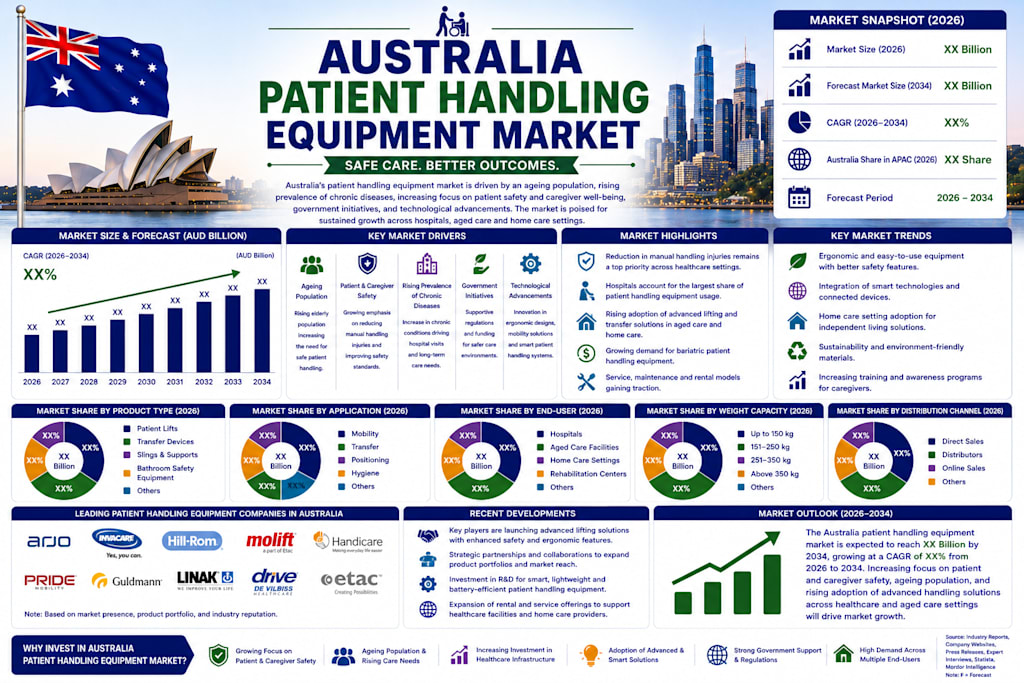
The Australia patient handling equipment market is witnessing consistent expansion as healthcare providers increasingly prioritize patient safety, caregiver ergonomics, and infrastructure modernization. According to IMARC Group, the market was valued at USD 263.87 Million in 2025 and is projected to reach USD 451.29 Million by 2034, growing at a CAGR of 6.14% from 2026–2034 . This steady upward trajectory reflects Australia’s broader healthcare transformation, driven by demographic pressures and sustained public investment in aged care and hospital infrastructure.
Patient handling equipment includes essential devices such as medical beds, hoists, transfer aids, wheelchairs, and lifting systems designed to support safe patient movement while reducing physical strain on healthcare workers. In Australia, the demand for these systems is increasingly tied to two structural forces: a rapidly aging population and a strong policy focus on improving safety standards in clinical and long-term care environments.
Request a Business Sample Report for Procurement & Investment Evaluation:
Why the Market Is Growing So Rapidly
A primary growth driver is Australia’s aging population, which is significantly increasing the need for mobility assistance and long-term care support. Older patients are more likely to experience mobility limitations, chronic conditions, and post-operative recovery challenges, all of which require patient handling solutions such as adjustable beds, lifts, and transfer systems. As the proportion of elderly citizens rises, healthcare facilities are expanding their procurement of specialized equipment to ensure safe and efficient care delivery.
Another major driver is the rising focus on caregiver safety and workplace injury prevention. Manual handling of patients has historically been a leading cause of workplace injuries in hospitals and aged care facilities. This has led to strong regulatory and institutional support for mechanized solutions such as powered lifts, slings, and ergonomic transfer systems. By reducing manual lifting requirements, healthcare organizations are improving staff safety while also increasing operational efficiency.
Government investment is also playing a crucial role. Australia has significantly increased funding for aged care reform and hospital infrastructure upgrades, enabling healthcare providers to modernize outdated facilities. These investments are accelerating the replacement cycle of traditional hospital furniture and encouraging adoption of advanced patient handling systems with integrated safety features.
Technological advancements are further shaping market growth. Modern patient handling equipment now incorporates features such as electronic positioning, pressure injury prevention systems, and smart monitoring capabilities. These innovations improve patient comfort while also enabling healthcare professionals to monitor risk factors in real time. As hospitals adopt digital healthcare ecosystems, patient handling equipment is increasingly becoming part of broader connected care infrastructure.
Finally, the expansion of home healthcare services is contributing to demand growth. With more patients receiving treatment outside hospitals, there is rising need for portable and easy-to-use patient handling solutions that support mobility at home. This shift is aligning with government initiatives aimed at reducing hospital burden and improving quality of life for elderly patients.
What the Opportunities Are
One of the most significant opportunities lies in aged care facility expansion and modernization. As Australia continues upgrading its elderly care infrastructure, there is strong demand for advanced beds, lifting systems, and transfer aids designed specifically for long-term care environments. Providers that can offer durable, user-friendly, and safety-certified solutions are well positioned to benefit from ongoing procurement cycles.
Another major opportunity is the growth of smart and connected patient handling systems. Equipment integrated with IoT sensors, fall detection systems, and automated alerts is gaining traction in hospitals focused on reducing patient risk and improving workflow efficiency. These smart systems also provide valuable operational data that can help healthcare administrators optimize staffing and resource allocation.
The hospital expansion and redevelopment pipeline presents another strong opportunity. New hospital projects and facility upgrades across Australia are generating large-scale demand for patient handling infrastructure. This includes everything from advanced ICU beds to ceiling-mounted lift systems, all of which are essential for modern clinical environments.
There is also a growing opportunity in home healthcare and community-based care solutions. As healthcare delivery shifts toward decentralized models, demand is rising for compact, easy-to-operate equipment suitable for non-hospital environments. This segment is particularly attractive for companies offering portable mobility aids and lightweight transfer systems.
In addition, public procurement programs and government tenders represent a stable and recurring revenue opportunity. With strong government involvement in healthcare spending, suppliers that align with regulatory standards and tender requirements can secure long-term contracts across public hospitals and aged care facilities.
Another key opportunity lies in training and integrated service offerings. Healthcare facilities are not only seeking equipment but also training programs for staff on safe patient handling practices. Companies offering bundled solutions—equipment plus training and maintenance—can create stronger customer relationships and improve retention rates.
Lastly, replacement demand for outdated hospital furniture is a continuous market driver. Many healthcare facilities still operate older manual systems, creating a steady upgrade cycle for modern, automated alternatives that enhance both patient comfort and caregiver safety.
Recent News & Developments in Australia Patient Handling Equipment Market
• February 2025: The Australian government expanded its aged care modernization funding, increasing support for hospital and residential facility upgrades aimed at improving patient safety standards. This initiative is directly encouraging procurement of advanced patient handling systems across public healthcare networks. Funding allocations are also prioritizing the reduction of caregiver injury rates through the adoption of mechanical lifting and transfer solutions. The policy shift reflects a broader national focus on safer and more efficient elderly care delivery.
• June 2025: Several major healthcare infrastructure projects across New South Wales and Victoria progressed into advanced construction phases, including new hospital wards and expanded intensive care units. These projects are integrating modern patient handling systems such as motorized beds and ceiling lift installations. The expansions are expected to significantly increase equipment demand in both acute and long-term care settings. Procurement contracts associated with these projects are driving strong market activity among medical device suppliers.
• September 2025: Australian healthcare providers reported increased adoption of ergonomic and automated patient transfer systems aimed at reducing workplace injuries among nursing staff. Hospitals have begun replacing manual lifting equipment with powered hoists and smart transfer devices. Early adoption data indicates measurable improvements in caregiver safety and workflow efficiency. This trend is expected to continue as hospitals align with stricter occupational health and safety standards.
Why Should You Know About Australia Patient Handling Equipment Market?
The Australia patient handling equipment market represents a critical intersection of healthcare safety, demographic change, and infrastructure modernization. As hospitals and aged care facilities evolve, patient handling solutions are becoming essential—not optional—components of healthcare delivery systems.
For investors, the market offers stable long-term growth supported by recurring replacement demand and government-backed healthcare spending. For manufacturers, it presents opportunities to innovate in smart mobility, ergonomic design, and integrated care technologies. For policymakers, it highlights an important lever for improving healthcare quality while reducing occupational injuries among frontline workers.
With consistent growth projected through 2034 and strong structural demand drivers, the market is positioned as a resilient and strategically important segment within Australia’s broader healthcare ecosystem.
About the Creator
Rashi Sharma
I am a market researcher.
Enjoyed the story? Support the Creator.
Subscribe for free to receive all their stories in your feed.
Comments
There are no comments for this story
Be the first to respond and start the conversation.