
Australia Paper Cups and Paper Plates Market Set for Sustainable Growth as Eco-Friendly Packaging Demand Accelerates
Rising environmental awareness, supportive government policies, and growing demand for sustainable food packaging are driving steady growth in Australia's paper cups and paper plates market.

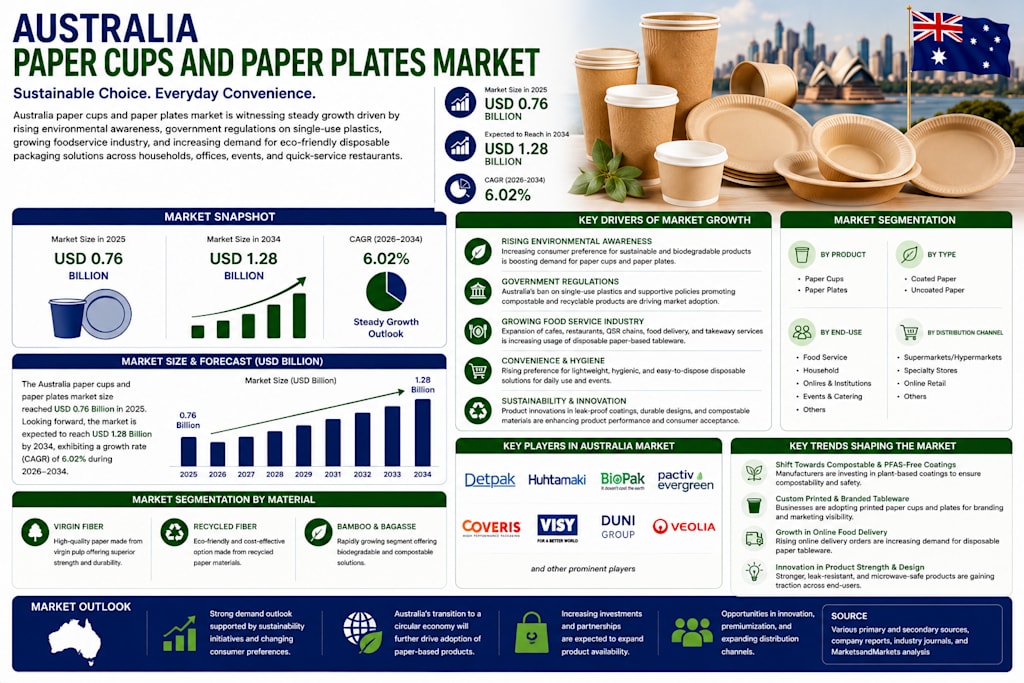
Australia's transition toward environmentally responsible packaging is creating new opportunities for manufacturers of disposable paper products. The Australia paper cups and paper plates market is benefiting from growing consumer awareness, expanding food delivery services, and increasing regulations aimed at reducing single-use plastics.
According to IMARC Group, the Australia paper cups and paper plates market was valued at USD 1.2 million in 2025 and is projected to reach USD 1.7 million by 2034, expanding at a compound annual growth rate (CAGR) of 4.16% during 2026–2034. The market's steady growth reflects Australia's broader commitment to sustainability, circular economy initiatives, and eco-friendly packaging innovations.
Paper cups and paper plates have become preferred alternatives across cafés, quick-service restaurants, catering businesses, educational institutions, and corporate events. As businesses seek packaging solutions that balance convenience with environmental responsibility, manufacturers continue introducing recyclable, biodegradable, and compostable products that meet both regulatory requirements and consumer expectations.
Evaluate Market Opportunity with the Business Sample Report:
Why the Market Is Growing So Rapidly
Australia's increasing focus on environmental sustainability remains one of the strongest drivers behind market expansion. Governments across multiple states continue implementing policies that discourage conventional plastic disposables, encouraging businesses to adopt paper-based alternatives. This regulatory shift has accelerated demand from restaurants, cafés, hospitality operators, and event organizers seeking compliant packaging solutions.
The country's thriving food service industry is another major contributor. Rapid growth in takeaway dining, online food delivery platforms, and coffee culture has significantly increased the consumption of disposable cups and plates. Independent cafés and large restaurant chains alike are investing in premium paper packaging that enhances customer experience while supporting sustainability goals.
Consumer preferences are also evolving rapidly. Australian shoppers are increasingly willing to support brands that demonstrate environmental responsibility. Businesses responding to these expectations are replacing plastic products with recyclable or compostable paper alternatives, strengthening long-term market demand.
Technological innovation is further supporting market growth. Manufacturers continue improving coating technologies, moisture resistance, durability, and printing capabilities, allowing paper cups and plates to perform effectively across hot beverages, cold drinks, and prepared meals. Enhanced product quality has expanded applications across hospitality, retail, healthcare, education, and commercial food services.
Growing corporate sustainability initiatives are also encouraging businesses to reduce their environmental footprint. Large organizations, educational campuses, airports, entertainment venues, and public institutions are increasingly incorporating eco-friendly disposable tableware into procurement strategies, creating additional opportunities for manufacturers.
What the Opportunities Are
1. Expansion of Sustainable Packaging Solutions
Manufacturers can capitalize on increasing demand for recyclable, biodegradable, and compostable paper products that help businesses comply with environmental regulations while enhancing brand reputation.
2. Growth in Food Delivery Services
Australia's expanding online food delivery ecosystem continues creating demand for durable paper cups and disposable tableware capable of maintaining food quality during transportation.
3. Premium Product Innovation
Businesses increasingly seek premium disposable products featuring superior insulation, leak resistance, attractive branding, and customized printing, creating higher-value market segments.
4. Commercial and Institutional Procurement
Hospitals, schools, universities, government offices, sporting venues, and corporate campuses are adopting environmentally responsible procurement policies, opening significant long-term supply opportunities.
5. Private Label Manufacturing
Retailers and supermarket chains continue expanding private-label sustainable packaging offerings, enabling manufacturers to build long-term supply partnerships.
6. Export Opportunities
Australian manufacturers focusing on certified sustainable paper products may find growing opportunities in neighboring Asia-Pacific markets where environmental regulations are becoming increasingly stringent.
7. Circular Economy Investments
Companies investing in recyclable materials, renewable raw materials, and innovative waste recovery systems can strengthen competitiveness as Australia's circular economy continues to evolve.
Recent News & Developments in Australia Paper Cups and Paper Plates Market
• February 2025: Australian governments continued expanding initiatives supporting the reduction of single-use plastic products across additional commercial sectors. Businesses in hospitality and food service increasingly transitioned toward recyclable and compostable paper alternatives to comply with evolving sustainability requirements. These regulatory efforts further encouraged investment in environmentally friendly disposable packaging solutions.
• June 2025: Several packaging manufacturers announced investments to expand production capacity for sustainable paper-based food service products. Companies introduced improved paper cups and plates featuring enhanced barrier coatings, better durability, and higher recyclability to address growing demand from cafés, restaurants, and institutional buyers. These developments strengthened domestic manufacturing capabilities while supporting Australia's sustainability objectives.
• September 2025: Australia's food service industry continued reporting strong adoption of sustainable disposable packaging as restaurants, coffee chains, and takeaway businesses accelerated their environmental commitments. Growing consumer preference for eco-friendly packaging encouraged wider deployment of paper cups and paper plates across both independent businesses and national chains. The positive market momentum reinforced confidence in long-term sector growth.
Why Should You Know About Australia Paper Cups and Paper Plates Market?
Australia's paper cups and paper plates market represents more than the growth of disposable food packaging—it reflects the country's broader transition toward a sustainable economy. As governments strengthen environmental regulations, businesses embrace circular economy principles, and consumers prioritize eco-conscious purchasing decisions, demand for paper-based alternatives is expected to remain resilient.
For manufacturers, the market offers opportunities to innovate with advanced materials, premium designs, and environmentally responsible production methods. Investors can benefit from steady long-term growth supported by regulatory changes and expanding food service demand, while policymakers can view the sector as an important contributor to national sustainability objectives.
With the market expected to grow from USD 1.2 million in 2025 to USD 1.7 million by 2034 at a CAGR of 4.16%, Australia's paper cups and paper plates industry is well positioned to support both economic growth and environmental responsibility in the years ahead.
About the Creator
Rashi Sharma
I am a market researcher.
Enjoyed the story? Support the Creator.
Subscribe for free to receive all their stories in your feed.
Comments
There are no comments for this story
Be the first to respond and start the conversation.