
Australia Overhead Cranes Market: Infrastructure Catalyst, Automation Shift & Safety-First Dynamics
How a $100.4bn national pipeline, mining's A$59.4bn tax contribution, and IoT enabled lifting solutions are driving a 6.35% CAGR toward a $203m market by 2034

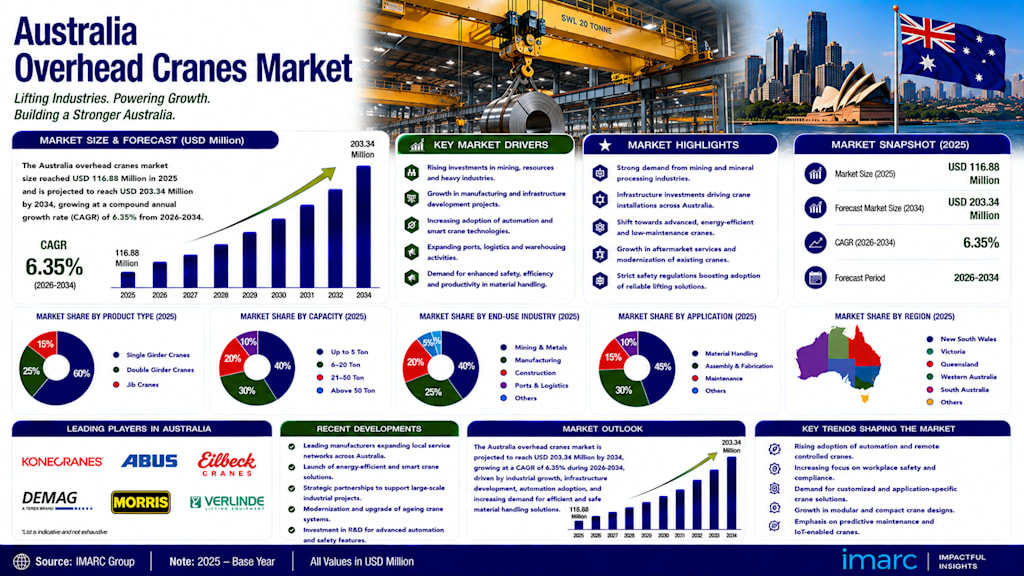
The Australia overhead cranes market is expanding steadily as core industries across the country prioritise efficient, safe and technologically advanced material handling solutions. Overhead cranes — encompassing bridge, gantry and jib configurations — are deployed across manufacturing floors, mining maintenance facilities, ports and warehouses to handle heavy loads, improve workflow productivity and support rigorous workplace safety standards. According to IMARC Group, the Australia overhead cranes market size reached USD 116.88 Million in 2025 and is projected to reach USD 203.34 Million by 2034, exhibiting a robust compound annual growth rate (CAGR) of 6.35% during 2026–2034. Development in infrastructure, mining, and manufacturing processes is increasing the pressure to have efficient lifting solutions, while rising investments in warehouse automation and sophisticated logistics networks further strengthen the market.
What's Driving Market Growth?
Unprecedented Government Infrastructure Pipeline. A cornerstone driver is the scale and ambition of public infrastructure spending. The 2025 26 Infrastructure Investment Program (IIP) stands at AUD 100.4 billion, including AUD 86.7 billion allocated to major projects. In 2025 26 alone, the Australian Government committed USD 15.2 billion to support state infrastructure projects. The 2026 27 Budget has announced over USD 8.6 billion for new and ongoing nationally significant projects, alongside a USD 4.25 billion infrastructure program for 2026 27, with USD 2.74 billion dedicated to transport, housing, energy and economic development projects. The Brisbane 2032 Olympic and Paralympic Games contribute a further USD 3.4 billion in dedicated infrastructure investment. These megaprojects — spanning bridges, highways, tunnels, ports and freight hubs — rely heavily on high-capacity overhead cranes for lifting massive prefabricated components and structural steel elements.
Mining Sector: The Heavy Lifting Engine. Australia's mining industry remains a colossal demand centre for overhead crane systems, particularly in the critical 11 50 ton lifting capacity segment. The sector contributed approximately AUD 59.4 billion in tax and royalty revenues during fiscal year 2024, underscoring its scale and corresponding demand for medium capacity crane systems. Overhead cranes are essential for maintaining mineral processing machinery, assisting extraction workflows and managing large scale assets. The 2026 27 Federal Budget's USD 500 million commitment to mineral exploration, combined with sustained investment in lithium, copper and rare earth elements, continues to spur equipment needs across established and emerging mine sites. The federal government has also agreed to provide approximately USD 3.1 billion to support five projects under the Critical Minerals Facility, ensuring long term demand for heavy-duty lifting systems in mining environments.
Warehouse Automation and E Commerce Logistics Growth. The transformation of Australia's logistics and warehousing industry is driving sustained demand for automated overhead cranes. The warehousing and storage market is projected to expand from USD 18.40 billion in 2024 to USD 35.20 billion by 2033, exhibiting a 7.50% CAGR, with e commerce and retail capturing significant market share and pushing demand for advanced lifting solutions. Overhead cranes are increasingly integrated into automated and semi automated warehouses to manage inventory movement efficiently, reduce manual labour requirements and improve operational safety. Institutional investors are prioritising facilities with advanced automation and specialised operational capabilities as they seek scalable, high productivity infrastructure.
Advanced Manufacturing and Smart Industry 4.0 Adoption. The manufacturing sector holds the largest end use share at 23% in 2025, driven by ongoing industrial modernisation and the critical need for efficient material handling across production facilities. Increasing adoption of automation, robotics and digital manufacturing is driving demand for more sophisticated crane systems capable of integrating with modern production processes. In the broader context, total expenses for mining, manufacturing and construction are expected to increase by 20.7 per cent over the period 2025–26 to 2028–29, reflecting the government's increased support for these core industries. The construction machinery market, of which overhead cranes are a specialised segment, is seeing accelerated adoption of telematics, GPS tracking and IoT for real time equipment monitoring and predictive maintenance, with the broader market expected to reach USD 3.40 billion by 2030.
Market Segmentation & Key Insights
By Type, bridge cranes dominate with a 48% share in 2025, driven by their versatility in handling heavy loads across manufacturing floors, warehouses and industrial facilities requiring extensive horizontal coverage. Available in single or double girder configurations, they are extensively deployed across manufacturing plants, mining maintenance facilities, automotive workshops and steel processing plants.
By Lifting Capacity, the 11 50 ton segment leads with a 30% share in 2025, reflecting strong demand from mining operations, manufacturing facilities and infrastructure projects requiring medium to heavy lifting capabilities. This capacity range offers the optimal balance between lifting power and operational flexibility, making it suitable for diverse industrial applications.
By End Use, manufacturing holds the largest share at 23% in 2025, supported by ongoing industrial modernisation and increasing adoption of advanced technologies. Other key end use segments include construction, metal and mining, power and utilities, ports and shipyards, and automotive and transportation.
By Region, Australia Capital Territory & New South Wales leads, supported by expanding construction activity, modernisation of manufacturing facilities and government backed development projects. Western Australia's market is propelled by its strong mining, mineral processing and energy sectors.
What the Opportunities Are?
IoT Enabled Smart Crane Technologies and Predictive Maintenance. The shift toward Industry 4.0 is transforming crane operations. The Australia internet of things (IoT) market is projected to reach USD 92.6 billion by 2033, growing at a 13.15% CAGR. Manufacturers are increasingly embedding IoT connectivity, remote monitoring and real time performance analytics into overhead crane systems, enabling predictive maintenance, automatic load tracking and enhanced operator safety through built in alerts. In February 2025, family owned Towne Lifting & Testing joined forces with Australian smart lifting innovator Sole Digital to unveil the "Crane of the Future," a cutting edge digital crane solution aimed at enhancing safety and providing advanced operational insights. These intelligent solutions reduce downtime, improve operational efficiency and align with broader Industry 4.0 adoption across manufacturing, logistics and mining sectors.
Standardised and FEM Compliant Equipment. Manufacturing and industrial facilities are increasingly adopting overhead cranes built to FEM (Federation Europeenne de la Manutention) standards, driven by a broader emphasis on precision, safety and operational efficiency. These systems are chosen not only for load handling capabilities but also for their role in streamlining workflows and minimising manual labour, positioning FEM compliant solutions as a key growth segment.
Large Capacity Heavy Lift Systems for Infrastructure Megaprojects. Australia is witnessing increased deployment of large capacity overhead cranes in civil and transport construction projects. In December 2024, one of South Australia's largest overhead cranes was deployed to install 12 super T beams at the Aldinga Interchange as part of the Main South Road duplication project, marking heightened reliance on heavy lift equipment in major infrastructure works. As the national infrastructure pipeline expands, including the 68 infrastructure proposals identified by Infrastructure Australia's 2026 Priority List (covering transport, freight, water and energy), demand for high capacity systems capable of precise heavy lifting will accelerate.
Automated Solutions for Regional and Remote Operations. The persistent shortage of skilled crane operators, particularly in regional and remote areas where industrial activity is expanding, is driving demand for automated and remote controlled overhead crane solutions. Labour shortages in the logistics sector are straining crane operations and impacting daily productivity, prompting companies and industry bodies to focus heavily on skills development while also accelerating the adoption of less labour intensive automated systems. Providers offering autonomous or semi autonomous overhead cranes with remote diagnostics and simplified user interfaces will capture market share in these underserved regions.
Lifecycle Services, Retrofitting and Modernisation. Beyond new equipment sales, a significant opportunity lies in lifecycle services. Major players are increasingly emphasising retrofitting, modernisation and predictive maintenance solutions to generate recurring revenue and strengthen customer relationships. As existing crane fleets age across mining, manufacturing and logistics facilities, the demand for control system upgrades, safety retrofits and IoT sensor installations will create a steady service stream. This is particularly relevant given the high initial investment costs and extended ROI cycles that can slow new equipment adoption, making cost effective modernisation packages an attractive alternative for small and medium sized enterprises.
Port and Shipyard Modernisation. Australia's ports and shipyards are undergoing significant capacity upgrades to handle increasing freight volumes and larger vessels. In Queensland, strong logistics and port development support additional demand for high capacity lifting systems. The Ports Capacity and Connectivity priority within Infrastructure Australia's 2026 list signals a clear procurement pipeline for overhead crane and gantry systems at major maritime hubs. As ports modernise to accommodate larger ships and faster cargo turnaround, the need for efficient, high volume overhead lifting solutions becomes critical.
Recent News and Developments in Australia Overhead Cranes Market
February 2025: Family owned Towne Lifting & Testing celebrated its 80th anniversary with the launch of a cutting edge digital crane solution in partnership with Australian smart lifting innovator Sole Digital, unveiling the "Crane of the Future" to enhance safety and provide advanced operational insights.
August 2025: Modular Cranes completed delivery of three overhead cranes to Queensland's Fraser Coast region for a new government manufacturing facility, featuring advanced capabilities including crane to crane synchronisation and LED lighting.
May 2026: The federal government announced a $500 million Budget boost for exploration to help mineral exploration companies secure faster and more efficient project assessments, indirectly supporting ongoing demand for overhead crane systems in mining operations.
May 2026: The 2026 27 Budget confirmed over $8.6 billion for new and ongoing nationally significant projects**, alongside **$12.1 billion in new infrastructure investments including $10.3 billion for transport infrastructure projects, $976 million for transport and $803 million for community infrastructure.
December 2024: One of South Australia's largest overhead cranes was deployed to install 12 super T beams at the Aldinga Interchange as part of the Main South Road duplication project, marking a significant milestone in the use of heavy lift equipment for major infrastructure works.
2026: Infrastructure Australia launched its new 2026 Infrastructure Priority List, identifying 68 priority proposals across transport, freight, water and energy systems that will create sustained demand for material handling and lifting equipment over the next decade.
Why Should You Know About Australia Overhead Cranes Market?
You should know about this market because it captures how massive public infrastructure pipelines, resource sector resilience and industrial automation intersect to create sustained, multi year demand for sophisticated material handling equipment. Overhead cranes are no longer simple load moving devices — they are IoT enabled, FEM compliant, predictive maintenance ready assets that directly impact project timelines, worker safety and operational margins.
For investors, the overhead cranes market offers exposure to a stable growth industrial equipment category anchored in Australia's $100.4 billion IIP**, the **$500 million exploration boost for mining, and the accelerating shift toward automated warehousing driven by a warehousing market projected to reach USD 35.20 billion by 2033. The projected CAGR of 6.35% reflects confident alignment with government backed capital works and broader industrial modernisation, while higher growth sub segments — including IoT enabled smart cranes, FEM compliant systems, automated regional solutions and lifecycle retrofitting — offer differentiated upside.
For procurement specialists, industrial engineers and infrastructure investors, understanding segmentation across bridge and gantry configurations, the 11 50 ton capacity dominance, and the emerging role of predictive maintenance technologies helps shape resilient supply chain and capital allocation strategies. In essence, the Australia overhead cranes market captures how heavy engineering, digital intelligence and policy driven construction converge — making it a compelling area for investors, technology partners and industrial strategists seeking smarter approaches to materials handling, workforce safety and long term infrastructure performance.
About the Creator
Thomas
Market Research Analyst | Industry Trends & Forecasting | Turning market data into clear, actionable business insights across global sectors.
Enjoyed the story? Support the Creator.
Subscribe for free to receive all their stories in your feed.
Comments
There are no comments for this story
Be the first to respond and start the conversation.