
Australia Organic Packaged Foods Market: Clean Label Surge, Native Ingredient Innovation & Green Consumerism
How rising health consciousness, regulatory reforms and indigenous botanicals are driving a USD 7.2 billion organic packaged food revolution by 2034

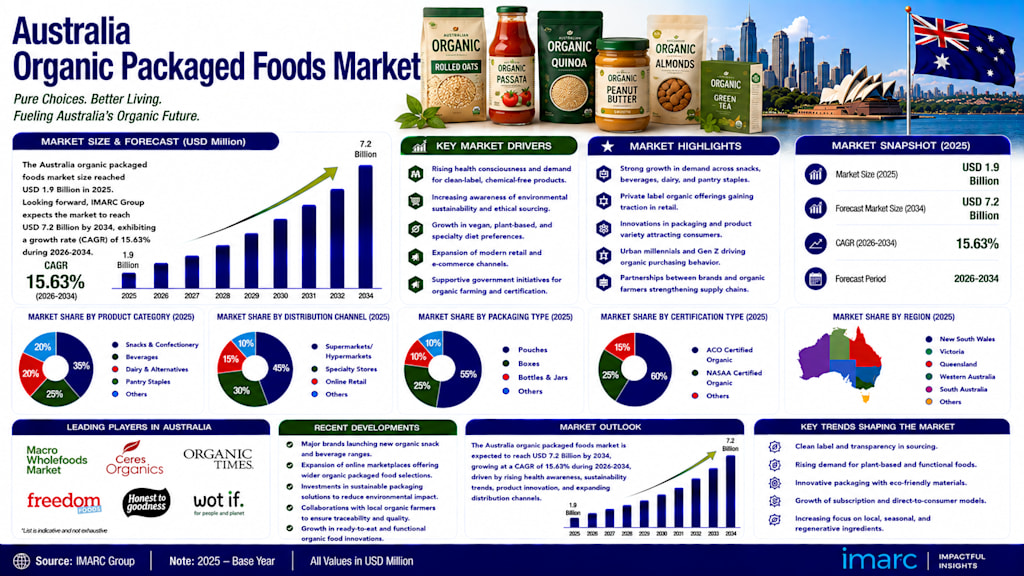
The Australia organic packaged foods market is undergoing a rapid and profound transformation as health-conscious consumers, retail giants and ingredient innovators increasingly prioritise clean label integrity, native botanical functionality and verifiable environmental credentials. Organic packaged foods — spanning bakery and confectionery products, ready-to-eat cereals, dairy products, snacks and nutrition bars, sauces, dressings and condiments — are deployed across supermarket aisles, specialty health food stores and rapidly expanding e commerce channels to serve a sophisticated consumer base seeking minimally processed, additive free and ethically sourced convenience options. According to IMARC Group, the Australia organic packaged foods market size reached USD 1.9 Billion in 2025 and is projected to reach USD 7.2 Billion by 2034, exhibiting a stellar compound annual growth rate (CAGR) of 15.63% during 2026–2034. As the draft National Organic Standard moves toward legal enforcement and consumer trust in certification logos grows by 18% since 2019, organic packaged foods have become a strategic asset for brand differentiation and long term market relevance.
What's Driving Market Growth?
Clean Label Imperative & Transparent Ingredient Sourcing. The single most powerful driver is the escalating demand for clean label products with simple, transparent ingredient lists free from artificial additives, preservatives and GMOs. Consumers increasingly read labels, scrutinise certification claims and reject products with unrecognisable chemical names. In January 2025, pressure mounted for overhauling organic labelling legislation in Australia, with a draft national legal standard proposed to control organic claims and prevent deceptive packaging. The Australian organic food market is seeing supermarkets expand their variety of organic offerings across packaged goods categories, partnering with new startups to offer discounted products and increase consumer accessibility. Transparency and trust are now the most important drivers for purchase, with consumers demanding rigorous adherence to organic standards and ethical production practices.
Consumer Health Consciousness and Sustainable Consumption. Australians are increasingly turning to organic packaged foods as part of broader wellness lifestyles, with the organic packaged food and beverages market expanding rapidly as consumers prioritise natural, non-GMO and eco friendly goods. According to the Australian Organic Market Report 2023, 60% of shoppers prefer products that are chemical free, and 48% want them to be environmentally friendly. Those most likely to purchase organic goods are aged 18 39 years, earning over $40,000 annually, with tertiary education and at least one child, representing a demographic segment with both willingness and capacity to pay premium prices for certified products. Plant based products, sustainable packaging innovations and tailored offerings for children and pregnant women are key emerging trends shaping product development.
Indigenous Australian Ingredients as Functional Differentiators. One of the most distinctive emerging trends is the integration of native Australian botanicals such as wattleseed, finger lime and kakadu plum into organic packaged foods. These ingredients deliver high antioxidant content and essential nutrients while representing Australia's unique biodiversity. The use of indigenous ingredients appeals to consumers seeking authentic, locally produced foods with nutritional value and unique flavour profiles, supports local agriculture by encouraging native crops with lower environmental footprints, and parallels larger trends of innovation and cultural heritage appreciation. This marriage of ancient knowledge with contemporary food technology differentiates organic packaged food in a competitive marketplace.
Distribution Channel Expansion: Offline Dominance and Online Acceleration. Distribution networks are one of the key drivers of market growth, with enhanced accessibility fuelling increased trial and repeat usage. The offline segment, including supermarkets and specialty health food stores, remains the highest contributor but online channels are the fastest growing. Consumers increasingly desire convenient access to organic foods through online shopping, with subscription services and home delivery improving the shopping experience, mirroring changing customer behaviour driven by hectic lifestyles and a need for wider product ranges. The multiplication of retail venues allows organic packaged foods to penetrate a more extensive demographic base, including regional and remote consumers.
Market Segmentation & Key Insights
By Product, the market is segmented into Bakery and Confectionary Products, R.T.E. Cereals, Dairy Products, Snacks and Nutrition Bars, Sauces, Dressings and Condiments, and Others. Snacks and nutrition bars are among the fastest growing segments, driven by the demand for high protein, low sugar options made from Australian organic, grass fed beef and free range pork, as showcased at the Naturally Good Expo 2025.
By Distribution Channel, the market is bifurcated into Online and Offline. Offline channels — including supermarkets, hypermarkets and specialty health food stores — currently lead in volume, but online is the fastest growing segment, driven by subscription models and home delivery services.
By Region, major markets include Australia Capital Territory & New South Wales, Victoria & Tasmania, Queensland, Northern Territory & Southern Australia, and Western Australia. New South Wales contributes the most to the organic sector in monetary value, while Victoria leads in terms of jobs created.
What the Opportunities Are?
National Organic Standard Compliance and Certification Services. With the federal government responding to recommendations for the National Organic Standard Bill 2024, a framework for regulating the sale and importation of organic goods in Australia is advancing, offering stronger export opportunities. However, there is significant confusion among consumers: 33% of organic consumers purchased a product believing it was organic only to learn later it wasn't, and 31% believe that trust in organic status is a barrier to purchasing. This creates a compliance driven opportunity for certification advisory services, auditing firms and label verification platforms that help both domestic producers and importers navigate the emerging legal framework. Certification logos have seen an 18% increase in recognition since 2019, but fraudulent and ambiguous claims remain widespread.
Premium Organic Product Lines and Direct to Consumer E commerce. The organic packaged foods market offers wide ranging investment opportunities, from launching premium organic product lines and meal kits to acquiring or scaling small organic brands. Investors can also explore e commerce platforms focused exclusively on organic goods, as well as logistics solutions optimised for temperature sensitive, eco conscious packaging. Direct to consumer subscription models that deliver curated organic snack boxes, meal kits and pantry staples to urban professionals and families represent a scalable, high margin growth avenue.
Indigenous Ingredient Sourcing and Value Added Product Development. The integration of native Australian ingredients such as kakadu plum, finger lime and wattleseed into organic packaged foods remains underdeveloped relative to its potential. Brands that develop proprietary formulations featuring these botanicals — in snack bars, beverages, condiments and bakery goods — can capture consumer demand for functional health benefits while supporting regenerative agriculture and Indigenous enterprise partnerships. This trend aligns with both wellness and sustainability pillars, creating authentic brand narratives that competitors lacking local provenance cannot replicate.
Sustainable Packaging Innovation and Circular Design. As Australian consumers become more environmentally conscious, packaging is emerging as a purchase differentiating factor. The sustainable packaging segment is expected to reach USD 2.12 billion by 2034, growing at a 6.50% CAGR. Organic packaged food brands that adopt compostable films, recyclable mono materials and post consumer recycled content will appeal to eco conscious buyers willing to pay premiums for reduced environmental impact. The federal government's response to the Organic Standard Bill also opens stronger opportunities for exporting organic products, requiring packaging compliance with multiple international standards.
Plant Based and Functional Organic Formulations. The growing popularity of plant based diets is driving innovation in organic packaged foods. Dairy alternatives, plant based protein snacks and fortified cereals represent high growth sub segments. In May 2025, Veganz Germany joined hands with Jindilli Beverages to launch 2D printed Mililk® plant milk in Australia under Milkadamia, representing a landmark innovation offering sustainable, shelf stable dairy alternatives in response to rising demand for environmentally conscious organic offerings. Brands that develop organic, plant based convenience foods with added functional benefits — probiotics, prebiotics, high protein — will capture the premium wellness segment.
Recent News and Developments in Australia Organic Packaged Foods Market
April 2026: The federal government formally responded to recommendations made for the National Organic Standard Bill 2024, offering a framework for regulating the sale and importation of organic goods in Australia and stronger opportunities for exporting organic products.
May 2025: Veganz Germany partnered with Jindilli Beverages to launch 2D printed Mililk® plant milk in Australia under the Milkadamia brand, offering sustainable, shelf stable dairy alternatives and representing a landmark innovation in the organic packaged foods market.
May 2025: The Naturally Good Expo 2025 in Sydney showcased health oriented packaged food innovators including KOOEE! Snacks (high protein, low sugar Australian organic meat snacks), Fun Day Sweets (all natural confectionery), Barbell Foods (minimally processed meat snacks) and Fodbods (FODMAP friendly, gut friendly snack bars).
May 2025: A study in Nature Food examined green labelling practices in Australia, finding that nearly 4 in 10 packaged food products on supermarket shelves carry sustainability claims, but many of those claims are vague, unverified and potentially misleading, underscoring the need for stronger regulatory enforcement.
July 2025: A major organic certifier collapsed, leaving around 400 Australian businesses scrambling to be recertified by September 26 to continue exporting their products, highlighting the vulnerability of the certification ecosystem.
Why Should You Know About Australia Organic Packaged Foods Market?
You should know about this market because it captures how regulatory reform, consumer wellness values and botanical innovation intersect to create one of Australia's fastest growing consumer packaged goods categories. Organic packaged foods are no longer a niche sold only in specialty stores — they are mainstream offerings found in every major supermarket, demanded by a sophisticated demographic (18 39 years, tertiary educated, family households) that reads labels, verifies certification logos and rejects misleading claims. The shift toward clean label transparency, indigenous ingredients and sustainable packaging represents nothing less than a fundamental re engineering of how Australia produces, packages and markets convenience foods.
For investors, the organic packaged foods market offers exposure to a high growth consumer goods category anchored in an unavoidable demographic tailwind: 60% of shoppers prefer chemical free products, 48% prioritise environmental friendliness, and Australia is the world's leading organic farmland nation with 53 million certified hectares. The projected CAGR of 15.63% — dramatically outpacing the broader organic food market's 7.19% growth — reflects strong confidence in adoption trends, product innovation and the accelerating shift from conventional to organic packaged goods. The Australian organic industry is worth $2.6 billion, contributing $851 million to the economy and growing by over 15% each year, yet Australia's organic market still represents only 1% of the global organic market (USD 225 billion), leaving enormous headroom for expansion.
For food manufacturers, retail executives, ingredient suppliers and sustainability investors, understanding segmentation across product types, the economics of native ingredient sourcing, the compliance requirements of the emerging National Organic Standard, and the accelerating shift toward online distribution helps shape intelligent product development, procurement strategies and capital allocation that deliver measurable health, environmental and financial outcomes.
In essence, the Australia organic packaged foods market captures how ingredient transparency, functional botanicals and regulatory enforcement converge — making it a compelling area for innovators, investors and brand strategists seeking smarter approaches to clean label production, sustainable packaging and premium market positioning across one of the world's most health conscious and environmentally aware consumer populations.
About the Creator
Thomas
Market Research Analyst | Industry Trends & Forecasting | Turning market data into clear, actionable business insights across global sectors.
Enjoyed the story? Support the Creator.
Subscribe for free to receive all their stories in your feed.
Comments
There are no comments for this story
Be the first to respond and start the conversation.