
Australia Non Dairy Coffee Creamers Market 2026: Plant Based Shift, Barista Innovation & Clean Label Revolution
How rising lactose intolerance, café excellence and functional ingredients are reshaping Australia's morning coffee ritual

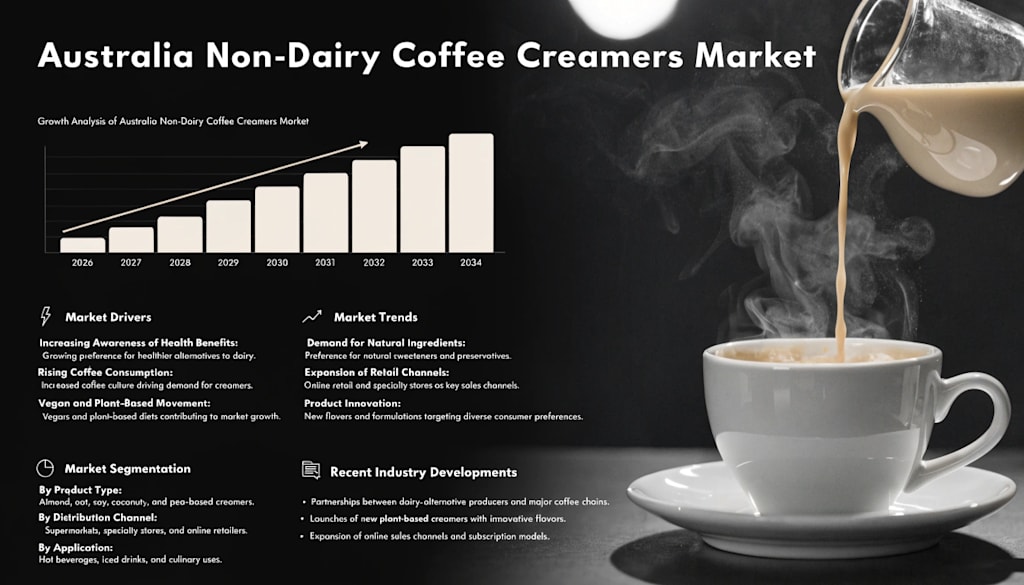
The Australia non dairy coffee creamers market is experiencing robust expansion as health conscious consumers, café professionals and home brewing enthusiasts increasingly prioritise plant based alternatives that deliver creaminess, flavour and functional benefits without dairy. Non dairy coffee creamers — including liquid and powder formats derived from oat, almond, soy, coconut and other plant sources — are deployed across cafés, households and commercial kitchens to enhance coffee texture, accommodate dietary restrictions and align with sustainable lifestyles. According to IMARC Group, the market size reached USD 78.5 Million in 2025 and is projected to reach USD 154.9 Million by 2034, exhibiting a compound annual growth rate (CAGR) of 7.85% during 2026–2034. As Australia's sophisticated coffee culture continues to evolve and consumers demand clean label, allergen friendly options, non dairy creamers have moved decisively from niche aisles to mainstream coffee counters.
What's Driving Market Growth?
Rising Lactose Intolerance and Dairy Allergies. A significant proportion of the Australian population experiences discomfort after consuming traditional dairy products, driving sustained demand for digestible, plant based alternatives. According to industry reports, approximately 25% of Australians were lactose intolerant in 2024, with women considerably more prone to this condition than men. Beyond lactose intolerance, broader dairy allergies affect segments of the population — with an estimated 11.8% of adults reportedly avoiding dairy due to adverse physiological effects like gastrointestinal discomfort — reinforcing the appeal of allergen friendly, inclusive options in Australia's evolving coffee culture.
Expanding Coffee Culture and At Home Brewing. Australia's world renowned coffee culture is a powerful catalyst for non dairy creamer adoption. In 2024, each Australian consumed 1.91 kilograms of coffee, with rising café trends, specialty brews and premium coffee experiences gaining popularity. As Australians become more experimental with coffee styles — lattes, flat whites and cold brews — demand for a variety of creamers that complement diverse flavour profiles continues to increase. The growth of home brewing culture, accelerated by pandemic era habits and sustained by online coffee trends and social media, further creates need for convenient, shelf stable and flavourful non dairy options.
Plant Based Lifestyles and Flexitarian Diets. More Australians are adopting flexitarian or fully plant based diets, driven not only by health considerations but also by increasing ethical and environmental consciousness. While exclusive consumption of plant based milk remains modest at 2.1% of shoppers, a growing group of 42.4% of Australians purchased both dairy milk and plant based alternatives in 2024–25, signalling that hybrid consumption is becoming the new normal. Plant based dairy alternatives continue their strong expansion, growing at 5.2% in 2025 — a faster rate than the overall dairy category at 3.6%.
E Commerce and Mainstream Retail Expansion. Online shopping has become deeply embedded in Australian consumer behaviour, with approximately 17.08 million Australians shopping online each month in 2024 — a 45% increase from 11.78 million in 2020. E commerce platforms offer wide assortments of plant based creamers, enabling consumers to compare brands, ingredients and prices easily, while supporting small and emerging brands in reaching broader audiences without traditional retail gatekeepers.
Market Segmentation & Key Insights
By Form, the market includes liquid and powder formats. Liquid non dairy creamers dominate the barista and café segment, prized for their superior steaming and frothing performance. For the broader coffee creamer market, powdered coffee creamer held the leading position among product types in 2025.
By Source, the market covers almond, coconut, soy, oat and others. Oat milk has emerged as the fastest growing alternative, winning over baristas for its ability to mimic dairy's performance, enable latte art and avoid splitting or curdling in hot coffee. The Alternative Dairy Co.'s range of barista milks — crafted exclusively for the café industry — are the preferred choice among baristas, reinforcing oat's ascendancy in professional coffee settings. Almond and coconut creamers remain popular, particularly for consumers seeking lower calorie options.
By Distribution Channel, major channels include supermarkets and hypermarkets, convenience stores, online stores and foodservice/café channels. Foodservice and café channels represent a critical segment, with barista grade formulations driving professional adoption and exposing consumers to plant based options in high quality coffee environments.
By Region, key markets include Australia Capital Territory & New South Wales, Victoria & Tasmania, Queensland, Northern Territory & South Australia, and Western Australia.
What the Opportunities Are?
Barista Grade Innovation and Performance Creamers. The single most significant opportunity lies in developing barista grade non dairy creamers that match or exceed dairy's steaming, frothing and flavour performance. Brands like The Alternative Dairy Co., MilkLab and Australian owned barista almond milk lines are setting benchmarks, but room remains for formulations that offer superior creaminess, neutral flavour profiles and heat stability. The Alternative Dairy Co. launched its 'Stay Fussy' campaign in 2025 with mobile café caravans touring Sydney and Melbourne, inviting latte lovers to sample barista quality oat milk in daily brews.
Functional and Nutrient Fortified Creamers. Manufacturers are increasingly investing in product development that incorporates functional ingredients such as MCT oil, vitamins and adaptogens into non dairy creamer formulations. Creamers that support cognitive function, energy metabolism or stress management offer premium price points and differentiation. Similarly, clean label, allergen free formulations with minimal additives and natural ingredients are attracting health focused consumers.
Flavour Innovation and Seasonal Offerings. The non dairy creamer category remains under indexed on flavour variety compared to the broader coffee creamer market. Manufacturers can capture consumer attention through seasonal offerings (pumpkin spice, gingerbread, limited edition fruit profiles) and permanent flavour extensions that complement specific coffee blends. Planet Oat's seasonal pumpkin spice coffee creamer and new gingerbread flavour for 2025 demonstrate the potential of flavour innovation to drive engagement.
E Commerce Direct to Consumer Subscription Models. With online shopping deeply entrenched, brands that establish direct to consumer subscription models for non dairy creamers can build recurring revenue streams, customer loyalty and valuable consumption data. Subscription services offering curated creamer bundles, automatic replenishment and exclusive flavour releases appeal to convenience seeking consumers.
Partnerships with Coffee Roasters and Café Chains. Strategic partnerships between non dairy creamer manufacturers and coffee roasters create embedded distribution channels. The Alternative Dairy Co.'s collaboration with baristas and its mobile activation programme demonstrates how sampling in real world coffee environments drives trial and repeat purchase.
Recent News and Developments in Australia Non Dairy Coffee Creamers Market
February 2026: The Alternative Dairy Co. launched a new Almond Milk Barista product, made from Australian almonds and free from animal ingredients — a plant based alternative suited to both professional cafés and home baristas, featuring barista style almond milk that steams and froths well for hot and iced coffee recipes.
February 2025: The Alternative Dairy Co. rolled out its 'Stay Fussy' café caravan campaign across high traffic locations in Sydney and Melbourne, offering latte lovers the chance to sample its plant based oat milk in a creamy, perfectly poured latte. Senior business leader Rachel Glasbergen stated: "The Stay Fussy campaign highlights how our range of plant based milks, crafted exclusively for the cafe industry, are the preferred choice amongst baristas".
2025: Euromonitor International reported that plant based dairy in Australia continued to outpace traditional dairy, growing at 5.2% compared with 3.6% in the overall dairy category. However, the category is maturing as consumers seek better nutrition, stronger functionality and more authentic flavour. "One third of Australians still don't consume plant based dairy because they perceive dairy as nutritionally superior," noted Julia Illera, research manager.
2025: GLNC's Plant Based Report 2025 revealed a 33% decline in overall plant based products since 2022, including a 22% reduction in plant based milk — highlighting that the non dairy coffee creamers category operates within a consolidating market where only the most innovative, high performing products survive.
September 2025: TechSci Research reported that the Australia Non Dairy Coffee Creamers market stood at USD 70.75 million in 2024, projected to reach USD 112.53 million by 2030 at a CAGR of 8.09%, driven by rising lactose intolerance, veganism and innovations in clean label, allergen free formulations.
Why Should You Know About Australia Non Dairy Coffee Creamers Market?
You should know about this market because it illustrates how health conscious consumer behaviour, world class coffee culture and product innovation intersect to create strong growth opportunities in a fast moving consumer segment. Non dairy coffee creamers are no longer just substitutes for the lactose intolerant — they are sophisticated, functional and performance optimised products that enhance Australia's cherished coffee ritual while aligning with broader dietary and environmental values.
For investors, the non dairy coffee creamers market offers exposure to a high growth consumer category anchored in the structural shift toward plant based consumption, sustained at home coffee preparation and ongoing product differentiation through functional ingredients. The projected CAGR of 7.85% reflects strong confidence in adoption trends, technology advancement and recurring consumption tied to Australia's deep coffee culture.
For food and beverage manufacturers, café operators, ingredient suppliers and retail planners, understanding non dairy creamer segmentation, barista grade performance metrics, clean label formulations and e commerce distribution strategies helps shape intelligent product development, channel partnerships and consumer engagement programmes that deliver measurable loyalty and premium pricing outcomes.
In essence, the Australia non dairy coffee creamers market captures how wellness consciousness, coffee craftsmanship and ingredient innovation converge — making it a compelling area for innovators, investors and organisations seeking smarter approaches to the world's second most traded commodity and Australia's favourite daily ritual.
About the Creator
Thomas
Market Research Analyst | Industry Trends & Forecasting | Turning market data into clear, actionable business insights across global sectors.
Enjoyed the story? Support the Creator.
Subscribe for free to receive all their stories in your feed.
Comments
There are no comments for this story
Be the first to respond and start the conversation.