
Australia Natural Gas Market 2026: LNG Expansion, Energy Transition & Export Demand Driving Growth
How rising energy demand, Asia-Pacific exports, and infrastructure investments are shaping the Australia natural gas industry

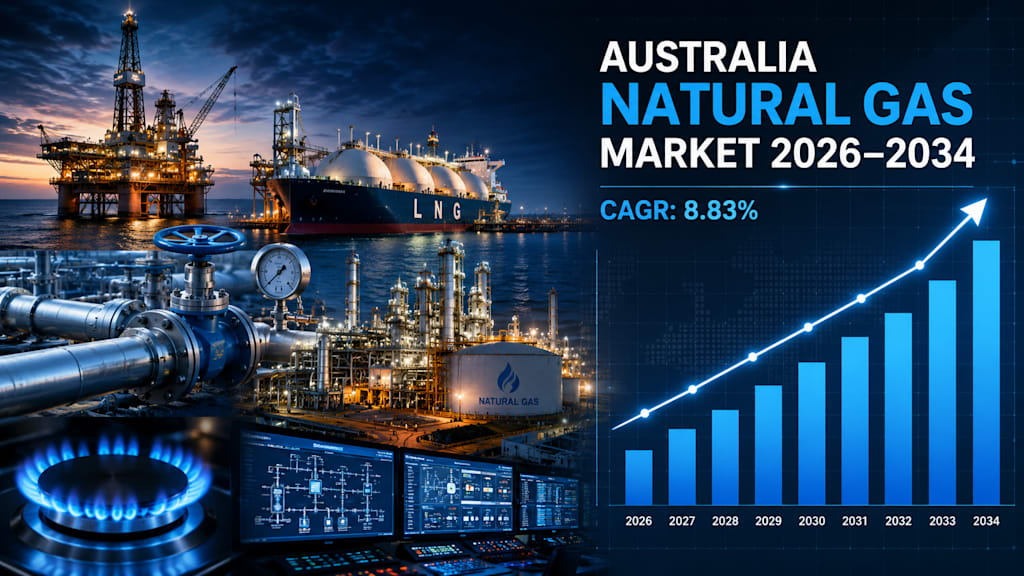
Australia Natural Gas Market Overview
The Australia natural gas market is a critical component of the country’s energy sector, supporting electricity generation, industrial operations, residential consumption, and large-scale exports through liquefied natural gas (LNG). Australia is one of the world’s leading LNG exporters, supplying key markets across the Asia-Pacific region.
According to IMARC Group, the Australia natural gas market size reached USD 34.46 Billion in 2025 and is projected to reach USD 73.82 Billion by 2034, exhibiting a compound annual growth rate (CAGR) of 8.83% during 2026–2034.
The market is experiencing strong growth driven by expanding domestic energy requirements, rising industrial consumption, and increasing demand from international markets transitioning toward cleaner fuel alternatives.
Key Market Drivers
Rising Demand for Cleaner Transitional Energy
Natural gas is increasingly viewed as a lower-emission alternative to coal, making it a key transitional fuel in Australia’s shift toward cleaner energy systems.
Strong LNG Export Demand
Australia’s proximity to major Asian economies such as Japan, China, and South Korea supports long-term export contracts and sustained demand for LNG.
Expanding Industrial and Power Generation Use
Industries including manufacturing, chemicals, and fertilizers rely heavily on natural gas for consistent energy supply, while gas-fired power plants help stabilize renewable energy fluctuations.
Infrastructure Development and Pipeline Expansion
Investments in pipelines, storage facilities, and LNG terminals are enhancing supply reliability and supporting both domestic and export demand.
Government Policies Supporting Energy Security
Federal and state initiatives are promoting gas exploration, infrastructure development, and domestic supply stability, strengthening market growth.
Request a Sample Report with the Latest 2026 Data & Forecasts
What the Opportunities Are
Expansion of LNG Export Capacity
Ongoing development of LNG projects and export terminals is creating opportunities for increased global market share.
Technological Advancements in Exploration and Extraction
Innovations such as advanced drilling techniques, digital reservoir modeling, and AI-based monitoring are improving efficiency and reducing costs.
Integration with Renewable Energy Systems
Natural gas is increasingly used to complement renewable energy by providing backup power and grid stability.
Growth in Asia-Pacific Energy Demand
Rapid industrialization and urbanization in Asia-Pacific countries are driving long-term demand for Australian natural gas exports.
Development of New Gas Fields
Exploration and expansion of offshore and onshore reserves are unlocking additional supply potential.
Recent News and Industry Developments
May 2026: The Australia natural gas market is experiencing supply pressures and price volatility due to rising domestic demand and export commitments. Wholesale gas prices in eastern Australia have remained elevated, with prices hovering around AUD 12–14 per gigajoule, significantly higher than historical averages. This has increased energy costs for industries and households, driving policy discussions around supply security.
April 2026: Liquefied natural gas (LNG) exports continue to play a dominant role in the market, with Australia remaining one of the world’s largest LNG exporters. The country exported approximately 80 million tonnes of LNG in 2025, with major export destinations including Japan, China, and South Korea. Strong export demand continues to influence domestic gas availability and pricing dynamics.
March 2026: Domestic gas supply concerns have intensified, particularly on the east coast, where shortfalls are being highlighted by regulators. Reports indicate potential seasonal supply gaps, prompting discussions on policy interventions such as gas reservation mechanisms to ensure sufficient domestic supply.
February 2026: Industrial demand for natural gas remains strong, particularly from manufacturing and mining sectors. Gas consumption in the industrial sector accounts for a significant share of total demand, as it is widely used for power generation, processing, and heating applications across heavy industries.
2025–2026 (market trend): The market is being shaped by the transition toward cleaner energy, with natural gas positioned as a bridge fuel supporting renewable integration. However, challenges such as supply constraints, infrastructure bottlenecks, and global price fluctuations continue to influence market stability and investment decisions.
Why You Should Know About the Australia Natural Gas Market
The Australia natural gas market is a fast-growing and strategically important sector supporting both domestic energy needs and global energy supply.
With projected growth from USD 34.46 Billion in 2025 to USD 73.82 Billion by 2034, the market demonstrates strong expansion driven by LNG exports, infrastructure investments, and increasing demand for cleaner energy sources.
As the global energy landscape evolves, Australia’s natural gas industry is expected to remain a key player in ensuring energy security and supporting the transition toward a lower-carbon future.
About the Creator
Amyra Singh
Market research analyst who loves spotting patterns, digging into data, and turning insights into strategies that help brands grow and stay ahead of the curve.
Enjoyed the story? Support the Creator.
Subscribe for free to receive all their stories in your feed.
Comments
There are no comments for this story
Be the first to respond and start the conversation.