
Australia Mortgage Lending Market 2026: Policy Reform, Digital Lending & Refinancing Surge
How expanded home guarantee schemes, regulatory shifts and competitive investor dynamics are reshaping Australia's 2.4 trillion dollar residential lending landscape

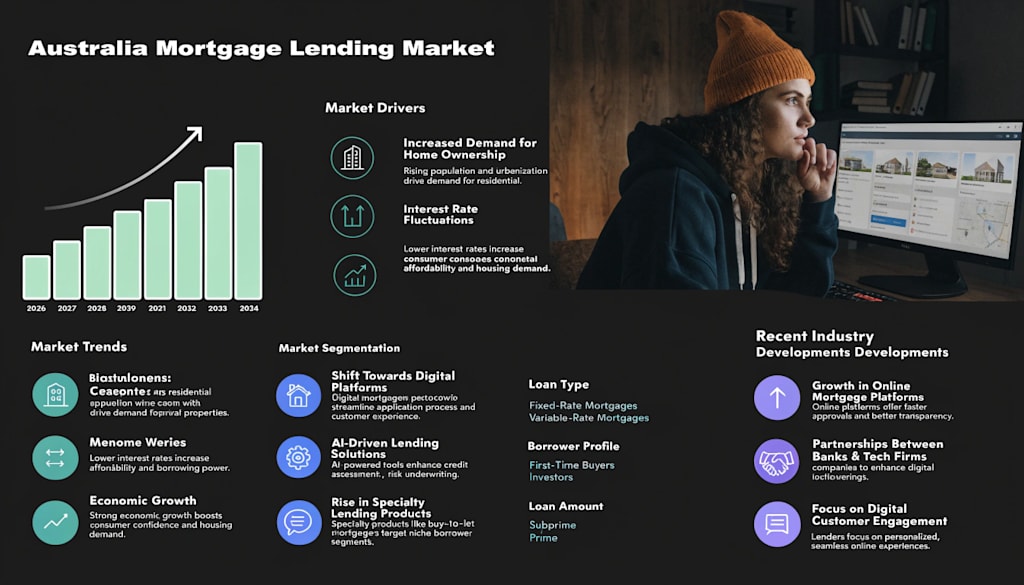
The Australia mortgage lending market is expanding steadily as home buyers, property investors, refinancers and financial institutions navigate a complex landscape of evolving policy settings, competitive lender dynamics and digital transformation. Mortgage lending — encompassing conventional loans, fixed and variable rate products, and refinancing — serves as the financial backbone of Australia's residential property sector, facilitating access to housing for owner-occupiers, first home buyers and investors. According to IMARC Group, the market size reached USD 32,525.03 Million in 2025 and is projected to reach USD 47,081.16 Million by 2034, exhibiting a compound annual growth rate (CAGR) of 4.20% during 2026–2034. As the broader Mortgages in Australia market industry is valued at $155.1 billion in 2026 (IBISWorld), the sector remains a cornerstone of the domestic financial economy.
What's Driving Market Growth?
Expanded Government Homeownership Schemes. The Home Guarantee Scheme has been a material driver of lending activity. From October 2025, the scheme has allowed all first-home buyers to purchase with a 5% deposit without paying lenders mortgage insurance, materially lowering entry barriers and broadening the addressable borrower base. This has intensified competition at the more affordable end of the market, with more young people seizing the opportunity to break the rent cycle and lock in their first home sooner.
Resilient Investor Demand Outpacing Owner-Occupiers. Investor lending is forecast to outpace owner-occupier activity in 2026 despite rate pressures and tax uncertainty. Money.com.au forecasts total home lending to grow around 7% in 2026 to 594,279 loans, with investor loans tipped to rise 13% to roughly 246,600, while owner-occupier growth is expected to slow to about 3%. In New South Wales, investor lending is projected to climb 16% to 77,470 loans, while Victoria continues to close the gap, with investor lending up 21% over the past year.
Refinancing Surge Amid Rising Rates. Borrowers are responding to successive rate rises by seeking more competitive products. The value of refinancing submissions processed through broker networks increased 18.7% year on year in the March 2026 quarter, with Victoria and Tasmania recording a year on year increase of more than 28% in refinance submissions. Refinancing accounted for 34% of total mortgage demand in February 2026, and more than 640,000 home loans were renegotiated or switched in 2025.
AI Driven Lending Transformation. Australian lenders are rapidly embracing digital mortgage solutions to enhance customer experience and operational efficiency. The federal government is also recruiting AI to speed up housing approvals, with a $105.9 million commitment over four years to develop an AI tool that guides proponents and shares environmental data to get more projects approved. Meanwhile, APRA's new rules from February 2026 cap high debt to income loans (six or above) at 20% of new lending.
Market Segmentation & Key Insights
By Type of Mortgage Loan, conventional mortgage loans dominate the market with a share of 62.9% in 2025, owing to their widespread accessibility and competitive interest rate structures backed by established financial institutions. By Mortgage Loan Terms, the 30 year mortgage leads with a share of 57.6% in 2025, driven by lower monthly repayment obligations that enhance affordability for households. By Lender, primary mortgage lenders comprise the largest segment with a market share of 71.2% in 2025, reflecting the entrenched dominance of authorised deposit-taking institutions. By Interest Rate, fixed rate mortgage loans exhibit a clear dominance with 64.5% share in 2025, driven by borrower demand for payment certainty amid monetary policy fluctuations. By Region, Australia Capital Territory & New South Wales represents the largest region with 39.8% share in 2025, driven by Sydney's concentration of financial services, high property values, robust population growth and strong investor lending activity.
What the Opportunities Are?
Refinancing Solutions and Retention Strategies. With refinancing accounting for a significant portion of mortgage demand, lenders that offer competitive refinancing packages, streamlined switching processes and attractive retention offers capture valuable market share. The trend of refinance upgrades with the same lender up 15.2% year on year suggests that institutions investing in customer retention programmes can secure loyalty in a volatile rate environment.
Digital End to End Mortgage Platforms. Key players are driving the market by expanding digital platforms, diversifying product portfolios and strengthening broker partnerships to enhance customer acquisition and improve lending efficiency. Australian lenders that invest in fully digital origination, automated credit assessment and real time approval workflows will gain operational advantages and improved customer satisfaction.
First Home Buyer and Affordable Housing Finance. With expanded government schemes lowering deposit barriers, products tailored specifically to first home buyer constraints — including lower deposit requirements, flexible servicing tests and targeted rate discounts — present significant growth opportunities. The Federal Budget's $2 billion over four years for critical enabling infrastructure, supporting up to 65,000 new homes, complements this segment.
Specialised Investor Products and Portfolio Lending. As investor demand continues to outpace owner occupier growth, lenders that develop sophisticated investor focused products — including interest only options, portfolio lending facilities and tax aware structuring — will capture the growing investor segment. However, the one year reprieve on negative gearing and CGT reforms set for the Federal Budget introduces near term uncertainty that specialised products can help navigate.
Mutual and Non Bank Lender Expansion. The mutual bank and credit union sector has more than tripled its combined mortgage book in seven years, amassing 150.9billioninresidentiallending∗∗andnearlydoublingitsmarketsharefrom3.2150.9billioninresidentiallending∗∗andnearlydoublingitsmarketsharefrom3.227.3 billion in new mortgage balances — growth of 22% in a single year, compared to 6.9% for the market as a whole. Non bank lenders are also winning switchers, recording a 44% jump in external refinancing customers.
Recent News and Developments in Australia Mortgage Lending Market
April 2026: Money.com.au forecast total home lending to grow around 7% in 2026 to 594,279 loans, with investor lending tipped to rise 13% while owner-occupier growth slows to about 3%.
April 2026: The value of refinancing submissions processed through Mortgage Choice increased 18.7% year on year in the March 2026 quarter, as borrowers responded to successive rate rises by seeking more competitive rates.
March 2026: Reserve Bank of Australia lifted the cash rate to 4.10% in a narrow 5 4 vote, the second consecutive hike of 2026, with further rises anticipated.
February 2026: APRA's new rules took effect capping high debt to income loans (DTI of six or above) at 20% of new residential lending to constrain higher risk borrowing.
February 2026: The mutual bank and credit union sector's combined mortgage book reached 150.9billion,upfrom150.9billion,upfrom54.3 billion in March 2019, nearly tripling in seven years and nearly doubling market share to 6.1%.
October 2025: The expanded Home Guarantee Scheme allowed all first home buyers to purchase with a 5% deposit without paying lenders mortgage insurance, materially broadening the addressable borrower base.
Why Should You Know About Australia Mortgage Lending Market?
You should know about this market because it captures how government policy intervention, borrower behaviour and technological innovation intersect to create a dynamic multi billion dollar lending ecosystem that underpins Australia's housing market. Mortgage lending is no longer just a commodity banking product — it is a sophisticated competitive arena where digital platforms, refinancing strategies and targeted investor products determine market share and profitability.
For investors, the mortgage lending market offers exposure to a stable growth financial category anchored in Australia's structurally undersupplied housing market, robust population growth and the nation's enduring preference for homeownership. The projected CAGR of 4.20% reflects steady baseline demand, while higher growth sub segments — including mutual lender expansion (22% annual growth), refinancing (18.7% increased submissions) and digital lending platforms — offer differentiated upside potential.
For lenders, brokers, fintech developers, regulators and property investors, understanding mortgage lending segmentation, rate sensitivity, policy reform trajectories and emerging lender dynamics helps shape intelligent investment decisions, product development, risk management frameworks and strategic partnerships that deliver measurable market share and borrower outcomes.
In essence, the Australia mortgage lending market captures how financial intermediation, housing policy and competitive lender strategy converge — making it a compelling area for investors, financial institutions and market participants seeking smarter approaches to residential financing, risk segmentation and customer acquisition in one of the world's most mature but resilient housing finance markets.
About the Creator
Thomas
Market Research Analyst | Industry Trends & Forecasting | Turning market data into clear, actionable business insights across global sectors.
Enjoyed the story? Support the Creator.
Subscribe for free to receive all their stories in your feed.
Comments
There are no comments for this story
Be the first to respond and start the conversation.