
Australia Modular Construction Market 2026: Prefabrication Innovation, Sustainable Building Practices & Faster Project Delivery Driving Growth
How off-site construction techniques, labor efficiency benefits, and increasing demand for sustainable infrastructure are transforming the Australia modular construction industry

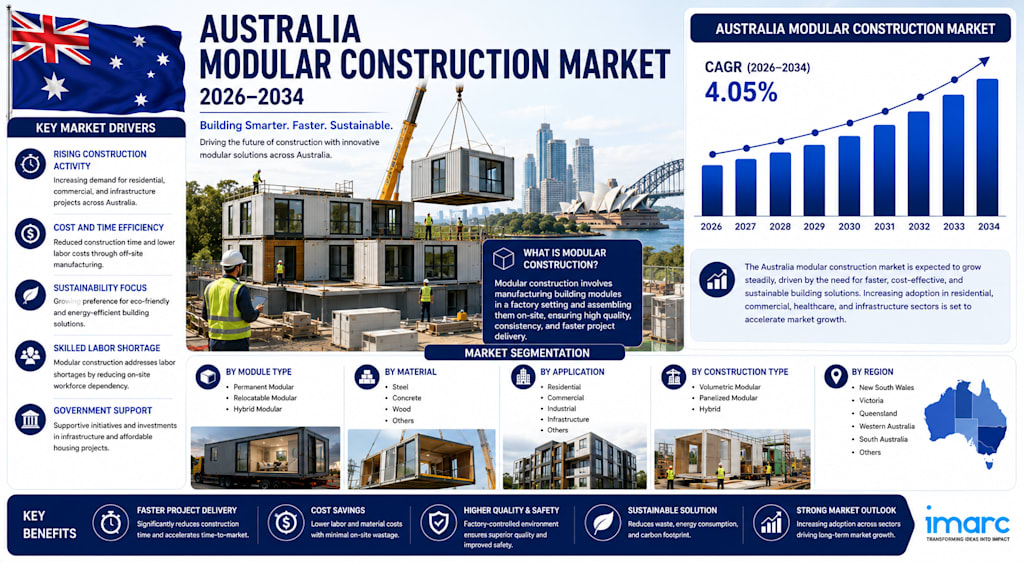
Australia Modular Construction Market Overview
The Australia modular construction market is a rapidly evolving segment of the country's construction industry, encompassing prefabricated buildings, volumetric modular units, panelized construction systems, modular housing, commercial structures, healthcare facilities, educational buildings, and industrial applications.
According to IMARC Group, the Australia modular construction market was valued at USD 11.8 Billion in 2025 and is expected to grow to USD 17.1 Billion by 2034 at a CAGR of 4.05% during the forecast period from 2026–2034.
The market is witnessing steady growth driven by increasing demand for cost-effective construction methods, labor shortages in the construction sector, rising emphasis on sustainability, technological advancements in prefabrication, and the need for faster project completion timelines.
Key Market Drivers
Rising Demand for Faster Construction Timelines
Modular construction significantly reduces project completion times by enabling simultaneous site preparation and off-site manufacturing, making it attractive for residential, commercial, and infrastructure projects.
Labor Shortages in the Construction Industry
Persistent labor constraints across Australia's construction sector are encouraging developers to adopt modular building techniques that require fewer on-site workers.
Growing Focus on Sustainable Construction
Modular construction minimizes material waste, improves resource efficiency, and supports environmentally sustainable building practices, aligning with national sustainability objectives.
Increasing Housing Demand
Australia's growing population and housing requirements are creating demand for innovative construction methods capable of delivering residential projects more efficiently.
Technological Advancements in Prefabrication
The adoption of digital design tools, Building Information Modeling (BIM), automation, and advanced manufacturing technologies is improving modular construction quality and scalability.
Request a Sample Report with the Latest 2026 Data & Forecasts
What the Opportunities Are
Expansion of Modular Housing Projects
Rising demand for affordable and rapidly deployable housing solutions presents significant opportunities for modular construction providers.
Growth in Healthcare and Education Infrastructure
Hospitals, clinics, schools, and educational facilities increasingly utilize modular structures to accelerate project delivery and reduce costs.
Development of Sustainable Building Solutions
The growing emphasis on green building certifications and low-carbon construction methods is creating opportunities for eco-friendly modular systems.
Adoption of Smart Construction Technologies
The integration of digital design platforms, automation, robotics, and data-driven project management solutions can improve productivity and competitiveness.
Expansion into Remote and Regional Areas
Modular construction offers an efficient solution for projects in remote locations where traditional construction methods face logistical challenges.
Recent News and Developments
June 2026: Modular construction companies across Australia continued expanding production capabilities to meet growing demand from residential, commercial, and public infrastructure projects.
May 2026: Developers increased investments in prefabricated building technologies aimed at reducing construction timelines and addressing labor shortages.
April 2026: Sustainable construction initiatives encouraged broader adoption of modular building systems due to their waste reduction and environmental performance benefits.
February 2026: Educational and healthcare infrastructure projects increasingly incorporated modular construction methods to accelerate project delivery and operational readiness.
January 2026: Industry participants strengthened investments in advanced manufacturing technologies, automation, and digital design solutions to improve modular construction efficiency.
December 2025: Growing demand for affordable housing and efficient construction practices continued supporting the expansion of modular building projects across Australia.
Why You Should Know About the Australia Modular Construction Market?
The Australia modular construction market is becoming an increasingly important pillar of the country's construction, housing, and infrastructure development sectors.
With projected growth from USD 11.8 Billion in 2025 to USD 17.1 Billion by 2034, at a CAGR of 4.05%, the market demonstrates strong long-term potential supported by rising housing demand, labor efficiency requirements, sustainability goals, and technological innovation.
As construction companies, developers, and infrastructure providers continue investing in prefabrication technologies, advanced manufacturing capabilities, and sustainable building solutions, the sector is expected to play a critical role in shaping the future of construction across Australia.
About the Creator
Amyra Singh
Market research analyst who loves spotting patterns, digging into data, and turning insights into strategies that help brands grow and stay ahead of the curve.
Enjoyed the story? Support the Creator.
Subscribe for free to receive all their stories in your feed.
Comments
There are no comments for this story
Be the first to respond and start the conversation.