
Australia Modified Starch Market Gains Momentum Amid Food Innovation and Sustainable Manufacturing
Growing demand from food processing, pharmaceuticals, and biodegradable packaging is accelerating market expansion across Australia.

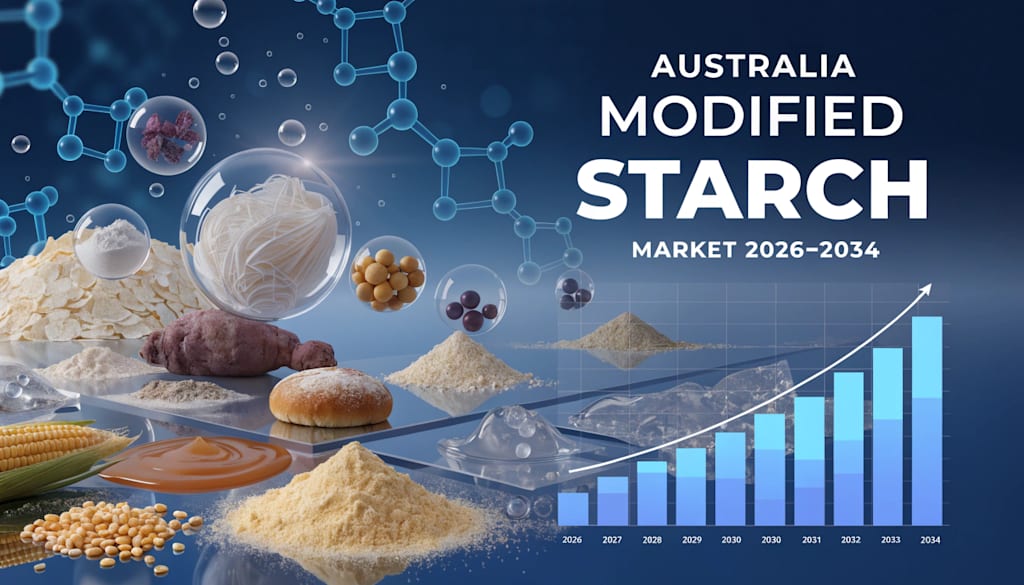
The Australia modified starch market is emerging as a critical enabler across food, industrial, and sustainability-driven sectors. According to IMARC Group, the market reached USD 320.4 million in 2025 and is projected to grow to USD 492.3 million by 2034, expanding at a CAGR of 4.64% during 2026–2034.
This steady growth reflects more than just incremental demand—it signals a structural shift in how industries are sourcing functional ingredients. Modified starch, once seen as a niche additive, is now central to product innovation, operational efficiency, and sustainability compliance across Australia’s evolving manufacturing ecosystem.
Request a Business Sample Report for Procurement & Investment Evaluation:
Why the Market Is Growing So Rapidly
One of the primary growth drivers is the increasing reliance on modified starch in the food and beverage industry. Manufacturers are seeking ingredients that enhance texture, stability, and shelf life while aligning with clean-label expectations. Modified starch delivers on all fronts, making it indispensable in processed foods, sauces, gluten-free products, and plant-based alternatives.
Another major factor is the rise of health-conscious and dietary-specific consumption patterns. Consumers are demanding reduced-sugar, gluten-free, and nutritionally balanced foods without compromising taste or structure. Modified starch plays a technical role in maintaining consistency and mouthfeel in these formulations, which is driving its adoption across premium and functional food categories.
Beyond food, the expansion into industrial applications is significantly accelerating market growth. Industries such as paper, textiles, pharmaceuticals, and construction are increasingly using modified starch for its binding, thickening, and film-forming capabilities. This diversification reduces dependency on a single sector and strengthens long-term demand stability.
Sustainability is another powerful catalyst. As industries shift toward eco-friendly materials, modified starch is gaining attention as a biodegradable alternative to synthetic additives. Its compatibility with ESG goals and regulatory frameworks makes it a preferred choice in packaging and green construction materials.
Finally, Australia’s localized production advantage is playing a key role. With access to raw materials such as maize, wheat, and tapioca, domestic producers benefit from supply chain efficiency and cost optimization. This proximity enables faster innovation cycles and supports customized starch solutions tailored to industry needs.
What the Opportunities Are
The market is not just growing—it is evolving, opening up several high-value opportunities for businesses and investors:
1. Clean-label product innovation
Companies can capitalize on the rising demand for natural, minimally processed ingredients by developing non-GMO and clean-label modified starch solutions tailored for premium food brands.
2. Plant-based and alternative protein segment
Modified starch is essential in plant-based formulations for texture and binding. As alternative proteins gain traction, this creates a strong demand pipeline.
3. Biodegradable packaging materials
With sustainability mandates increasing, starch-based biodegradable materials offer a scalable opportunity to replace plastic-based components in packaging.
4. Advanced food processing technologies
Innovations like enzymatic processing and nano-structuring of starch are enabling superior functionality, opening doors for high-margin specialty applications.
5. Industrial diversification
Expansion into pharmaceuticals, textiles, and construction ensures multiple revenue streams, reducing market volatility and enhancing resilience.
6. Export potential for specialized starch products
Australia’s ability to produce high-quality, customized starch solutions positions it as a competitive exporter in the Asia-Pacific region.
7. R&D-driven differentiation
Companies investing in research—such as improving gel strength, texture, and efficiency—can create proprietary products that command premium pricing.
Recent News & Developments in Australia Modified Starch Market
• March 2025: The Australian government introduced new sustainability guidelines encouraging the adoption of biodegradable materials in packaging and construction. These regulations incentivize the use of plant-based additives like modified starch, accelerating industry-wide adoption. The policy framework also includes funding support for bio-based material innovation, strengthening domestic production capabilities.
• July 2025: A leading food ingredient manufacturer announced the expansion of its modified starch production facility in Australia. The investment aims to increase output capacity and develop customized starch solutions for clean-label and plant-based food applications. This move reflects growing demand from both domestic and export markets.
• September 2025: The market recorded a notable increase in adoption across industrial sectors, particularly in eco-friendly packaging and pharmaceuticals. Industry reports highlighted a measurable rise in starch-based material usage as companies transition away from synthetic alternatives. This shift underscores the material’s growing importance in sustainability-focused manufacturing strategies.
Why Should You Know About Australia Modified Starch Market?
The Australia modified starch market represents a compelling intersection of food innovation, industrial utility, and sustainability transformation. It is not a high-volatility, speculative market—instead, it offers steady, reliable growth backed by real-world applications across multiple industries.
For investors, it provides exposure to a diversified demand base with strong long-term fundamentals. For businesses, it opens pathways to innovate in food technology, biodegradable materials, and advanced manufacturing inputs. For policymakers, it aligns perfectly with national sustainability goals and the transition toward bio-based economies.
In short, modified starch is no longer just an ingredient—it is becoming a strategic material shaping the future of how products are made, consumed, and sustained.
About the Creator
Rashi Sharma
I am a market researcher.
Enjoyed the story? Support the Creator.
Subscribe for free to receive all their stories in your feed.
Comments
There are no comments for this story
Be the first to respond and start the conversation.