
Australia Millets Market 2026: Ancient Grain Revival, Gluten Free Surge & Climate Smart Farming
How digestive wellness trends, export diversification and research backed value added processing are driving millet adoption across Australia

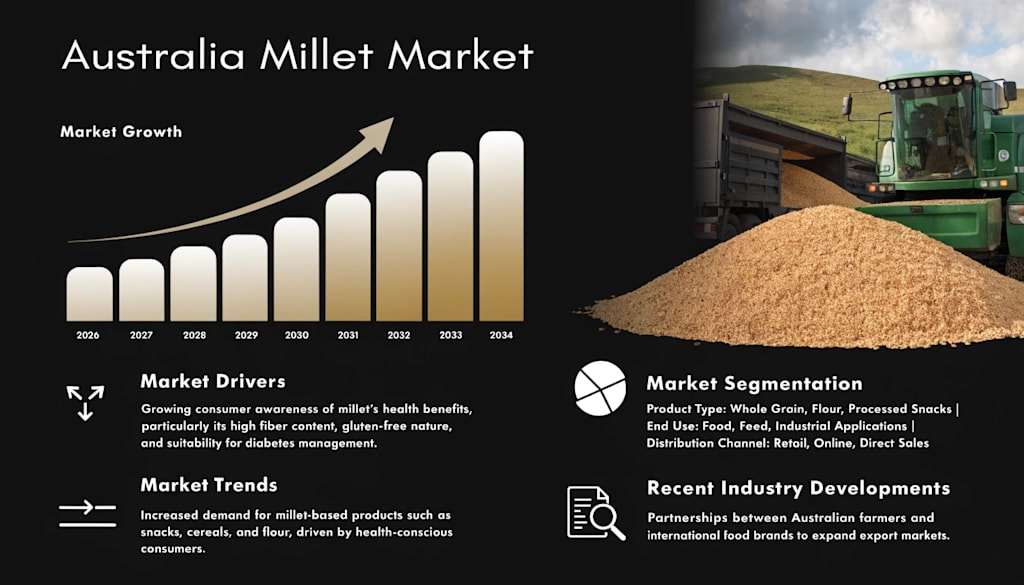
The Australia millets market is steadily expanding as health conscious consumers, gluten free product developers and climate resilient farming advocates increasingly turn to one of the world’s oldest cultivated grains. Millets — a group of small seeded grasses that includes pearl millet, finger millet, proso millet and white French millet — are naturally gluten free, fibre rich and packed with essential minerals. They are deployed across breakfast cereals, snack bars, gluten free flours, ready to eat meals and traditional dishes, as well as in the animal feed sector where the vast majority of domestic production still ends up. According to IMARC Group, the market size reached USD 278.03 Million in 2025 and is projected to reach USD 387.05 Million by 2034, exhibiting a compound annual growth rate (CAGR) of 3.74% during 2026–2034.
As Australia confronts rising rates of coeliac disease, diabetes and obesity, and as the grains sector searches for drought tolerant alternatives to traditional cereals, millets have moved from indigenous pantry staple to a genuine commercial opportunity across retail aisles, foodservice menus and export markets.
What’s Driving Market Growth?
Gluten Free and Digestive Wellness Trends. The most powerful driver of millet adoption is the sustained growth of the gluten free category. An estimated one in four Australian consumers now regularly purchase gluten free products, driven both by diagnosed coeliac disease and by a broader perception that gluten avoidance supports digestive health and well being. Millets offer a nutritional profile that goes well beyond simple substitution — they are high in insoluble fibre, magnesium, phosphorus and B vitamins, and they have a low glycaemic index, making them particularly attractive to consumers managing type 2 diabetes or weight concerns. In the packaged food segment, millet is increasingly featured in snacks, breakfast cereals, dosa and idli premixes, instant upma and poha, waffle and pancake mixes, and energy bars. The import momentum for millet based packaged foods grew at 17.31% between 2023 and 2024, indicating that Australian consumers are actively seeking out convenient, nutritious millet products from international brands.
Millet Flour and Clean Label Reformulation. Within the broader millets market, millet flour is the fastest evolving sub segment. It is being used by gluten free bakeries, artisan bread makers and packaged food manufacturers to replace wheat, rice flour or corn starch in everything from flatbreads and pancakes to biscuits and smoothie bases. The Australia millet flour market is experiencing steady growth due to rising awareness of millet’s health benefits and a shift away from refined flours. Notably, the import trend for millet flour recorded a growth rate of 7.15% in 2024, contrasting with a compound annual decline in previous years, suggesting that changing consumer preferences are now overcoming earlier market inertia.
Climate Resilient Agriculture and Domestic Production Incentives. Millets are naturally drought tolerant and can be grown on marginal soils with far less water than wheat, rice or corn. As Australia’s agricultural regions face increasingly erratic rainfall and longer dry periods, government agencies and research bodies are actively promoting millets as a strategic climate smart crop. The Grains Research and Development Corporation (GRDC) has funded multiple projects examining the potential of millets for human consumption, particularly in the gluten free sector. Queensland’s Department of Agriculture and Fisheries (DAF) has launched a $500,000 co funded project with the GRDC and DFAT to help grain growers turn their millet and sorghum crops into human grade foods, thereby securing higher farmgate prices and opening new local and international markets.
Pearl and Finger Millets Leading the Growth. From a product type perspective, pearl millet and finger millet dominate the Australian market. In 2022, pearl millet accounted for approximately 52.0% of the market and finger millet for a further substantial share, with the two segments collectively representing around 80.5% of total volume. Both are expected to continue their leadership, with projected CAGRs of 11.56% and 11.66% respectively over the forecast period, substantially outpacing the overall market.
Market Segmentation & Key Insights
By Millet Type, the market includes pearl millet, finger millet, proso millet and other varieties. Pearl millet is the volume leader, prized for its versatility and robust agronomic characteristics, while finger millet is gaining ground in health focused and traditional dish applications. By Application, the market is segmented into food and beverages, animal feed, and industrial uses. Human consumption is the fastest growing application, while animal feed still absorbs the bulk of domestic production — an estimated 90% of Queensland’s sorghum and millet production is currently directed to livestock. By Distribution Channel, the market covers retail (supermarkets and health food stores), foodservice (cafés, bakeries and restaurants), online retailers and industrial ingredient supply.
By Region, major production and consumption centres include Queensland, New South Wales and Victoria. Queensland is the primary growing region, benefiting from its subtropical climate and active state government research support, while NSW and Victoria lead in value added processing, food manufacturing and urban consumer demand for gluten free products.
What the Opportunities Are?
Export Expansion into Asia and North America. Australia’s millet exports are currently modest but show clear potential for growth. In 2024, the top destination markets were Japan, New Zealand and Belgium, but there are “really good opportunities to promote these grains to places like India and China too” according to DAF researchers. Australian grown millet carries a premium positioning based on clean, sustainable production credentials, and exporters can target both the human grade food sector and the expanding pet food and specialty feed segments.
Value Added Processing and Product Development. The single largest opportunity lies in shifting millet away from livestock feed and into human grade foods. The DAF’s Food Innovation team is already testing white French millet as a substitute in bread, biscuits, pancakes and smoothies, and the same model can be extended to extruded snacks, gluten free pasta, breakfast cereals and plant based protein blends. Manufacturers who invest in value added processing lines, proprietary product formulations and consumer facing branding will capture the highest margins in the value chain.
Allergen Free and Clean Label Ingredients. As major food manufacturers seek to simplify ingredient statements and eliminate artificial additives, millet flour and millet based ingredients offer a naturally clean label, non GMO and allergen free solution. Millet flour can replace modified starches, gum systems and multiple refined flours in a single ingredient substitution, appealing to both industrial food formulators and the growing cohort of home bakers seeking healthier alternatives.
Foodservice and Café Menu Integration. The café and restaurant sector is increasingly accommodating gluten free, plant forward and ancient grain offerings. Millet porridges, millet based salads, millet flatbreads and millet crusted proteins are largely absent from Australian menus, representing a significant whitespace opportunity. Foodservice distributors who introduce millet in user friendly formats — pre cooked, ready to heat or dry packed with recipe instructions — can build early mover advantage in a hospitality sector always searching for point of difference ingredients.
Sustainability Certifications and Premium Positioning. Millets’ low water footprint and climate resilience lend themselves naturally to sustainability claims. Products certified as “regenerative agriculture,” “low carbon grain” or “drought smart crop” resonate with environmentally conscious consumers and attract premium pricing, both domestically and in export markets. Early mover brands that invest in third party certifications can secure shelf space and customer loyalty before the category becomes crowded.
Recent News and Developments in Australia Millets Market
2025–2026: The GRDC and DFAT funded $500,000 project led by Queensland’s Department of Agriculture and Fisheries continued to develop value added millet infused products. The research team tested white French millet as a gluten free substitute in bread, biscuits, pancakes and smoothies, and conducted consumer sensory trials to assess market acceptance.
October 2025: A sampled export transaction recorded Australian millet grain sold at 0.35 USD / kg to the Philippines, highlighting the price competitiveness of Australian grown millet in Asian markets.
February 2026: The IndexBox Australia Millet Market Report noted that India accounted for approximately 40% of global millet consumption and production, establishing the global supply context within which Australia must position its own production and trade strategies.
2025: The Australia millet based packaged food market recorded an import growth rate of 17.31% from 2023 to 2024, driven by consumers seeking healthier, gluten free and convenient meal solutions. The most dynamic sub segments included dosa and idli premixes, waffle and pancake mixes, and instant upma and poha, reflecting the influence of South Asian culinary traditions on Australian health food trends.
Why Should You Know About Australia Millets Market?
You should know about this market because it illustrates how digestive wellness trends, climate smart agriculture and value added processing intersect to create steady growth in a grain category that has been largely overlooked in the Australian food system. Millets are no longer just cheap birdseed or niche ethnic ingredients — they are increasingly recognised as a strategic crop that supports gluten free formulations, delivers high fibre and low glycaemic impact, and thrives on Australia’s increasingly unpredictable rainfall patterns.
For investors, the millets market offers exposure to a stable growth agricultural category anchored in rising gluten free consumption, expanding plant based and clean label product development, and active government backed research into value added grain processing. The projected CAGR of 3.74% reflects steady baseline demand for millet as both a staple ingredient and a specialty health grain, while higher growth sub segments — including pearl and finger millet food products (exceeding 11% CAGR), millet based packaged foods and export ready human grade grains — offer differentiated upside.
For grain growers, food manufacturers, ingredient suppliers and export traders, understanding millet segmentation, gluten free formulation potential, value added processing pathways and emerging export destinations helps shape intelligent planting decisions, product development roadmaps and market entry strategies that deliver measurable health, sustainability and financial outcomes.
In essence, the Australia millets market captures how ancient grain resilience, modern nutrition science and climate adaptation converge — making it a compelling area for investors, innovators and agricultural organisations seeking smarter approaches to sustainable grain production, gluten free food innovation and diversified export growth.
About the Creator
Thomas
Market Research Analyst | Industry Trends & Forecasting | Turning market data into clear, actionable business insights across global sectors.
Enjoyed the story? Support the Creator.
Subscribe for free to receive all their stories in your feed.
Comments
There are no comments for this story
Be the first to respond and start the conversation.