
Australia Meat Market Expands as Premium Exports and Sustainable Protein Demand Strengthen Industry Growth
Australia’s meat industry is evolving through premium beef exports, advanced processing technologies, and growing global demand for high-quality protein products.

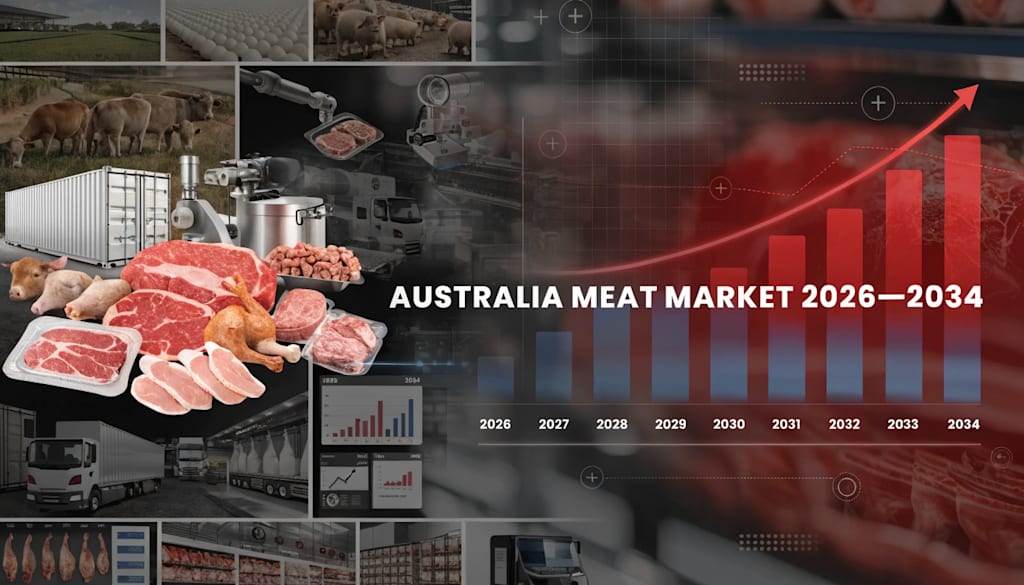
The Australia meat market continues to play a central role in the country’s agricultural economy, supported by strong domestic consumption, expanding export demand, and world-class livestock production systems. According to IMARC Group, the Australia meat market was valued at USD 29.15 Billion in 2025 and is projected to reach USD 34.39 Billion by 2034, exhibiting a CAGR of 1.85% during 2026–2034.
Australia has long maintained a reputation as one of the world’s leading meat producers and exporters, particularly in beef and lamb production. The country’s advanced farming infrastructure, strict biosecurity standards, and efficient supply chains have helped establish Australian meat products as premium offerings in global markets. Rising demand from Asia-Pacific countries and the Middle East continues to strengthen export opportunities for Australian meat processors and producers.
Consumer preferences are also reshaping the domestic market. Australians increasingly prioritize premium-quality, ethically sourced, grass-fed, and traceable meat products. This trend is encouraging producers to focus on sustainable farming methods, transparency, and higher-value product categories that align with evolving dietary and environmental expectations.
IMARC segments the Australia meat market by type into raw and processed meat. By product, the market includes chicken, beef, pork, mutton, and others. Distribution channels include supermarkets and hypermarkets, departmental stores, specialty stores, online platforms, and other retail formats. Regionally, the market spans Australia Capital Territory & New South Wales, Victoria & Tasmania, Queensland, Northern Territory & Southern Australia, and Western Australia.
Request a Business Sample Report for Procurement & Investment Evaluation:
Why the Market Is Growing So Rapidly
One of the primary growth drivers is Australia’s strong agricultural and export infrastructure. The country benefits from expansive grazing lands, modern feedlot operations, and advanced meat processing facilities capable of meeting strict international quality standards. Australia’s free trade agreements and strategic access to Asian markets further strengthen its competitive position in global meat exports. Growing demand from countries such as China, Japan, South Korea, and the Middle East continues supporting export-led industry growth.
Premium and grass-fed meat products are also becoming increasingly popular among consumers. Health-conscious buyers often associate grass-fed beef and lamb with better nutritional profiles, lower fat content, and more sustainable farming practices. Australian producers are leveraging these preferences by expanding premium product lines and strengthening branding around quality, traceability, and animal welfare standards. Premium Wagyu and grain-fed beef categories continue attracting strong demand in both domestic and international markets.
Technological advancements across the meat supply chain are contributing significantly to market expansion. Producers and processors are investing in precision farming, automated processing systems, smart cold chain logistics, and advanced food safety technologies to improve operational efficiency and maintain product quality. Automation is helping address labor shortages while improving consistency, productivity, and export competitiveness within the industry.
The rise of e-commerce and modern retail infrastructure is also influencing meat consumption patterns across Australia. Supermarkets and hypermarkets dominate distribution due to extensive retail networks and integrated cold storage systems. At the same time, online grocery platforms are expanding rapidly as consumers seek convenience, home delivery services, and digital purchasing options. Retailers are increasingly investing in automated fulfillment centers and digital supply chain capabilities to support changing consumer behavior.
Consumer awareness surrounding sustainability and ethical sourcing is another important factor shaping market growth. Buyers increasingly seek meat products produced through environmentally responsible practices and transparent supply chains. Producers are responding through carbon reduction initiatives, renewable energy adoption, and sustainable grazing techniques designed to align with global ESG expectations and long-term environmental goals.
What the Opportunities Are
1. Premium Beef and Wagyu Exports
Growing international demand for high-quality beef products creates strong opportunities for Australian producers specializing in premium and grain-fed meat categories.
2. Sustainable and Ethical Meat Production
Consumers increasingly prefer traceable and ethically sourced meat products, encouraging investment in sustainable farming and animal welfare initiatives.
3. Advanced Processing Technologies
Automation, AI-driven quality control, and smart logistics systems are opening opportunities for processors seeking higher efficiency and export competitiveness.
4. Expansion of Online Meat Retail
Digital grocery platforms and direct-to-consumer meat delivery services are creating new revenue channels across urban Australian markets.
5. Growth in Asian Export Markets
Strong protein demand from China, Japan, South Korea, and Southeast Asia continues supporting long-term export opportunities for Australian meat suppliers.
6. Value-Added and Processed Meat Products
Convenience-focused consumers are driving demand for marinated, portion-controlled, and ready-to-cook meat products with premium positioning.
7. ESG and Carbon Reduction Initiatives
Investments in renewable energy, regenerative agriculture, and low-emission livestock systems offer long-term competitive advantages within the global meat industry.
• February 2025: Meat & Livestock Australia expanded its international promotional initiatives through the Aussie Beef and Lamb brand at Gulfood Dubai, celebrating fifty years of Australian red meat presence in Middle Eastern markets. The campaign focused on strengthening export relationships and expanding premium meat positioning across global foodservice and retail channels. Industry analysts viewed the initiative as a strategic effort to increase Australia’s high-value export footprint in rapidly growing protein markets.
• June 2025: Australian sheep meat exports surged amid rising global demand for lamb and mutton products, with exports increasing significantly compared to previous years. Domestic sheep prices reached record levels as processors and exporters expanded supply agreements across China, the United States, Europe, and the Middle East. Analysts reported that Australia continued strengthening its leadership position within the global sheep meat trade due to rising international demand and constrained supply from competing exporters.
• November 2025: Cargill completed its acquisition of Teys Australia following regulatory approvals, increasing ownership to 100% and strengthening its long-term presence within Australia’s meat processing industry. The acquisition enhanced supply chain integration, export capabilities, and processing operations across key livestock regions. Market observers highlighted the transaction as one of the most significant consolidation moves within Australia’s meat processing sector during 2025.
Why Should You Know About Australia Meat Market?
The Australia meat market remains one of the country’s most strategically important agricultural industries, supporting rural employment, export revenues, food security, and global trade relationships. As premium protein demand rises worldwide, Australia’s reputation for quality, safety, and sustainability continues strengthening its competitive position within international markets.
For investors, the market offers long-term opportunities tied to export growth, premium product expansion, and food processing innovation. For producers and processors, advancements in automation, sustainability, and supply chain efficiency are creating new pathways for profitability and global competitiveness. Policymakers also recognize the industry’s importance in supporting regional economies, agricultural resilience, and trade diversification.
With growing global demand for premium protein products and increasing investments in sustainable production systems, the Australia meat market is positioned for continued evolution and long-term strategic growth.
About the Creator
Rashi Sharma
I am a market researcher.
Enjoyed the story? Support the Creator.
Subscribe for free to receive all their stories in your feed.
Comments
There are no comments for this story
Be the first to respond and start the conversation.