
Australia Managed Print Services Market Set for Steady Expansion as Enterprises Embrace Digital Print Transformation
Driven by cost efficiency, cloud adoption, and enterprise workflow optimization, the Australia managed print services market is on a consistent growth trajectory through 2034.

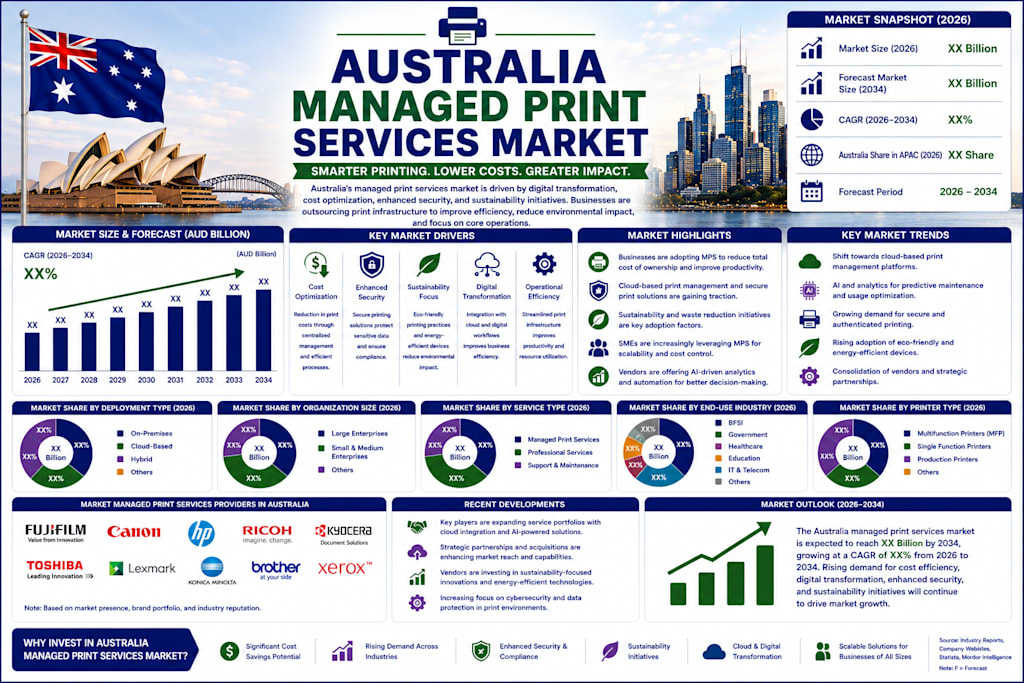
The Australia managed print services (MPS) market is experiencing steady and structurally driven growth, supported by rising enterprise demand for cost optimization, digital workflow efficiency, and secure document management. According to IMARC Group, the market size reached USD 1,058.1 Million in 2025 and is projected to grow significantly to USD 1,870.7 Million by 2034, reflecting a CAGR of 6.34% during 2026–2034 . This expansion highlights how organizations across Australia are increasingly shifting from traditional print infrastructure ownership toward fully managed, service-based models.
At its core, managed print services refer to the outsourcing of an organization’s print environment, including hardware, maintenance, consumables, and document workflow optimization. In Australia, this transition is being accelerated by hybrid work models, tightening IT budgets, and growing pressure on enterprises and government agencies to reduce operational inefficiencies while improving data security and compliance.
Request a Business Sample Report for Procurement & Investment Evaluation:
Why the Market Is Growing So Rapidly
One of the primary growth drivers of the Australia managed print services market is the increasing emphasis on cost efficiency and operational optimization. Enterprises are moving away from fragmented, device-heavy print environments toward centralized, contract-based solutions that reduce unnecessary printing costs and improve asset utilization. MPS providers help organizations gain better visibility over print usage, enabling measurable reductions in paper and energy consumption.
Another significant driver is the rapid adoption of cloud-based print management solutions. Cloud integration allows businesses to remotely manage print fleets across multiple locations, supporting hybrid and remote work environments. This shift is especially important for large enterprises and government institutions that require standardized print operations across distributed networks. The migration from on-premises infrastructure to cloud-based platforms is also reducing IT maintenance burdens, further boosting adoption.
Security and compliance concerns are also contributing to market expansion. As organizations handle increasing volumes of sensitive digital and printed documents, the need for secure print release, user authentication, and data protection has intensified. Managed print services now include advanced security features that help organizations comply with regulatory requirements while minimizing risks of data breaches.
In addition, sustainability goals are becoming a central factor shaping the market. Companies are under pressure to reduce paper waste and lower carbon footprints. MPS providers are responding by offering usage analytics, print optimization tools, and environmentally responsible printing programs. These solutions align with corporate ESG strategies, making managed print services an attractive long-term investment.
Finally, the growing trend of digital workplace transformation is fundamentally reshaping enterprise document workflows. Organizations are integrating print management with broader IT service ecosystems, enabling automation, analytics, and workflow digitization. This convergence of print and IT services is reinforcing the strategic importance of managed print services across Australian industries.
What the Opportunities Are
The Australia managed print services market presents several high-value opportunities for service providers, investors, and enterprise adopters.
Firstly, cloud-based managed print platforms represent a major growth avenue. As organizations modernize IT infrastructure, demand is rising for scalable, subscription-based print management solutions that eliminate the need for heavy upfront investments. Providers that offer seamless cloud integration and hybrid deployment models are well positioned to capture enterprise clients.
Secondly, there is a strong opportunity in government and public sector contracts. Public institutions in Australia are increasingly consolidating procurement under centralized frameworks, creating long-term, high-value service agreements for MPS providers. These contracts often involve large-scale deployment across departments, ensuring recurring revenue streams.
Thirdly, SME adoption is expanding rapidly, driven by the need for affordable IT outsourcing. Small and medium enterprises are increasingly shifting to managed print services to avoid capital expenditure on printers and maintenance. This segment offers significant volume-driven growth potential for providers offering flexible pricing models.
Fourth, AI-driven print analytics and predictive maintenance are emerging as key differentiators. Providers that integrate machine learning to predict device failures, optimize toner usage, and automate servicing will gain a competitive edge. These capabilities enhance efficiency while reducing downtime for clients.
Fifth, sustainability-focused managed print solutions are becoming a powerful market differentiator. Enterprises are actively seeking providers that can help them track, measure, and reduce environmental impact. Services such as paper usage tracking and carbon offset programs are increasingly being bundled into MPS offerings.
Sixth, industry-specific print solutions are gaining traction. Sectors such as healthcare, BFSI, education, and manufacturing require tailored print environments with strict compliance and workflow requirements. Customizable managed print offerings for these verticals present strong long-term revenue opportunities.
Lastly, integration with broader IT managed services portfolios is creating cross-selling potential. Companies offering end-to-end digital workplace solutions, including print, cloud, cybersecurity, and device management, are expected to outperform standalone print service providers.
Recent News & Developments in Australia Managed Print Services Market
• April 2025: Australian government agencies continued expanding centralized procurement frameworks for IT and print services to streamline vendor management and reduce operational duplication. This initiative is strengthening standardized managed print adoption across departments and improving cost transparency. The structured panel system is also encouraging competitive participation from major global vendors, enhancing service quality benchmarks across public sector contracts.
• July 2025: A leading managed print services provider in Australia announced a major expansion of cloud-based print management solutions targeting hybrid workplaces. The rollout focuses on improving remote print accessibility and secure document handling for enterprise clients. Early deployments reported measurable reductions in IT support costs and improved document workflow efficiency across distributed offices.
• September 2025: Sustainability-driven print initiatives gained momentum as enterprises adopted advanced print tracking systems to reduce paper waste and improve ESG reporting metrics. Several large organizations integrated automated usage monitoring tools to optimize print volumes. These initiatives are aligning corporate sustainability goals with operational cost savings, reinforcing long-term adoption of managed print services.
Why Should You Know About Australia Managed Print Services Market?
The Australia managed print services market is no longer just about printers and maintenance—it has evolved into a strategic enterprise efficiency and digital transformation enabler. As organizations prioritize cost control, cloud migration, and cybersecurity, managed print services are becoming deeply embedded in IT infrastructure strategies.
For investors, the market offers stable, recurring revenue potential driven by long-term service contracts and growing enterprise dependency. For businesses, it provides measurable cost savings, improved operational efficiency, and enhanced document security. For policymakers and government agencies, it enables standardized procurement, better resource utilization, and stronger sustainability outcomes.
With consistent growth projected through 2034 and accelerating adoption across both public and private sectors, Australia’s managed print services market represents a mature yet evolving opportunity space where efficiency, technology, and sustainability converge.
About the Creator
Rashi Sharma
I am a market researcher.
Enjoyed the story? Support the Creator.
Subscribe for free to receive all their stories in your feed.
Comments
There are no comments for this story
Be the first to respond and start the conversation.