
Australia Iron Ore Market 2026: Supply Resilience, Green Iron Transition & Asian Diversification
How record export volumes, China's decarb push and new magnetite projects are reshaping Australia's premier resources sector

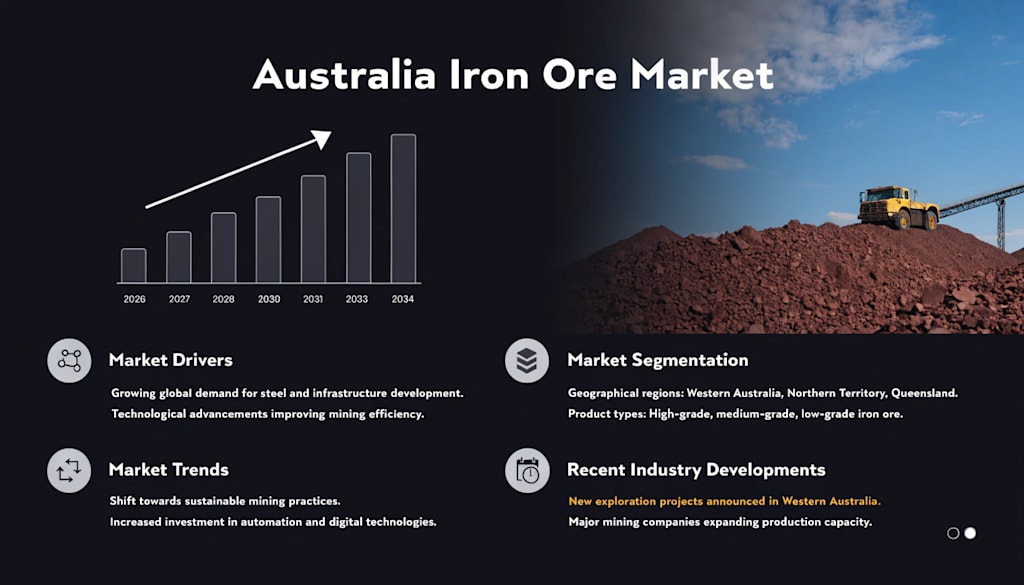
The Australia iron ore market is entering a period of profound structural change as the nation's world-leading mining industry confronts shifting global demand patterns, accelerating decarbonisation pressures and an unprecedented pipeline of new supply. Iron ore — overwhelmingly dominated by hematite production from the Pilbara region in Western Australia — is deployed across blast furnace steelmaking in China, emerging Southeast Asian mills and an expanding roster of green iron projects designed to serve electric arc furnace (EAF) steel production. According to IMARC Group, the market size reached USD 8.67 Billion in 2025 and is projected to reach USD 12.69 Billion by 2034, exhibiting a compound annual growth rate (CAGR) of 3.74% during 2026–2034. Australia remains the world's largest iron ore producer, accounting for 36.8% of global production in 2024 and estimated to have reached 967.8 million tonnes (Mt) in 2025, up 1.4% year-on-year.
What's Driving Market Growth?
Robust Supply Expansion Led by Major Projects. The supply side of Australia's iron ore market is experiencing its most significant growth phase in years, underpinned by the ramp up of several major projects. Mineral Resources’ Onslow Iron project is progressively increasing production, with full capacity targeted at 35Mt per annum. Fortescue’s Iron Bridge magnetite project continues its ramp up, while BHP’s South Flank and the newly commissioned Western Range mine — operated by Rio Tinto (54%) and China Baowu Steel Group (46%) — have added 25Mtpa of production capacity to the national supply base. Beyond these operational projects, a deep pipeline of development assets is advancing. Rio Tinto and Hancock Prospecting are jointly developing the **1.6 billion Hope Downs 2 project**, combining two deposits with a combined total annual production capacity of **31 million tonnes**, supported by a 13 billion investment in new mines, plants and equipment between 2025 and 2027. The Rhodes Ridge joint venture approved a $191 million feasibility study in December 2025 to develop one of the world’s major undeveloped iron ore deposits in WA, targeting initial annual production of 40–50 million tonnes.
Resilient Export Volumes Despite Price Headwinds. Australia's iron ore export performance remained strong in 2025 despite challenging market conditions. For the 2025 financial year, BHP dispatched approximately 290 million tonnes from Port Hedland, up from 287 million tonnes in FY2024, while Fortescue shipped around 198.2 million tonnes — a new record for the company. Rio Tinto delivered Pilbara shipments totaling 326.2 million tonnes for calendar 2025, with production reaching 327.3 million tonnes, recovering effectively from severe weather disruptions that had impacted first-quarter output. The broader industry outlook projects further production growth to 993.4 million tonnes in 2026, a 2.6% increase, supported by ramp-ups at Onslow, Western Range and Iron Bridge.
Asian Market Diversification Beyond China. While China remains the dominant customer — accounting for approximately 85% of Australia's iron ore exports and about two thirds of China's total iron ore consumption — Australian miners are actively cultivating alternative markets. Southeast Asia and India present growing opportunities. India, the world's fourth-largest iron ore producer, is expanding domestic steelmaking capacity, and while it is largely self sufficient, market dynamics can shift when Australian grades offer pricing advantages. This geographic diversification strategy provides an important buffer as Chinese steel demand undergoes structural change.
Market Segmentation & Key Insights
By Type, the market is overwhelmingly dominated by hematite — the direct shipping ore that has powered Australia's iron ore boom for decades. However, magnetite is the fastest growing segment, driven by its suitability for green steel production via direct reduced iron (DRI) and electric arc furnace pathways. High grade magnetite concentrates, such as the 70.55% iron product produced at Athena Resources' Byro project, command premium pricing for decarbonising steelmakers.
By Product, Australia's iron ore is classified into lump (direct feed for blast furnaces) and fines (requiring sintering or pelletising). The Rio Tinto led Pilbara Blend strategy has been enhanced to reduce lower grade SP10 volumes, supporting overall realisation and efficiency.
By End User, the dominant segment remains China's blast furnace steel sector. However, the growth segment is green iron and DRI ready feedstocks destined for EAF steelmaking, as Chinese policies increasingly favour low carbon production pathways.
By Region, Western Australia's Pilbara region accounts for virtually all large scale iron ore production, with Port Hedland and Dampier serving as the primary export gateways. South Australia holds substantial magnetite resources, including the Ridley Magnetite project scheduled for 2030.
What the Opportunities Are?
Green Iron: The 386 Billion Prize.** The single most transformative opportunity for the Australian iron ore sector is the transition from raw ore exports to green iron production. The Superpower Institute estimates Australia could generate **386 billion annually from green iron by 2060 — nearly triple current iron ore export value — while cutting almost 4% of global emissions. Green iron is produced using renewable energy rather than coal or gas, cutting up to 90% of emissions from the steelmaking process. The Australian government announced a 1 billion Green Iron Investment Fund in February 2025** to accelerate early stage projects[reference:15]. Exports of just **10 million tonnes of green iron annually by 2030** could generate up to **295 billion in value according to TSI estimates, demonstrating the dramatic value uplift available from downstream processing.
Magnetite Beneficiation and Hydrogen Based DRI. Australia's magnetite endowment — previously considered too capital intensive to develop compared to Pilbara hematite — is being reassessed as a strategic asset for the green steel era. Technology breakthroughs are accelerating this shift. DryFlow Magnetics announced plans in April 2026 to test its waterless magnetic separation technology at a South Australian mine, using solid state magnets to extract higher grade material while cutting 95% of water from the process. This technology could unlock water stranded magnetite assets and position Australia as "the dominant supplier in high-purity iron" according to CEO Brett Boynton. The HIFi CRC project, announced in June 2025 with a $50 million research programme, is modelling end to end green steel pathways based on magnetite ores, from beneficiation through to hydrogen based DRI and downstream processing. Australian made green iron has the potential to secure premium pricing in decarbonising markets, but the window is narrowing as Brazil and West Africa advance their own high grade magnetite projects.
Critical Minerals Co Production from Iron Ore Tailings. Iron ore operations generate vast quantities of tailings and waste rock that can harbour critical minerals essential for the energy transition. As major miners invest in circular economy infrastructure, there is growing opportunity for technology providers and junior explorers to extract value from existing mine waste. BHP's $2 billion sale of its WAIO power network stake to BlackRock in 2025 signals increasing financial interest in infrastructure enabled decarbonisation, and similar models could apply to tailings reprocessing facilities.
Autonomous Mining and AI Powered Orebody Intelligence. Australia's major miners are at the forefront of autonomous haulage, drill systems and rail operations — technology that reduces operating costs and improves safety. The next frontier is AI powered orebody intelligence, where machine learning algorithms process geological data to optimise extraction sequencing, reduce dilution and maximise product quality. With Rio Tinto's shares gaining 41.3% in the six months to April 2026, investors are rewarding companies that can demonstrate productivity gains through technology adoption.
Port, Rail and Green Logistics Infrastructure. The development of green iron hubs requires new infrastructure — hydrogen production facilities, DRI plants and potentially new port infrastructure to handle processed products separately from raw ore. The $50 million Cool Port concept in other Australian commodity sectors has parallels in iron ore: specialised berths for green iron exports with lower dust emissions and carbon accounting. The Australian government is actively seeking private capital partners for regional infrastructure development, presenting opportunities for infrastructure funds and logistics specialists.
Recent News and Developments in Australia Iron Ore Market
June 2025: Rio Tinto announced a $1.6 billion joint venture with Gina Rinehart's Hancock Prospecting to develop the Hope Downs 2 project in the Pilbara, combining two deposits with 31 million tonnes of annual capacity.
October 2025: Chinese iron ore buyer China Mineral Resources Group ordered major steelmakers to pause purchases of new BHP cargoes due to price disputes, highlighting ongoing trade tensions despite improving diplomatic relations.
December 2025: Rhodes Ridge joint venture approved a $191 million feasibility study to develop one of the world's major undeveloped iron ore deposits in WA, targeting 40–50 million tonnes of initial annual production.
February 2025: The federal government launched a $1 billion Green Iron Investment Fund to accelerate early stage green iron projects across Australia.
April 2025: Rio Tinto achieved its strongest Q2 iron ore output since 2018 in Pilbara, rebounding from weather related disruptions and delivering shipments of 83.7 million tonnes.
April 2026: DryFlow Magnetics announced plans to test its waterless magnetic separation technology at Peak Iron Mines' Hawks Nest project, unlocking water stranded magnetite for green steel production.
Why Should You Know About Australia Iron Ore Market?
You should know about this market because it captures how supply expansion, decarbonisation mandates and technological innovation intersect to reshape Australia's most valuable export industry. Iron ore is no longer just a bulk commodity shipped from Pilbara to Chinese blast furnaces — it is increasingly a processed, low carbon product whose value is determined by its suitability for green steelmaking. The transition from hematite only exports to an integrated green iron industry represents the most significant structural shift in Australian resources since the China driven investment boom began.
For investors, the iron ore market offers exposure to a high volume, cash generating resource category that remains the foundation of Australian mining, projected to grow from USD 8.67 billion in 2025 to USD 12.69 billion by 2034 at a CAGR of 3.74%, with additional downstream potential estimated at up to $386 billion annually by 2060. The major producers (Rio Tinto, BHP, Fortescue and MinRes) are investing tens of billions in sustaining production and developing green iron capacity, creating opportunities across mining services, magnetite processing technology and hydrogen infrastructure.
For miners, investors and policymakers, understanding iron ore segmentation (hematite vs magnetite), grade dynamics, supply demand fundamentals, Chinese decarbonisation policy and the emerging green iron value chain helps shape intelligent investment decisions and strategic positioning that will determine Australia's role in the global steel industry for the next three decades.
In essence, the Australia iron ore market captures how extractive scale, environmental responsibility and value added processing converge — making it a compelling area for investors seeking exposure to both traditional resource demand and the once in a generation transition to green industrial production.
About the Creator
Thomas
Market Research Analyst | Industry Trends & Forecasting | Turning market data into clear, actionable business insights across global sectors.
Enjoyed the story? Support the Creator.
Subscribe for free to receive all their stories in your feed.
Comments
There are no comments for this story
Be the first to respond and start the conversation.