
Australia Industrial Drying Equipment Market Is Heating Up with Smart Manufacturing Trends
Driven by automation, sustainability, and industrial demand, Australia’s drying equipment market is entering a high-efficiency growth phase

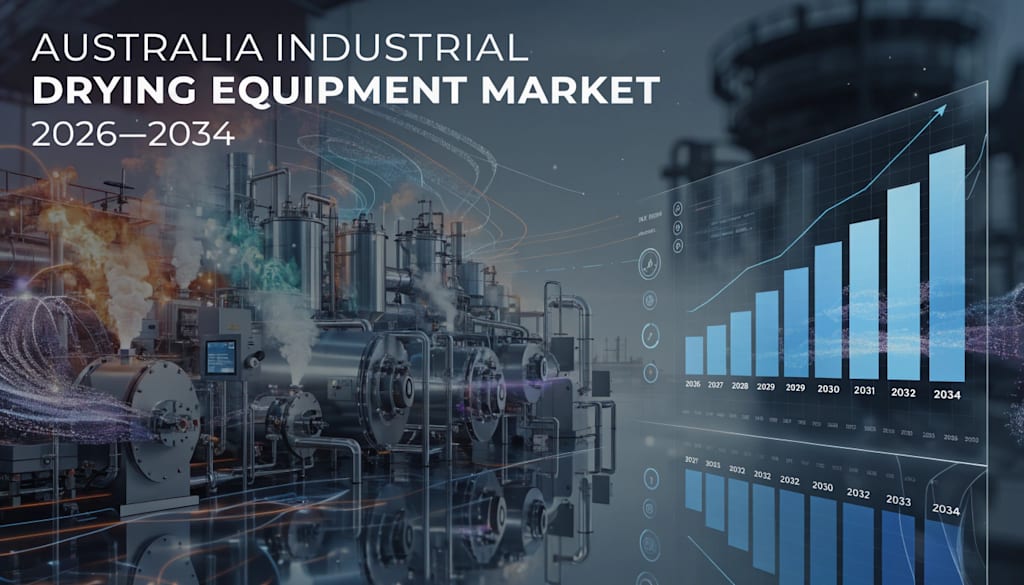
The Australia industrial drying equipment market is quietly becoming one of the most critical enablers of modern manufacturing. According to IMARC Group, the market reached a value of USD 51.9 million in 2025 and is projected to grow to USD 90.0 million by 2034, expanding at a CAGR of 6.12% during 2026–2034.
This growth reflects a broader shift in Australia’s industrial ecosystem—where efficiency, sustainability, and precision are no longer optional. Industrial drying equipment, once considered a backend process, is now central to product quality, compliance, and operational performance across sectors like food processing, pharmaceuticals, and chemicals.
As industries modernize and global competition intensifies, drying technologies are evolving into smart, energy-efficient systems that align with both environmental goals and economic efficiency.
Request a Business Sample Report for Procurement & Investment Evaluation:
Why the Market Is Growing So Rapidly
One of the most important drivers behind this growth is the rapid expansion of Australia’s food processing, pharmaceutical, and chemical industries. These sectors rely heavily on precise moisture control to ensure product stability, safety, and shelf life. As demand for processed and packaged goods increases, so does the need for reliable drying technologies that can maintain consistent quality at scale.
Another key factor is the shift toward energy-efficient systems. Rising fuel costs and strict environmental regulations are pushing manufacturers to adopt drying equipment that consumes less energy while delivering high performance. Technologies such as heat recovery systems and variable speed drives are becoming standard, helping companies reduce operational costs while meeting sustainability targets.
Automation and smart technologies are also playing a transformative role. The integration of IoT-enabled dryers allows real-time monitoring, predictive maintenance, and precise control over drying parameters. This not only improves efficiency but also reduces downtime and labor dependency—an important advantage in a market facing workforce constraints.
Customization is another powerful growth lever. Different industries have unique drying requirements, especially sectors like pharmaceuticals where strict regulatory compliance is essential. Manufacturers are increasingly designing tailored solutions with advanced temperature and humidity controls to meet these specialized needs, enhancing both productivity and product quality.
Finally, the push toward renewable energy integration is gaining traction. Solar-assisted and biomass-powered drying systems are emerging as viable alternatives, aligning industrial operations with Australia’s broader carbon reduction commitments and sustainability goals.
What the Opportunities Are
The market is not just growing—it is evolving in ways that create significant opportunities for investors and businesses alike:
• Energy-efficient retrofitting demand: Existing industrial facilities are upgrading legacy drying systems to reduce energy consumption and comply with regulations, opening a large aftermarket opportunity.
• Smart factory integration: As Industry 4.0 adoption accelerates, companies that offer IoT-enabled drying equipment with analytics and automation capabilities will gain a competitive edge.
• Pharmaceutical-grade precision systems: The need for highly controlled drying environments in pharmaceuticals and biotechnology is creating demand for premium, high-margin equipment.
• Food export expansion: Australia’s strong food export industry requires advanced drying solutions to preserve quality during long-distance shipping, especially for dairy, meat, and processed foods.
• Renewable-powered drying solutions: Equipment that integrates solar or biomass energy sources is becoming increasingly attractive, particularly for companies focused on ESG compliance.
• Customized industrial solutions: Manufacturers offering modular and industry-specific drying systems can tap into niche but highly profitable segments.
• Regional industrial growth: Expanding industrial activity across regions like Queensland and Western Australia is creating localized demand for drying equipment and services.
Recent News & Developments in Australia Industrial Drying Equipment Market
• January 2025: The Australian government introduced updated industrial energy efficiency guidelines targeting manufacturing facilities, encouraging the adoption of low-energy drying systems. The policy includes incentives for companies investing in advanced heat recovery and renewable-integrated drying technologies. This move is expected to accelerate equipment upgrades across multiple sectors.
• May 2025: A leading industrial equipment manufacturer announced the expansion of its operations in Australia with a new facility focused on producing IoT-enabled drying systems. The investment aims to meet rising demand from food processing and pharmaceutical industries while reducing delivery lead times. The company also highlighted plans to integrate AI-based monitoring features into its product line.
• September 2025: Industry data revealed a significant rise in adoption of automated drying solutions across mid-sized manufacturing firms in Australia. Reports indicated double-digit growth in installations of smart drying systems, driven by cost savings and operational efficiency gains. This trend underscores the market’s transition toward intelligent and connected equipment.
Why Should You Know About Australia Industrial Drying Equipment Market?
The Australia industrial drying equipment market is more than a niche industrial segment—it’s a foundational pillar of modern manufacturing. From ensuring food safety to enabling pharmaceutical precision and supporting sustainable production, drying technologies are deeply embedded in critical value chains.
For investors, the market offers steady, technology-driven growth with strong links to high-demand industries. For businesses, it presents opportunities to enhance efficiency, reduce costs, and meet evolving regulatory standards. And for policymakers, it plays a vital role in advancing sustainability goals and industrial competitiveness.
As automation, energy efficiency, and customization continue to reshape the landscape, this market is set to become a key driver of Australia’s next phase of industrial innovation.
About the Creator
Rashi Sharma
I am a market researcher.
Enjoyed the story? Support the Creator.
Subscribe for free to receive all their stories in your feed.
Comments
There are no comments for this story
Be the first to respond and start the conversation.