
Australia Industrial Coatings Market 2026: Infrastructure Drive, Protective Solutions & Green Innovation
How major infrastructure spending, mining resilience and low-VOC technology are shaping Australia's industrial coatings landscape

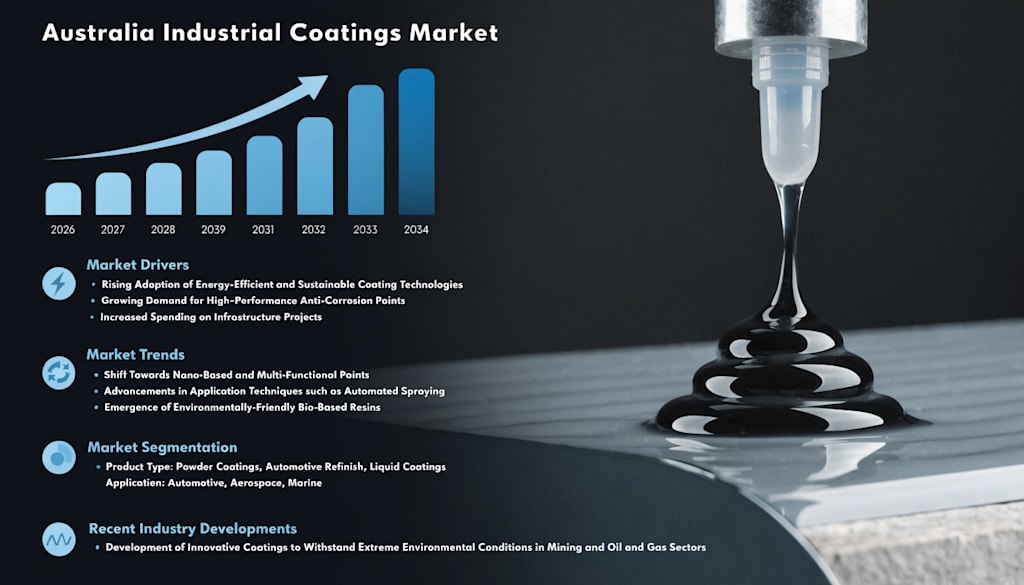
The Australia industrial coatings market is expanding steadily as infrastructure projects, resource sector operations and manufacturing facilities increasingly demand high-performance protective surface solutions. Industrial coatings — including acrylic, epoxy, polyurethane, alkyd, powder-based and solvent-borne systems — are deployed across general industrial facilities, mining assets, marine environments, oil and gas infrastructure and transportation networks to protect against corrosion, abrasion, chemical exposure and weathering.
According to IMARC Group, the market size reached USD 3.37 Billion in 2025 and is projected to reach USD 4.89 Billion by 2034, exhibiting a compound annual growth rate (CAGR) of 3.65% during 2026–2034. As Australia's construction sector remains near record levels with total activity reaching $318 billion in 2025, industrial coatings have become indispensable for extending asset lifespans and reducing maintenance costs across harsh Australian operating environments.
What's Driving Market Growth?
Accelerating Infrastructure Development and Government Investment. Australia's unprecedented infrastructure expansion is a primary catalyst for industrial coatings demand. Major public infrastructure pipelines continue to grow substantially, driven by significant additions in housing, energy transmission and transportation projects. Rail construction activity is expected to peak at 17.3 billion in 2025–26**[reference:2], while firms upgraded their expected spending for 2025-26 to **A199.3 billion, representing a 4.3 per cent increase. Transport infrastructure remains the largest expenditure category, creating direct coating demand for corrosion protection, weatherproofing and aesthetic finishing across bridges, tunnels, railways and public buildings.
Expanding Mining and Resource Sector Activities. Australia's mining industry serves as a cornerstone of the national economy and a leading contributor to export revenues. Mining operations expose equipment and infrastructure to abrasive particles, moisture and harsh chemicals, creating persistent demand for specialised protective coatings that resist corrosion, abrasion and chemical degradation. Critical mineral projects — including lithium, rare earth and other strategic minerals across Western Australia, Queensland and Tasmania — necessitate advanced industrial coating solutions that safeguard assets throughout exploration, processing and logistics operations.
Strengthening Environmental Regulations and Sustainability Mandates. Tightening environmental regulations are propelling innovation by accelerating the transition toward sustainable coating technologies. New VOC limits for coatings took effect in January 2024 under Green Building Council of Australia guidelines, compelling manufacturers to develop low-emission alternatives across industrial applications. Australia's commitment to achieving net-zero emissions by 2050 is creating sustained demand for eco-friendly industrial coatings across construction, manufacturing and infrastructure maintenance applications.
Technological Advancements and Integration. Advanced nanotechnology is increasingly being integrated into industrial coating formulations to deliver enhanced protective capabilities, including self-healing, hydrophobic and antimicrobial properties. These next-generation coatings respond to environmental stimuli such as temperature and humidity changes, providing proactive maintenance and extending asset lifespans.
Market Segmentation & Key Insights
By Product Type, the market includes acrylic, alkyd, polyurethane, epoxy, polyester and others. Acrylic dominates with a market share of 28.5% in 2025 — driven by exceptional versatility, outstanding weather resistance, compatibility with eco-friendly water-based formulations and strong applicability across construction and infrastructure sectors where ultraviolet stability and colour retention are essential in Australia's harsh climatic conditions.
By Technology, the market covers solvent borne, water borne, powder based and others. Solvent borne leads with a 42.5% share in 2025 — owing to its proven track record of delivering superior adhesion, chemical resistance and surface finish quality across demanding industrial applications, including mining operations, oil and gas facilities and marine environments where robust protection against corrosion is essential.
By End User, the market serves general industrial, marine, automotive and vehicle refinish, electronics, aerospace, oil and gas, mining, power generation and others. General industrial holds the largest segment with a 32.5% share in 2025 — reflecting broad-based demand for protective coatings across factories, warehouses, processing facilities and commercial structures requiring consistent surface protection from corrosion, chemical exposure and mechanical wear.
By Region, the market spans Australia Capital Territory & New South Wales, Victoria & Tasmania, Queensland, Northern Territory & Southern Australia and Western Australia. New South Wales and the Australian Capital Territory represent the leading region with a 34.8% share in 2025 — driven by the Sydney metropolitan concentration of industrial manufacturing, large-scale infrastructure investment (including Sydney Metro expansion and Western Sydney International Airport development), and a diverse industrial base spanning food processing, pharmaceuticals, electronics and defence.
What the Opportunities Are?
Eco-Friendly & Bio-Based Coating Formulations. As stricter VOC limits and sustainability mandates reshape the industry, there is strong opportunity for providers to offer water-borne, powder-based and bio-derived coatings that deliver equivalent protective performance with significantly reduced environmental impact. The Australian Paint Approval Scheme promotes low-VOC paints by categorising products based on their emission content, offering a transparent pathway for specifiers to select safer materials.
Intelligent & Nanotechnology-Enabled Coatings. Self-healing, hydrophobic and smart coatings that respond to environmental stimuli represent emerging growth areas. In October 2024, ACM CRC, LaserBond and the University of Sydney announced a collaborative project to develop automated laser cladding systems for metal matrix composite coatings targeting improved wear and corrosion resistance for mining, marine and defence applications.
Renewable Energy Infrastructure Coatings. The energy transition toward renewable sources presents new development opportunities for specialised industrial coatings. The growing adoption of acrylic coatings in renewable energy installations — including solar farms and wind energy infrastructure — reinforces consumption across emerging industrial applications.
Powder Coatings for Architectural & Industrial Use. Powder coating technology is gaining significant traction due to superior durability, minimal waste generation and absence of solvent emissions — aligning with stringent environmental standards and sustainability goals. In January 2025, AkzoNobel launched its Interpon D Futura Collection in Australia and New Zealand, offering sustainable powder coatings backed by 25-year warranties and Environmental Product Declarations.
Integrated Coating & Maintenance Services. As advanced coating systems become more sophisticated, there is demand for professional application training, surface preparation guidance, inspection services and maintenance contracts that help industrial operators maximise asset protection ROI and ensure dependable long-term performance.
Recent News and Developments in Australia Industrial Coatings Market
January 2025: AkzoNobel launched its Interpon D Futura Collection in Australia and New Zealand, offering sustainable powder coatings backed by 25-year warranties and Environmental Product Declarations — reinforcing powder coating adoption across architectural and industrial applications.
October 2024: ACM CRC, LaserBond, and the University of Sydney announced a collaborative project to develop an automated laser cladding system for metal matrix composite coatings targeting improved wear and corrosion resistance for mining, marine and defence applications.
November 2025: BASF Coatings entered a strategic distribution partnership with the SAPE Group to strengthen automotive refinish market presence within Melbourne, expanding distribution of automotive refinish coatings solutions.
Late 2025: Sparc Technologies secured its first commercial sale of ecosparc® graphene-based additive and signed a trial agreement with BHP Mitsubishi Alliance (BMA) to test ecosparc®-enhanced anti-corrosive coating at Goonyella Riverside Mine — demonstrating up to 60 per cent anticorrosion performance improvement with graphene-enhanced additives.
September 2025: Graphene Manufacturing Group announced that THERMAL-XR® ENHANCE graphene coating is now successfully patented in Australia for 20 years, later announcing distribution through Beijer Ref and Kirby's approximately 73 wholesale locations across Australia.
Why Should You Know About Australia Industrial Coatings Market?
You should know about this market because it illustrates how infrastructure priorities, resource sector resilience and environmental innovation intersect to create steady growth opportunities in a mission-critical segment of Australia's industrial landscape. Industrial coatings are no longer just protective layers — they are smart surface solutions that help operators extend asset lifespans, reduce maintenance costs, meet sustainability targets and withstand Australia's harsh climatic and operational conditions.
For investors, the industrial coatings market offers exposure to a stable-growth industrial category anchored in major public infrastructure pipelines, resilient mining demand and accelerating adoption of sustainable technologies. The projected CAGR of 3.65% reflects consistent confidence in adoption trends, technological differentiation and recurring demand tied to ongoing asset protection and maintenance cycles.
For industrial operators, asset managers, coating specifiers and supply chain planners, understanding market segmentation, technology trends, regulatory dynamics and integration strategies helps shape intelligent investment decisions, procurement roadmaps and asset protection programmes that deliver measurable durability, compliance and operational efficiency outcomes.
In essence, the Australia industrial coatings market captures how protection, innovation and sustainability converge — making it a compelling area for innovators, investors and organisations seeking smarter approaches to asset preservation, industrial performance and environmental stewardship.
About the Creator
Thomas
Market Research Analyst | Industry Trends & Forecasting | Turning market data into clear, actionable business insights across global sectors.
Enjoyed the story? Support the Creator.
Subscribe for free to receive all their stories in your feed.
Comments
There are no comments for this story
Be the first to respond and start the conversation.