
Australia Hemodialysis Market 2026: Renal Care Expansion, Home Therapy Shift & AI-Driven Innovation
How rising chronic disease burden, capacity pressures and intelligent monitoring systems are transforming kidney replacement therapy across Australia

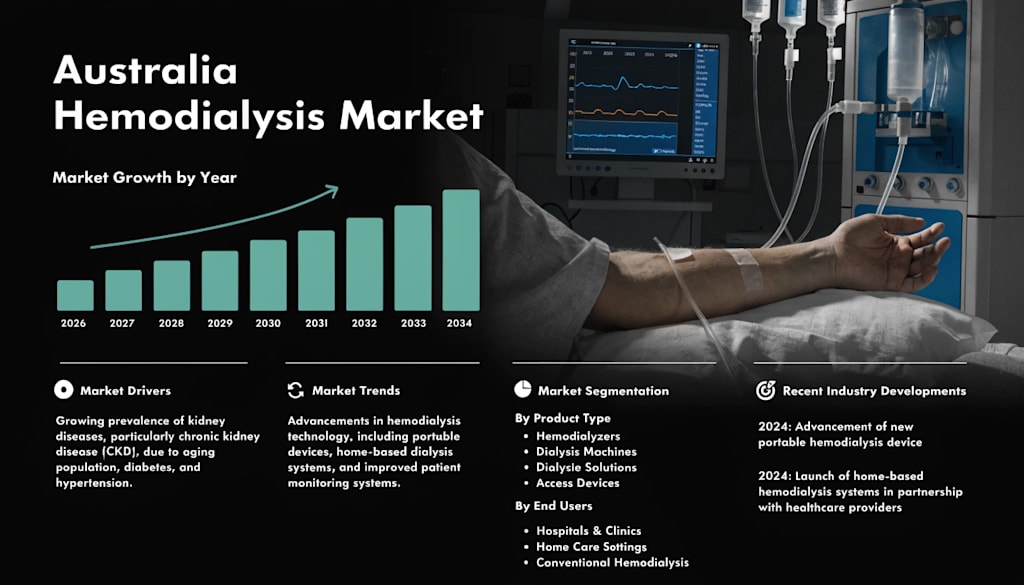
The Australia hemodialysis market is undergoing sustained expansion as healthcare providers, government agencies and private dialysis operators increasingly prioritise accessible, cost-effective and technologically advanced renal replacement therapy. Hemodialysis — encompassing in centre systems, home based platforms, vascular access devices and integrated monitoring solutions — is deployed across public hospitals, private dialysis centres and residential settings to remove waste products, regulate fluid balance and sustain life for patients with end stage renal disease (ESRD). According to IMARC Group, the market size reached USD 1,951.6 Million in 2025 and is projected to reach USD 2,663.4 Million by 2034, exhibiting a compound annual growth rate (CAGR) of 3.52% during 2026–2034. As Australia’s ageing population and rising metabolic disease prevalence collide with chronic capacity constraints, intelligent and home enabled dialysis technologies have become critical to the future of kidney care.
What’s Driving Market Growth?
Rising Prevalence of CKD, ESRD and Lifestyle Related Risk Factors. Australia is experiencing a sustained increase in chronic kidney disease (CKD) and ESRD driven by demographic aging, diabetes mellitus and hypertension. Approximately 1.7 million Australian adults live with CKD, largely attributable to rising incidence of metabolic diseases such as diabetes, hypertension and obesity. Diabetes alone accounts for nearly 40% of kidney failures, with hypertension ranking as the second most significant etiological factor. In 2022, some 15,518 patients underwent kidney replacement therapy (KRT), of whom 82% received hemodialysis. The highest incidence occurs among individuals aged 75 to 84, who commonly present multiple comorbidities necessitating frequent or intensive dialysis. Reflecting this burden, 1,117 Australians per million population were on dialysis in 2022, underscoring substantial pressure on renal services.
Escalating Capacity Pressures and Service Constraints. Despite Australia’s universal healthcare system, hemodialysis services are operating at or beyond safe capacity. A bi national survey conducted by the Australia and New Zealand Dialysis and Transplant Registry (ANZDATA) and the Australian and New Zealand Society of Nephrology (ANZSN) found that two thirds of Australian units are unable to provide dialysis at patients’ preferred locations due to infrastructure and funding shortfalls. More than half of units have implemented restrictive measures — reducing dialysis hours, delaying treatment initiation or limiting in centre capacity — and regional waitlists to commence treatment are now common. The national average patient:chair ratio stands at 3.34, rising to 3.49 when acute dialysis activity is included, with some regions averaging 4.37 patients per chair — well above the recommended limit. These constraints create urgent demand for expanded infrastructure, supply chain redundancy and alternative delivery models.
Strategic Shift Toward Home Based Hemodialysis. Australia is undergoing a deliberate transition from centre based to home hemodialysis (HHD), supported by compelling cost efficiencies, government subsidy frameworks and improved patient outcomes. Federal and state programs provide funding differentials of up to AUD 30,000 per patient per annum and cover additional home utility expenses to encourage uptake. Currently, 24% of dialysis patients use home based therapies (peritoneal dialysis or home hemodialysis), with HHD adoption accelerating due to fiscal incentives and demonstrable clinical outcomes delivering superior solute clearance and fluid management. Leading dialysis platforms — including the Fresenius 4008S and Gambro AK95 — have been optimised for self administered overnight regimens, further enhancing treatment convenience and quality of life.
Government Reimbursement and Infrastructure Investment. The Australian government provides strong support through the Medicare Benefits Schedule (MBS). Items such as 13104 reimburse up to 85% of the cost for home dialysis planning and management, while Item 13105 extends coverage for remote dialysis services, expanding treatment access to patients in very remote regions. The National Dialysis and Transplantation Outcomes (NDTO) program, managed by ANZDATA, leverages data driven insights to enhance care quality and inform policy decisions.
Market Segmentation & Key Insights
By Modality, the market includes in centre hemodialysis, home hemodialysis and peritoneal dialysis. In centre hemodialysis remains dominant, accounting for 76% of treated dialysis patients, while home based therapies constitute the remaining 24%. The home dialysis systems segment is expected to grow at a notably faster CAGR of 11% from 2025 to 2030 (Grand View Research), reflecting the strategic policy shift toward decentralised renal care.
By Type, the market segments into equipment (hemodialysis machines, peritoneal dialysis systems, and related accessories) and consumables. Hemodialysis equipment is projected to remain the leading segment throughout the forecast period. The Australia dialysis equipment market — a closely related sub segment — was valued at USD 528.70 Million in 2025 and is projected to reach USD 717.46 Million by 2035 at a CAGR of 3.10%.
By End User, hospitals historically account for over 75% of market share, though home settings are gaining share as HHD adoption accelerates.
By Region, New South Wales & ACT, Victoria & Tasmania, Queensland, Northern Territory & South Australia, and Western Australia represent distinct market geographies, with metropolitan centres currently dominating service delivery.
What the Opportunities Are?
AI Powered Predictive Clinical Decision Support. Australian healthcare AI company Nexev Pty Ltd is developing DIALIQ™, a real time clinical decision support system designed to predict and prevent intradialytic hypotension (IDH) — one of the most frequent and clinically significant complications during hemodialysis. IDH occurs in a substantial proportion of sessions and is associated with acute symptoms as well as long term consequences including myocardial stunning and increased hospitalisation rates. DIALIQ continuously analyses dialysis machine parameters, blood pressure trends and patient specific clinical context to estimate hypotension risk before overt collapse occurs. The platform was a finalist at the Australian Healthcare Week & Healthcare 2040 Expo Start Up PitchFest 2026. Vendors offering AI enabled renal analytics will capture significant market share as providers seek to transition from reactive to anticipatory care.
Robotic Vascular Imaging for Access Planning. Vxev, an Australian medical device company, announced highly successful results from the CANSCAN Trial (November 2025) for its VxWave™ Ultrasound Imaging System — a robotic tomographic ultrasound system integrating advanced robotics, machine learning and ultrasound signal processing to create 3D vascular models for hemodialysis access planning. The trial achieved a 94% scan completion rate and 100% data adequacy rate, with 98% of access options determined feasible across 115 patients with severe kidney damage. Given that nearly 3 out of 4 arteriovenous fistulas currently fail to mature or are abandoned before use, this technology addresses a critical gap in vascular access reliability, potentially reducing patient harm and hospitalisation costs.
Remote Patient Monitoring & Hospital in the Home Integration. Professor Ghapanchi, speaking at the 2025 Digital Health Festival, highlighted the critical role of remote patient monitoring (RPM) and automation technologies in delivering care at home, offering patients full transparency while alleviating pressure on healthcare infrastructure. Providers integrating RPM platforms with hemodialysis delivery can address both capacity constraints and patient preference for decentralised care.
Home Hemodialysis Expansion and Training Services. With federal and state programs incentivising HHD uptake, significant opportunity exists for specialised HHD training services, home installation support and maintenance contracts. Medicare item 13104 provides structured reimbursement for home dialysis planning and management, creating a favourable environment for service expansion. The strategic shift from centre based care to HHD opens recurring revenue streams across consumables, equipment servicing and patient education.
Private Dialysis Centre Infrastructure Development. With more than 80% of Australian regions reporting dialysis waiting lists — some with wait times extending years — and approximately one quarter of dialysis centres experiencing equipment idling due to staffing and funding limitations, there is substantial opportunity for public private partnerships and private investment in dialysis centre capacity. The Australian government is being urged to commit to sustained investment in infrastructure, innovation and workforce expansion, particularly in underserved regional areas.
Recent News and Developments in Australia Hemodialysis Market
August 2025: A Collaborative Special Report jointly released by ANZDATA and the Australian and New Zealand Society of Nephrology (ANZSN) provided a detailed picture of significant operational pressures facing kidney units. Key findings included two thirds of Australian units unable to provide dialysis at patients’ preferred locations due to infrastructure shortfalls, more than half of units reducing dialysis hours or delaying initiation, and severe variation in staffing levels with kidney specialists managing an average of 84 patients on kidney replacement therapy.
September 2025: The SAHMRI housed ANZDATA report revealed that dialysis chairs are full, waiting lists are growing and restrictions on patient care have become unavoidable — in some cases, directly impacting patients’ health. Professor Stephen McDonald, Director of ANZDATA, stated: “Units are being forced into decisions that compromise recommended care, and in some cases, this is directly impacting patients’ health”.
March 1, 2025: A change to the Medicare Benefits Schedule (MBS) took effect, lowering the Medicare rebate for certain out patient procedures from 85% to 75% to align with the standard for other services provided to private patients through a hospital setting. Kidney dialysis performed at home continues to receive an 85% Medicare rebate, maintaining financial support for home based therapy adoption.
November 2025: Vexev, an Australian medical device company, presented successful results of the CANSCAN Trial at the American Society of Nephrology’s Kidney Week 2025 in Houston, Texas. The trial demonstrated that the VxWave™ robotic ultrasound imaging system can reliably perform semi autonomous vascular mapping examinations directly within dialysis clinics, addressing historically poor patient compliance and variable scan quality.
March 2026: Australian healthcare AI company Nexev Pty Ltd was selected as a finalist for the Australian Healthcare Week & Healthcare 2040 Expo Start Up PitchFest 2026, presenting DIALIQ — a real time AI platform designed to predict and prevent intradialytic hypotension during hemodialysis. The company aims to transform dialysis from a reactive therapy into a proactive, personalised and safer treatment paradigm.
May 2026: A report highlighted that more than 80% of Australian regions have dialysis waiting lists, with some patients facing wait times of several years for treatment initiation or transfer to closer centres. Approximately one quarter of dialysis centres reported idling machines due to staffing and funding constraints.
Why Should You Know About Australia Hemodialysis Market?
You should know about this market because it captures how chronic disease burden, capacity constraints and digital health innovation intersect to create steady growth opportunities in a mission critical segment of Australia’s healthcare landscape. Hemodialysis is no longer just a life sustaining procedure — it is a complex ecosystem of smart equipment, AI driven analytics and home enabled delivery models that help clinicians anticipate complications, optimise resource allocation and improve patient quality of life.
For investors, the hemodialysis market offers exposure to a stable growth healthcare category anchored in an ageing population, rising metabolic disease prevalence and sustained government investment in renal replacement infrastructure. The projected CAGR of 3.52% reflects consistent demand, while high growth sub segments — including AI powered decision support, home dialysis systems (projected 11% CAGR), and robotic vascular imaging — offer differentiated upside potential.
For healthcare providers, dialysis equipment manufacturers, technology innovators and policy planners, understanding hemodialysis segmentation, home therapy reimbursement structures, AI integration strategies and emerging robotic technologies helps shape intelligent investment decisions, procurement roadmaps and service designs that deliver measurable patient safety, operational efficiency and equitable access outcomes.
In essence, the Australia hemodialysis market captures how renal science, digital intelligence and sustainable care delivery converge — making it a compelling area for innovators, investors and organisations seeking smarter approaches to kidney failure management, healthcare capacity optimisation and patient centred innovation.
About the Creator
Thomas
Market Research Analyst | Industry Trends & Forecasting | Turning market data into clear, actionable business insights across global sectors.
Enjoyed the story? Support the Creator.
Subscribe for free to receive all their stories in your feed.
Comments
There are no comments for this story
Be the first to respond and start the conversation.