
Australia Head-Up Display Market Set for Strong Growth Driven by AR Integration and Advanced Vehicle Safety Systems
Rapid adoption of AR-driven cockpit technologies and safety-focused vehicle interfaces is accelerating demand for HUD systems across Australia’s automotive and aviation sectors.

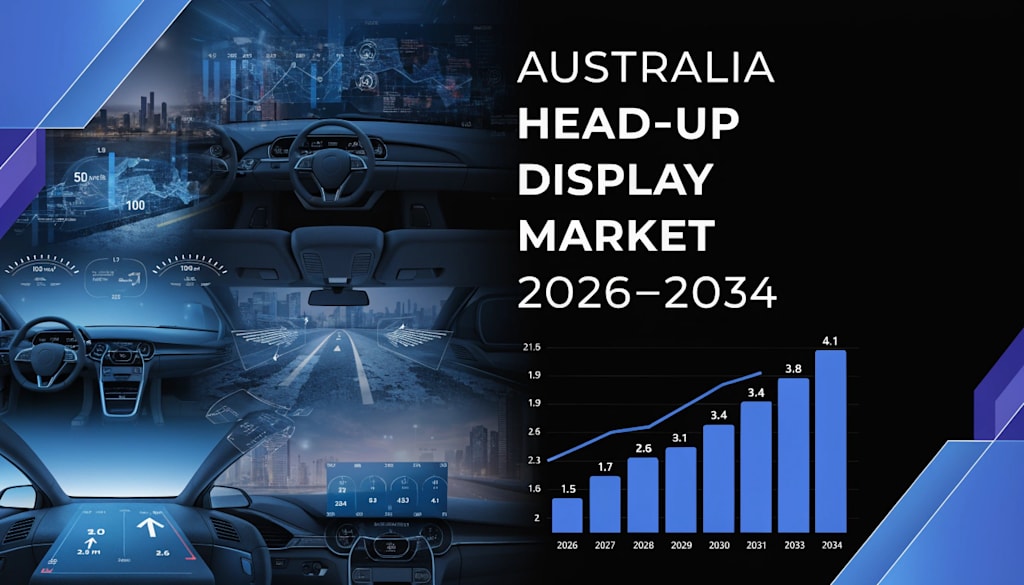
The Australia head-up display (HUD) market is entering a high-growth phase, driven by rapid advances in in-vehicle digitalization and increasing demand for safer, more intuitive driving experiences. According to IMARC Group, the market reached a value of USD 36.9 million in 2025 and is projected to grow significantly to USD 158.3 million by 2034, expanding at a strong CAGR of 16.92% during 2026–2034.
This expansion reflects a broader transformation in how information is delivered inside vehicles, shifting from traditional dashboards to immersive, windshield-projected systems that keep critical data directly within the driver’s line of sight.
At its core, a head-up display system projects key driving information such as speed, navigation, and alerts onto the windshield or a transparent panel. In Australia, this technology is gaining traction not only in premium automotive segments but increasingly across mid-range vehicles and aviation applications, supported by improvements in augmented reality (AR), digital optics, and advanced driver-assistance systems (ADAS).
Request a Business Sample Report for Procurement & Investment Evaluation:
Why the Market Is Growing So Rapidly
One of the most powerful growth drivers is the rising emphasis on road safety and driver attention management. HUD systems significantly reduce the need for drivers to look away from the road, improving reaction time and situational awareness. This aligns strongly with global and regional safety priorities, especially as vehicle traffic density and urban commuting complexity continue to rise.
Another key factor is the integration of augmented reality into HUD systems. AR-based HUDs are transforming the driving experience by overlaying navigation routes, hazard alerts, and lane guidance directly onto the real-world driving environment. This enhances spatial awareness and reduces cognitive load on drivers, making the technology particularly attractive for both passenger vehicles and commercial fleets.
Technological advancements are also accelerating adoption. Modern HUD systems now use digital projection technologies such as LED-based and waveguide optics, enabling sharper images, wider display areas, and better visibility under varying lighting conditions. These improvements are making HUDs more practical and scalable across different vehicle categories.
Additionally, the rise of connected vehicles and electric vehicles (EVs) is contributing significantly to market expansion. EV manufacturers are increasingly integrating digital cockpit ecosystems where HUDs act as a central interface for real-time vehicle data, battery status, and navigation. This integration strengthens the role of HUDs as a core component of next-generation mobility systems.
Finally, cost reductions in display modules and software-driven architecture are enabling broader adoption beyond luxury vehicles. What was once a premium feature is steadily becoming a mainstream automotive expectation in Australia’s evolving mobility landscape.
What the Opportunities Are
The Australia HUD market presents several high-value opportunities across automotive, technology, and aviation ecosystems:
First, augmented reality HUD expansion is creating opportunities for OEMs to differentiate vehicles through immersive driving interfaces. AR overlays for navigation and hazard detection are becoming a major selling point in mid- and high-end vehicles.
Second, integration with ADAS platforms is opening pathways for deeper system-level innovation. HUDs combined with lane assist, adaptive cruise control, and collision warnings create a unified driver awareness ecosystem.
Third, penetration into mid-segment vehicles is expanding the addressable market. As production costs decline, manufacturers are increasingly embedding HUD systems in non-luxury models, broadening consumer access.
Fourth, aviation applications are gaining traction, where HUDs improve pilot visibility, navigation precision, and flight safety. This creates a parallel growth channel beyond automotive.
Fifth, software-defined cockpit development is emerging as a major opportunity. HUDs are evolving into dynamic interfaces powered by AI, enabling personalized display configurations based on driver behavior and preferences.
Sixth, aftermarket HUD solutions are growing in popularity among consumers seeking affordable upgrades for older vehicles, especially in urban commuting environments.
Finally, partnerships between automotive OEMs and semiconductor/display companies are accelerating innovation cycles, particularly in projection optics, MEMS-based systems, and laser display technologies.
Recent News & Developments in Australia Head-Up Display Market
• January 2025: Major automotive manufacturers continued expanding AR-based cockpit systems as part of next-generation vehicle platforms. Industry developments highlighted growing interest in windshield-spanning HUD concepts, where navigation and driving data are projected across a wider visual field to improve driver immersion and reduce distraction. These innovations reflect a broader shift toward software-defined vehicle interiors, where displays adapt dynamically to driving conditions and user preferences.
• May 2025: The automotive display ecosystem saw increased collaboration between semiconductor and automotive system providers to develop advanced projection technologies. MEMS-based laser and high-resolution optical systems were showcased for cockpit applications, enabling more flexible HUD configurations. These developments are expected to support higher adoption of immersive display systems in premium and mid-range vehicles.
• September 2025: Strategic partnerships in the automotive technology space focused on next-generation AR HUD systems, integrating driver monitoring and real-time environmental sensing. These collaborations aim to improve safety and contextual awareness by combining HUD projection with ADAS data streams. The integration of intelligent visualization systems marked a key milestone in making AR HUDs more commercially scalable across vehicle platforms.
Why Should You Know About the Australia Head-Up Display Market?
The Australia head-up display market sits at the intersection of automotive innovation, safety regulation, and digital transformation. For investors, it represents a high-growth niche within the broader automotive electronics ecosystem, with strong double-digit CAGR expansion projected over the next decade.
For automakers, HUDs are becoming a competitive necessity rather than an optional feature, particularly as vehicles transition toward electric, connected, and semi-autonomous platforms. The ability to deliver real-time, distraction-free information is increasingly tied to brand differentiation and customer experience.
For policymakers and mobility planners, HUD adoption supports broader road safety objectives by reducing driver distraction and improving reaction times. This makes the technology relevant not only from a commercial standpoint but also from a public safety and regulatory perspective.
Ultimately, the market reflects a structural shift in how humans interact with vehicles—moving from physical controls and static dashboards to intelligent, adaptive, and immersive visual systems that redefine the driving experience.
About the Creator
Rashi Sharma
I am a market researcher.
Enjoyed the story? Support the Creator.
Subscribe for free to receive all their stories in your feed.
Comments
There are no comments for this story
Be the first to respond and start the conversation.