
Australia Halal Food Market: Global Export Powerhouse, Multicultural Demand & Certification Evolution
How a $123 billion market by 2034 is being shaped by record export growth, mainstream retail adoption, and the push for regulatory standardisation.

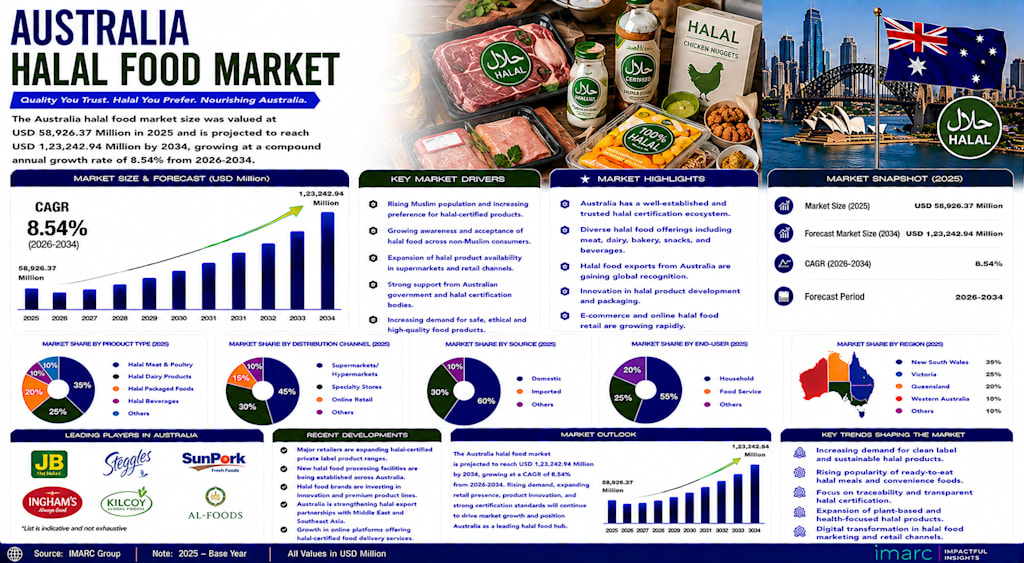
The Australia halal food market is undergoing a profound transformation, evolving from a niche sector serving a small domestic community into a multi-billion dollar export powerhouse that is reshaping the nation's agricultural and food processing landscape. According to IMARC Group, the market size reached USD 58,926.37 Million in 2025 and is projected to more than double to USD 123,242.94 Million by 2034, exhibiting a robust compound annual growth rate (CAGR) of 8.54% during 2026–2034. This extraordinary growth is driven by a powerful convergence of forces: a growing domestic Muslim population, surging global demand for premium Australian halal meat, and the mainstreaming of halal-certified products across major retail chains. As the industry confronts challenges of certification standardisation, it is also capitalising on unparalleled export opportunities, with Australian red meat and livestock exports to the Middle East and North Africa alone reaching $2.2 billion in 2025.
What's Driving Market Growth?
The Mainstreaming of Halal in Domestic Retail. The halal food market in Australia has moved decisively beyond ethnic grocery stores. A pivotal moment came when major grocery chains Woolworths and Coles began offering fresh halal meat, dramatically increasing accessibility for Muslim consumers and introducing halal-certified products to a broader audience. This mainstreaming is reflected in the market's distribution channels, with Supermarkets & Hypermarkets dominating with a 52.1% share in 2025, driven by convenience and consumer trust in certified offerings. The market is expanding beyond traditional meat and poultry to include processed foods, dairy, confectionery, and ready-to-eat meals, reflecting broader adoption across mainstream retail and foodservice channels. The rise of e-commerce platforms and online grocery delivery services is further driving accessibility and convenience. In a sign of the sector's growing commercial significance, fast-food chain Grill’d opened its first halal-certified restaurant in Blacktown, NSW, adapting its menu to cater to Muslim consumers.
Australia's Position as a Global Halal Export Powerhouse. The most powerful driver of market growth is Australia's status as a leading global supplier of halal-certified red meat. All Australian red meat is 100% Halal certified under the government's Authorised Halal Program, providing a trusted assurance of quality and compliance to international markets. Australian red meat and livestock exports to the Middle East and North Africa reached a record $2.2 billion in 2025**. Beef exports to the UAE alone were valued at **$316 million, with sheep meat exports reaching $394 million. The Australia-UAE Comprehensive Economic Partnership Agreement (CEPA) has further strengthened Australia's competitive position by removing tariffs on red meat. The Meat & Livestock Australia (MLA) presence at Gulfood 2026, featuring 37 Australian exporters, showcased the premium, Halal-assured quality that is driving demand across the MENA region, with chilled beef accounting for 84 per cent of Australian beef exports to the UAE.
Rising Muslim Population and Evolving Consumer Preferences. Australia's multicultural population is expanding, with the proportion of people living in urban areas rising from 58% in 1911 to 90% by 2021. This urbanisation, coupled with a growing Muslim population, is driving demand for certified, ethically sourced products. Consumers are increasingly seeking time-saving, high-quality meal solutions, leading to notable growth in halal ready-to-eat and convenience food categories. Manufacturers are responding with diversified product portfolios, including microwaveable meals and pre-prepared dishes, while ensuring strict adherence to halal standards. This shift is also opening doors to plant-based and vegetarian alternatives, catering to the rising interest in diverse dietary options among Muslim consumers.
Market Segmentation & Key Insights
By Product Type, the market is segmented into Meat, Poultry & Seafood; Processed Foods & Beverages; Dairy Products; Confectionery; and others. Meat, Poultry & Seafood dominates with a share of 48.5% in 2025, driven by high demand for protein-rich, certified halal products. However, the fastest growth is occurring in processed foods and ready-to-eat meals, reflecting changing consumer lifestyles.
By Distribution Channel, the market is segmented into Supermarkets & Hypermarkets, Convenience Stores, Specialty Stores, Online Retail, and Foodservice. Supermarkets & Hypermarkets dominates with a 52.1% share in 2025, benefiting from convenience and wide product availability. Online retail is the fastest-growing channel, driven by e-commerce platforms and delivery services.
By Region, the market is distributed across New South Wales & ACT, Victoria & Tasmania, Queensland, Western Australia, and others. NSW & ACT held the largest market segment in 2025, capturing 34.7% share, due to population density and strong demand for halal foods.
What the Opportunities Are?
Export Market Expansion in Asia and the Middle East. With significant growth potential in Indonesia, Malaysia, and the broader Middle East, there are substantial opportunities for Australian exporters. Indonesia currently imports approximately 140,000 metric tons of halal meat from Australia annually, and there is a significant gap to increase trade volume. Recent approvals for new export establishments to Malaysia, which already imports over AUD 300 million worth of halal-certified Australian sheep meat annually, further underscore these opportunities. Beef and veal exports to Indonesia were valued at $581 million in 2025, growing 49% since 2022.
Standardisation and Certification Reform. The halal certification industry in Australia is at a tipping point. Historically operating without a governing body or standardised guidelines, the industry is now facing pressure from consumers and industry players for greater transparency and consistency. This push for regulation presents a significant opportunity for certifiers who can offer robust, transparent, and internationally recognised certification. Government support for food safety and labelling regulations is poised to create a more structured and trusted market environment.
Diversification into Premium and Niche Halal Products. The market is seeing growing demand for premium products, as evidenced by the launch of premium halal Australian beef, including A5 Wagyu. There is also an opportunity in plant-based and vegan halal products, responding to the rising interest in vegetarian options among Muslim consumers. The diversification of product categories beyond meat into snacks, dairy, and confectionery presents a significant growth avenue.
Supply Chain and Traceability Investments. Retailers and manufacturers are investing in advanced traceability systems, cold chain management, and stringent certification processes. There is a growing opportunity for technology providers offering blockchain-based traceability, IoT-enabled cold chain monitoring, and AI-powered certification verification to support the integrity and transparency of the halal supply chain.
Recent News and Developments in Australia Halal Food Market
February 2026: Meat & Livestock Australia showcased 37 exporters at Gulfood 2026, following a record year where Australian red meat and livestock exports to the MENA region reached $2.2 billion. The Australia-UAE CEPA removed tariffs on red meat.
May 2026: Australia secured new market access to Indonesia for five export meat establishments, further boosting halal meat exports.
July 2025: An industry roundtable was held in Australia, marking the first step toward regulating the domestic halal certification market. Certifiers and suppliers opened conversations on standardisation, responding to consumer demand for transparency and consistency.
December 2023: Fast-food chain Grill’d opened its first halal-certified restaurant in Blacktown, NSW, marking a significant step in halal food entering mainstream foodservice.
March 2022: Exporters gained enhanced access to Malaysia's food sector, which imported over AUD 300 million worth of halal-certified Australian sheep meat annually, making up 71% of the country's total sheep meat imports.
Why Should You Know About Australia Halal Food Market?
You should know about this market because it captures how global trade dynamics, domestic demographic shifts, and evolving consumer expectations intersect to create one of Australia's most dynamic and strategically important food sectors. Halal food is no longer a niche market for a minority community — it is a mainstream economic force driving agricultural exports, reshaping retail shelves, and influencing the future of Australian food processing.
For investors, the halal food market offers exposure to a high-growth export-oriented category anchored in Australia's reputation as a trusted supplier of premium, safe, and ethically produced food. The projected CAGR of 8.54% reflects strong confidence in export demand, while the push for certification standardisation and product diversification offers differentiated upside potential.
For food manufacturers, exporters, and retailers, understanding the segmentation between meat, processed foods, and convenience products, the strategic importance of the MENA and Asian export markets, and the evolving certification landscape helps shape intelligent investment decisions, market entry strategies, and product development that deliver measurable export growth and consumer trust.
In essence, the Australia halal food market captures how cultural diversity, agricultural excellence, and global trade converge — making it a compelling area for investors, exporters, and food industry leaders seeking smarter approaches to halal certification, market expansion, and sustainable growth in one of the world's most trusted food-exporting nations.
About the Creator
Thomas
Market Research Analyst | Industry Trends & Forecasting | Turning market data into clear, actionable business insights across global sectors.
Enjoyed the story? Support the Creator.
Subscribe for free to receive all their stories in your feed.
Comments
There are no comments for this story
Be the first to respond and start the conversation.