
Australia Grid Modernization Market Powers Ahead as Renewable Integration Accelerates
Smart grids, renewable energy zones, and digital infrastructure are transforming Australia's electricity network.

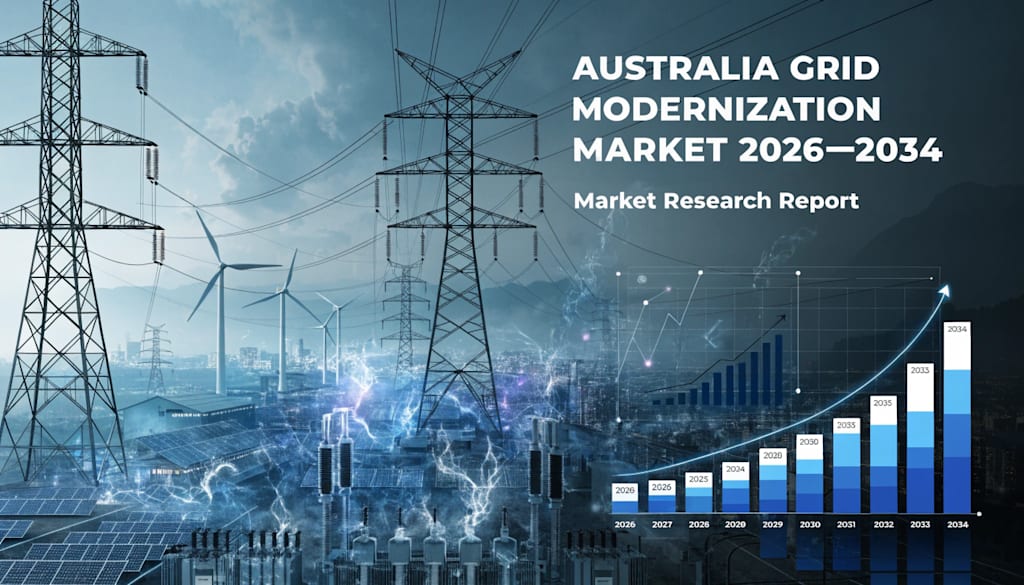
The Australia energy sector is undergoing one of the most significant transformations in its history. As the nation transitions toward a cleaner, smarter, and more resilient power system, grid modernization has become a strategic priority. According to IMARC Group, the Australia grid modernization market reached USD 914.1 Million in 2025 and is projected to soar to USD 4,586.2 Million by 2034, registering an exceptional CAGR of 19.04% during 2026-2034.
The rapid expansion reflects Australia's urgent need to modernize legacy infrastructure while accommodating soaring renewable energy capacity, electric vehicles, battery storage, and decentralized power generation. Traditional one-way electricity networks are giving way to intelligent, two-way systems capable of real-time management.
Grid modernization is no longer simply an infrastructure upgrade—it is the backbone of Australia's clean energy future. From advanced metering and automated substations to virtual power plants and distributed energy resource management systems, investment is accelerating across the entire electricity ecosystem.
Market Segmentation
By Component
• Hardware
• Software
• Services
By Application
• Residential
• Commercial
• Industrial
By End-User
• Utilities
• Independent Power Producers (IPPs)
• Government and Municipalities
By Region
• Australia Capital Territory & New South Wales
• Victoria & Tasmania
• Queensland
• Northern Territory & Southern Australia
• Western Australia
Request a Business Sample Report for Procurement & Investment Evaluation:
Why the Market Is Growing So Rapidly
Australia's renewable energy boom is the single biggest catalyst. Rooftop solar adoption is among the highest globally, with nearly one in three Australian households now generating their own electricity. This massive influx of distributed energy requires sophisticated grid infrastructure capable of managing two-way power flows and maintaining system stability.
The development of Renewable Energy Zones (REZs) is another major growth driver. These large-scale renewable clusters require extensive transmission upgrades to connect remote wind and solar assets with urban demand centers. Federal and state governments are investing billions in new interconnectors, substations, and high-voltage transmission corridors.
Electrification across transport, homes, and industry is placing new demands on the grid. The rapid adoption of electric vehicles, electric heating, and industrial electrification is increasing both electricity demand and network complexity. Smart grid technologies are essential for balancing these dynamic loads efficiently.
Digitalization is reshaping utility operations. Advanced sensors, artificial intelligence, predictive analytics, and real-time monitoring systems enable utilities to detect faults, optimize energy flows, and improve grid reliability. These technologies reduce downtime while enhancing resilience against extreme weather events and cyber threats.
Government policy support remains exceptionally strong. National decarbonization targets, the Rewiring the Nation initiative, and Australian Energy Market Operator (AEMO) roadmaps are providing clear long-term investment signals. Regulatory reforms are accelerating project approvals and supporting faster renewable integration.
What the Opportunities Are
1. Advanced Metering Infrastructure
Smart meter deployment offers substantial opportunities in data analytics and demand management.
2. Distributed Energy Resource Management Systems (DERMS)
Managing rooftop solar, batteries, and EV charging presents a rapidly expanding market.
3. Transmission Infrastructure Expansion
Renewable Energy Zones require massive new high-voltage transmission investment.
4. Virtual Power Plants (VPPs)
Aggregating distributed energy assets creates new revenue models and grid flexibility.
5. Grid Cybersecurity Solutions
Protecting increasingly digital networks is becoming mission-critical.
6. Battery Storage Integration
Large-scale storage projects are central to renewable grid stability.
7. AI-Driven Grid Analytics
Predictive maintenance and automated fault detection offer significant efficiency gains.
Recent News & Developments in Australia Grid Modernization Market
• February 2025: The Australian Energy Market Operator reported that new wind, solar, and battery project registrations reached approximately 5.2 GW since July, more than doubling the previous year's pace. This rapid pipeline growth highlights the increasing urgency of transmission expansion and digital grid upgrades to accommodate incoming renewable capacity.
• June 2025: The Australian Energy Market Commission finalized major grid connection reforms, with new standards scheduled to take effect in August 2025. The reforms are designed to reduce connection times, lower project costs, and accelerate renewable energy integration across the National Electricity Market.
• September 2025: Renewable energy supplied a record 77.9% of electricity in Australia's main grid during peak periods, underscoring the growing importance of advanced grid balancing, storage systems, and real-time network management technologies. This milestone further strengthened investment momentum across the grid modernization sector.
Why Should You Know About Australia Grid Modernization Market?
The Australia grid modernization market sits at the center of the nation's energy transition. For investors, it offers exposure to one of the fastest-growing infrastructure and clean technology sectors in the country.
For utilities, equipment manufacturers, and software providers, the opportunities are immense. Grid modernization touches every layer of the electricity value chain, from hardware and automation to AI, cybersecurity, and energy storage.
For policymakers, a modernized grid is essential to achieving emissions targets, improving energy security, and maintaining affordability for consumers.
As Australia races toward a renewable-powered future, grid modernization will determine how quickly, reliably, and efficiently that transition unfolds. Few markets are as strategically important—or as full of opportunity—as this one.
About the Creator
Rashi Sharma
I am a market researcher.
Enjoyed the story? Support the Creator.
Subscribe for free to receive all their stories in your feed.
Comments
There are no comments for this story
Be the first to respond and start the conversation.