
Australia Green Hydrogen Market 2026: Clean Energy Transition, Export Opportunities & Electrolyzer Innovation Driving Massive Growth
How renewable energy investments, government incentives, and global decarbonization goals are transforming the Australia green hydrogen industry

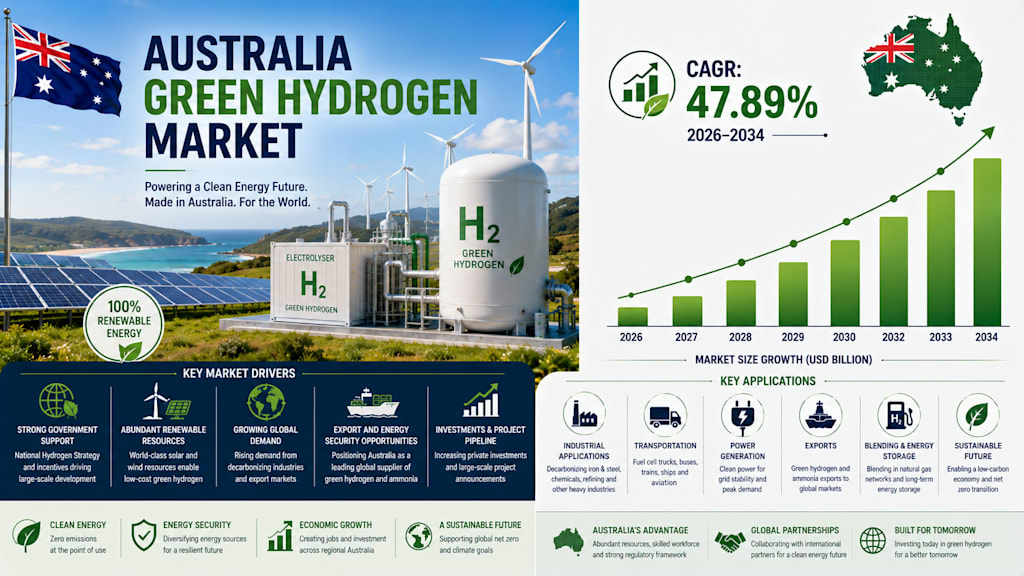
Australia Green Hydrogen Market Overview
The Australia green hydrogen market is emerging as one of the country’s fastest-growing clean energy sectors, focusing on hydrogen production using renewable energy sources such as solar and wind power through electrolysis processes. Green hydrogen is expected to play a critical role in industrial decarbonization, energy storage, export markets, and the transition toward net-zero emissions.
According to IMARC Group, the Australia green hydrogen market size reached USD 70.1 Million in 2025 and is projected to reach USD 2,594.0 Million by 2034, exhibiting a compound annual growth rate (CAGR) of 47.89% during 2026–2034.
The market is witnessing exceptional growth driven by strong government support, abundant renewable energy resources, increasing international demand for clean hydrogen, and large-scale investments in hydrogen infrastructure and export-oriented projects.
Key Market Drivers
Strong Government Support and Hydrogen Policies
Australian federal and state governments are introducing hydrogen roadmaps, tax incentives, funding programs, and infrastructure initiatives to accelerate green hydrogen development and attract long-term investments.
Abundant Renewable Energy Resources
Australia’s vast solar and wind energy potential provides favorable conditions for large-scale green hydrogen production at competitive costs.
Rising Global Demand for Clean Energy Exports
Countries such as Japan, South Korea, and European nations are increasing demand for imported green hydrogen to support decarbonization goals and clean energy transitions.
Expansion of Industrial Decarbonization Initiatives
Industries including steelmaking, chemicals, transport, and power generation are increasingly exploring green hydrogen as a low-carbon alternative to fossil fuels.
Growth of Hydrogen Infrastructure Investments
Development of hydrogen hubs, export terminals, storage facilities, and electrolyzer installations is supporting market expansion across Australia.
Request a Sample Report with the Latest 2026 Data & Forecasts
What the Opportunities Are
Expansion of Green Hydrogen Export Markets
Australia is positioning itself as a global green hydrogen exporter due to its strategic location and strong trade relationships within the Asia-Pacific region.
Growth of Green Ammonia Production
Converting hydrogen into green ammonia for transportation and storage is creating additional commercial opportunities for export-focused projects.
Increasing Investment in Electrolyzer Technologies
Advancements in proton exchange membrane (PEM) and alkaline electrolyzer technologies are improving production efficiency and reducing operational costs.
Development of Renewable Energy Hubs
Integrated renewable energy and hydrogen production hubs are emerging across regions such as Western Australia and Queensland.
Rising Demand for Hydrogen-Powered Transport
Hydrogen fuel technologies are gaining traction in heavy transport, industrial mobility, and long-distance logistics applications.
Recent News and Developments
May 2026: The Australia green hydrogen market continues to attract major international investment as Australia strengthens its position as a future clean hydrogen export hub. Several large-scale projects across Western Australia and Queensland are progressing to support hydrogen production for industrial use, power generation, and export to Asian markets including Japan and South Korea.
April 2026: Australia expanded support for renewable hydrogen infrastructure through public and private sector investments in electrolyser manufacturing, storage facilities, and export terminals. Industry reports indicate that announced hydrogen projects in Australia now represent more than 100 GW of planned renewable energy capacity, highlighting the scale of long-term hydrogen development activity.
March 2026: Green hydrogen development is increasingly linked to Australia’s mining and heavy industrial sectors. Mining companies and industrial operators are investing in hydrogen-powered trucks, renewable-powered processing facilities, and low-emission industrial operations to reduce carbon emissions and meet sustainability targets.
February 2026: Electrolyser deployment and renewable-powered hydrogen production projects are accelerating across the country. Australia’s installed and announced electrolyser pipeline exceeded approximately 15 GW in early 2026, supported by declining renewable energy costs and government decarbonisation initiatives.
December 2025: Export-oriented hydrogen partnerships continued expanding between Australia and Asian economies. Long-term agreements related to hydrogen and ammonia supply chains gained momentum as countries including Japan, Singapore, and South Korea increased investments in clean fuel imports and decarbonisation strategies.
2025–2026 (market trend): The Australia green hydrogen market is being shaped by large-scale renewable energy expansion, hydrogen export ambitions, industrial decarbonisation, and advances in electrolyser technologies. At the same time, infrastructure costs, water availability concerns, regulatory complexity, and uncertain global hydrogen demand continue to influence project development timelines and investment decisions across the sector.
Why You Should Know About the Australia Green Hydrogen Market?
The Australia green hydrogen market is becoming a cornerstone of the country’s long-term clean energy and industrial decarbonization strategy.
With projected growth from USD 70.1 Million in 2025 to USD 2,594.0 Million by 2034, the market demonstrates extraordinary expansion potential driven by renewable energy availability, supportive government policies, and rising global demand for low-carbon fuels.
As Australia accelerates investments in renewable infrastructure, hydrogen export capabilities, and industrial decarbonization technologies, green hydrogen is expected to play a critical role in shaping the country’s future energy economy and global clean energy leadership.
About the Creator
Amyra Singh
Market research analyst who loves spotting patterns, digging into data, and turning insights into strategies that help brands grow and stay ahead of the curve.
Enjoyed the story? Support the Creator.
Subscribe for free to receive all their stories in your feed.
Comments
There are no comments for this story
Be the first to respond and start the conversation.