
Australia Green Building Market 2026: Sustainable Construction, ESG Investments & Energy Efficiency Standards Driving Growth
How green certifications, government regulations, and demand for environmentally sustainable infrastructure are transforming the Australia green building industry

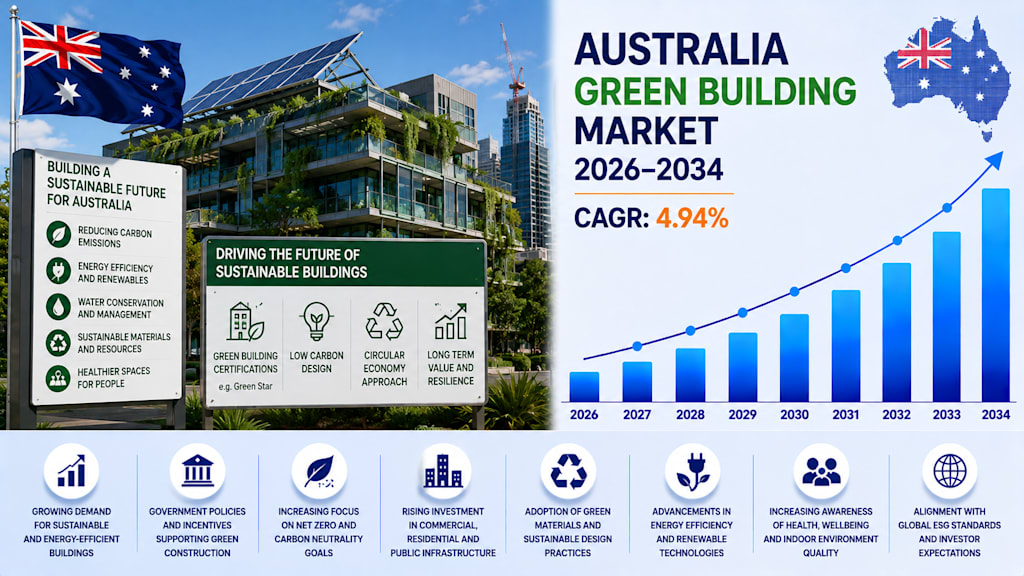
Australia Green Building Market Overview
The Australia green building market is an increasingly important segment of the country’s construction, real estate, and infrastructure industry, encompassing sustainable building materials, energy-efficient systems, environmentally responsible construction practices, renewable energy integration, and green-certified residential and commercial developments.
According to IMARC Group, the Australia green building market size reached USD 3.5 Billion in 2025 and is projected to reach USD 5.5 Billion by 2034, exhibiting a compound annual growth rate (CAGR) of 4.94% during 2026–2034.
The market is witnessing steady growth driven by stringent energy-efficiency regulations, increasing adoption of sustainable construction practices, growing demand for green-certified buildings, rising environmental awareness, and expanding ESG-focused investment activity across the real estate sector.
Key Market Drivers
Implementation of Energy Efficiency Regulations
Government regulations and building standards are increasingly encouraging developers and construction companies to adopt environmentally sustainable building designs, energy-efficient technologies, and low-carbon construction solutions.
Growing Popularity of Green Building Certifications
Certification frameworks such as Green Star are supporting higher adoption of sustainable building practices by establishing recognized benchmarks for environmental performance and operational efficiency.
Rising ESG Investment Trends
Institutional investors, property developers, and corporations are increasingly prioritizing environmental, social, and governance (ESG) objectives, supporting investment in green infrastructure and sustainable real estate assets.
Increasing Demand for Energy-Efficient Buildings
Property owners and occupants are increasingly seeking buildings that reduce energy consumption, lower operational costs, and improve long-term environmental performance.
Corporate Sustainability Commitments
Businesses are increasingly incorporating sustainability objectives into their real estate strategies, supporting demand for green-certified offices, commercial facilities, and environmentally responsible infrastructure projects.
Request a Sample Report with the Latest 2026 Data & Forecasts
What the Opportunities Are
Expansion of Net-Zero and Carbon-Neutral Buildings
The growing focus on emissions reduction targets is creating opportunities for developers to invest in net-zero energy buildings and carbon-neutral construction projects.
Growth of Renewable Energy Integration
The increasing adoption of rooftop solar systems, energy storage technologies, and renewable power solutions is strengthening opportunities across sustainable building developments.
Rising Demand for Smart Building Technologies
Developers are increasingly integrating automation systems, IoT-enabled monitoring solutions, and advanced energy management platforms to improve building performance and sustainability outcomes.
Development of Sustainable Commercial Real Estate
Commercial property owners are increasingly investing in green-certified office spaces, retail developments, and mixed-use projects to attract environmentally conscious tenants and investors.
Increasing Adoption of Environmentally Friendly Building Materials
Growing demand for recycled materials, sustainable timber, low-emission products, and resource-efficient construction solutions is creating opportunities across the green building value chain.
Recent News and Developments
May 2026 : The Australia green building market continued expanding as developers, investors, and property owners increasingly prioritized sustainability objectives, energy efficiency improvements, and environmentally responsible construction practices.
May 2026 : ESG-focused investment activity remained a major growth driver across the green building sector. Institutional investors increasingly favored sustainable real estate assets with strong environmental performance and long-term operational efficiency.
April 2026 : Green-certified commercial and residential developments continued gaining momentum as businesses and consumers increasingly sought environmentally sustainable buildings with lower energy consumption and reduced operating costs.
March 2026 : Smart building technologies experienced rising adoption across new construction projects. Developers increasingly integrated digital energy management systems, building automation solutions, and real-time sustainability monitoring platforms.
February 2026 : Government initiatives supporting emissions reduction, sustainable urban development, and energy-efficient infrastructure continued encouraging investments in green construction projects nationwide.
January 2026 : Renewable energy integration remained a key trend across the construction sector as developers expanded investments in solar energy systems, battery storage technologies, and energy-efficient building designs.
December 2025 : Demand for environmentally sustainable construction materials continued increasing as developers focused on reducing carbon footprints and improving resource efficiency across residential and commercial projects.
November 2025 : Green Building Council of Australia initiatives continued strengthening sustainability benchmarks across the industry, supporting broader adoption of environmentally responsible design and operational standards.
2025–2026 (Market Trend) : The Australia green building market is being shaped by rising sustainability awareness, stricter environmental regulations, growing ESG investment activity, and increasing demand for energy-efficient infrastructure. Developers are increasingly investing in green certifications, renewable energy integration, smart building technologies, and sustainable construction materials to enhance environmental performance and long-term asset value. At the same time, construction costs, regulatory compliance requirements, material supply challenges, and project financing considerations continue influencing market expansion and investment decisions.
Why You Should Know About the Australia Green Building Market?
The Australia green building market is becoming an increasingly important pillar of the country’s construction, infrastructure, and sustainable development ecosystem.
With projected growth from USD 3.5 Billion in 2025 to USD 5.5 Billion by 2034, the market demonstrates strong long-term potential supported by sustainability regulations, energy-efficiency requirements, ESG investment trends, and growing environmental awareness.
As developers, investors, and government agencies continue investing in green-certified projects, renewable energy systems, smart building technologies, and sustainable construction solutions, the sector is expected to play a critical role in shaping the future of Australia’s real estate, infrastructure, and environmental sustainability landscape.
About the Creator
Amyra Singh
Market research analyst who loves spotting patterns, digging into data, and turning insights into strategies that help brands grow and stay ahead of the curve.
Enjoyed the story? Support the Creator.
Subscribe for free to receive all their stories in your feed.
Comments
There are no comments for this story
Be the first to respond and start the conversation.