
Australia Government Cloud Market 2026: Sovereign Cloud Surge, Whole of Government Policy & AI Integration
How the new Cloud Policy, Top Secret defense cloud and $1.6bn procurement savings are driving Australia's public sector digital transformation

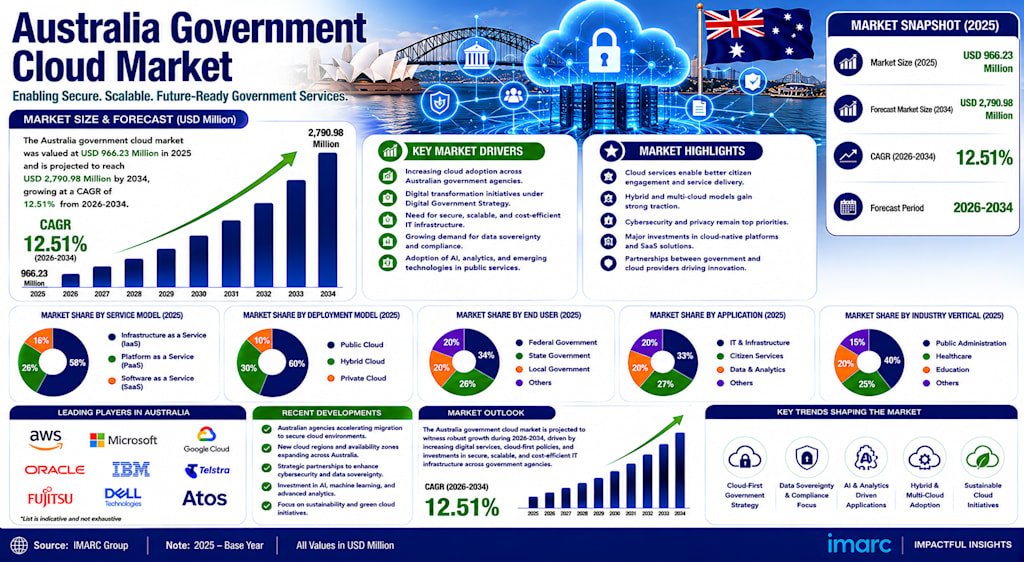
The Australia government cloud market is expanding at an accelerated pace as federal, state and local agencies undergo a fundamental shift from legacy on premise ICT infrastructure to secure, scalable and AI ready cloud platforms. Government cloud solutions — encompassing SaaS, PaaS and IaaS models delivered through hybrid, sovereign and accredited cloud environments — are deployed across defense and intelligence, citizen services, healthcare, transport, taxation and social welfare systems to modernise operations, strengthen cybersecurity and enable data driven policymaking.
According to IMARC Group, the market size reached USD 966.23 Million in 2025 and is projected to reach USD 2,790.98 Million by 2034, exhibiting a robust compound annual growth rate (CAGR) of 12.51% during 2026–2034. This near threefold expansion reflects the confluence of an overdue legacy system renewal cycle, a world leading national cloud computing policy that takes effect in July 2026, and a deepening commitment to sovereign data control — from the AUD 2 billion Top Secret Cloud for defense to multi cloud architectures that keep sensitive workloads onshore while unlocking the scalability of public cloud.
What's Driving Market Growth?
Whole of Government Cloud Computing Policy (Effective July 2026). The single most powerful driver is the new Cloud Policy, released by the Digital Transformation Agency (DTA) in December 2025 and taking effect on 1 July 2026. The policy mandates that Australian Public Service entities must prioritise cloud computing solutions when modernising IT infrastructure and consider cloud for all new digital initiatives unless an alternative is justified. It also requires agencies to leverage contemporary cloud technology to empower innovation, including artificial intelligence, while adopting cloud technologies responsibly and securely. The policy applies to all models of cloud adoption — public, private and hybrid — and encourages hybrid or multi cloud models when pure cloud solutions are not justified. By embedding cloud planning into mandatory Digital Investment Plans, the DTA has aligned the entire federal digital investment pipeline around cloud first principles, creating a multi billion dollar procurement tailwind through 2034.
Top Secret Cloud and Defense Grade Sovereign Infrastructure. Government investment in secure cloud infrastructure is substantial, exemplified by the partnership between the Australian Signals Directorate and Amazon Web Services (AWS) to develop a Top Secret Cloud for defense and intelligence agencies — representing a commitment of approximately AUD 2 billion over the next decade. This initiative demonstrates the strategic importance placed on sovereign cloud capabilities for handling classified information while driving innovation in cybersecurity and data analytics sectors. Data sovereignty has become a critical factor shaping cloud adoption, with regulatory frameworks providing guidelines for secure domestic data management and cloud providers expanding local infrastructure to meet these requirements.
Accelerated Adoption of Hybrid and Multi Cloud Architectures. Government agencies are increasingly embracing hybrid and multi cloud deployment models to balance data sovereignty requirements with operational flexibility. This approach enables agencies to maintain sensitive workloads on premise or in private cloud environments while leveraging public cloud scalability for less sensitive applications. Hybrid cloud leads the market with a share of 44.3% in 2025, attributed to government requirements for maintaining sensitive data on premise while leveraging public cloud scalability, meeting data sovereignty mandates, and enabling flexible workload management across secure environments.
Integration of Artificial Intelligence and Generative AI Technologies. Australian government agencies are rapidly integrating AI capabilities within cloud platforms to enhance service delivery and operational efficiency. The DTA completed one of the world's largest generative AI workplace trials in 2024, involving over 7,600 staff across 60 government agencies using Microsoft 365 Copilot. Participants reported significant productivity gains, with time savings reallocated to higher value activities including strategic planning and stakeholder engagement. This successful trial has positioned Australia as a global leader in responsible AI implementation within government, and the new Cloud Policy explicitly embeds AI readiness as a core requirement. The Australia Smart Governments Market is experiencing significant growth driven by increasing adoption of digital technologies by government bodies to enhance operational efficiency and service delivery.
Defense, Intelligence and National Security Cloud Uplift. Beyond the Top Secret Cloud, broader national security priorities are accelerating cloud adoption. The Cyber Security Legislative Reforms passed in late 2024 included amendments to the Security of Critical Infrastructure Act 2018 (SOCI Act), clarifying obligations for critical infrastructure owners and operators to protect data storage systems that hold business critical data. The 2025 release of the Protective Security Policy Framework features a focus on new and emerging technologies, ensuring policy settings are appropriate for the contemporary threat environment. The government is currently developing Horizon 2 of the Cyber Security Strategy, which will include additional initiatives between 2026 2028 to ensure critical infrastructure and essential government systems can withstand and bounce back from cyber hazards.
Significant Investment in Procurement and Strategic Vendor Agreements. The DTA has secured a new five year Volume Sourcing Agreement with Microsoft on behalf of the Australian Government, commencing on 1 July 2026. The agreement provides cost certainty through stable pricing, improved discounts and capped price increases for essential ICT products and online services used across the Australian Government. A review of the Australian Government's Single Seller Arrangements found they delivered $1.6 billion in discounts between 2019 and 2024, with more than 10,000 Australians employed by Single Seller Arrangement sellers. The agreement introduces stronger legal protections, enhanced governance, reporting and security provisions for handling government data, and accelerates the APS's capability to adopt AI and other innovative technologies. The DTA also has whole of government agreements with AWS, IBM, Oracle, Rimini Street and SAP.
Market Segmentation & Key Insights
By Component, solutions dominate the market with a share of 59.8% in 2025, driven by strong demand for comprehensive cloud management platforms, security solutions and analytics capabilities that enable government agencies to effectively manage complex digital infrastructure and deliver enhanced citizen services. The solutions segment includes cloud management platforms, security solutions, analytics tools and application development frameworks essential for government digital operations, with cloud security and compliance solutions being particularly critical under the Protective Security Policy Framework.
By Deployment Model, hybrid cloud leads with a share of 44.3% in 2025, attributed to government requirements for maintaining sensitive data on premise while leveraging public cloud scalability, meeting data sovereignty mandates, and enabling flexible workload management across secure environments.
By Service Model, Infrastructure as a Service (IaaS) represents the largest segment with a market share of 42.1% in 2025, owing to government agencies' need for scalable computing resources, storage capabilities and networking infrastructure to support mission critical applications and digital transformation initiatives.
By Application, server and storage lead the market with a share of 34.5% in 2025, reflecting the fundamental requirement for secure data storage, processing capacity and computational resources essential to government operations and service delivery frameworks.
By Region, Australia Capital Territory & New South Wales dominate with 36.2% market share in 2025, driven by the concentration of federal government departments in Canberra and major state agencies in Sydney, along with established cloud infrastructure and advanced digital government capabilities.
By Market Structure, the Australia government cloud market exhibits a moderately consolidated competitive structure, featuring major global hyperscalers alongside specialized domestic providers. Competition centers on security certifications, data sovereignty compliance, and delivery of comprehensive managed services tailored to public sector requirements. The broader Australia cloud computing market size reached USD 28.8 Billion in 2025 and is projected to reach USD 155.6 Billion by 2034 at a CAGR of 19.58%, reflecting the extensive opportunity within which the government segment operates. Australian organizations are expected to spend more than A$33.6 billion on public cloud services in 2026, an increase of 17.9% from 2025.
What the Opportunities Are?
Sovereign Cloud and Data Residency Solutions. Data sovereignty has become a critical factor shaping cloud adoption, with regulatory frameworks providing guidelines for secure domestic data management, ensuring sensitive information remains under national jurisdiction. Cloud providers are expanding local infrastructure to meet these requirements, and recent initiatives highlight the emphasis on in country processing of data and interactions. There is strong opportunity for providers offering sovereign cloud platforms with Australian data residency, IRAP certifications at PROTECTED level, and secure government grade encryption. The Top Secret Cloud partnership between ASD and AWS, representing approximately AUD 2 billion over the next decade, demonstrates the scale of addressable opportunity in the highest security segments.
AI Ready Cloud Platforms and Machine Learning Infrastructure. With the Cloud Policy explicitly requiring agencies to embed AI readiness across cloud platforms to support innovation and service delivery, and the DTA's GenAI trial proving the productivity case at scale, the demand for AI optimised cloud infrastructure is accelerating. The DTA estimates that faster cloud adoption can support $5 billion in productivity gains for the Australian Government by enabling widespread use of AI tools. Vendors offering integrated AI/ML services within government accredited cloud environments — including model training infrastructure, inferencing platforms and responsible AI governance tools — will capture significant share as agencies move from trials to production deployments. With 80% of government CIOs citing AI as a top budget priority and 85% expecting IT budgets to rise in 2026, cloud providers with embedded AI capabilities are positioned for sustained growth.
Hybrid and Multi Cloud Management Platforms. The popularity of hybrid deployments creates opportunities for cloud management and orchestration platforms that unify operations across on premise, private cloud and multiple public cloud environments. The DTA encourages hybrid or multi cloud models when pure cloud solutions are not justified, ensuring strategic alignment with security and compliance mandates. As agencies adopt increasingly complex multi vendor cloud estates, demand will grow for FinOps tools that optimize cloud expenditure (one of the five core policy requirements), cloud security posture management (CSPM) solutions for government compliance, and multi cloud governance platforms with automated policy enforcement.
Cloud Migration and Legacy Modernisation Services. The government's aging ICT estate represents both a risk and an opportunity. The Cloud Policy requires entities to prioritise moving off legacy systems, to transition to cloud where it makes sense to do so, and to prioritise timely decommissioning of legacy systems as part of cloud initiatives. Accelerating cloud adoption by five years could save the Australian Government 3.4 billion over the next four years, and 13.5 billion by 2035. This creates multi year pipelines for specialist cloud migration service providers, system integrators and managed service providers with expertise in government specific compliance frameworks and legacy application modernization.
Cloud Security and Compliance Automation. Cloud security and compliance solutions are particularly critical, with government agencies facing stringent requirements under the Protective Security Policy Framework. The Cyber Security Legislative Reforms, including amendments to the SOCI Act and the 2025 release of the updated PSPF, have elevated compliance obligations for government cloud deployments. The ACSC released executive guidance on the cloud shared responsibility model for government in October 2025. Vendors offering automated compliance monitoring, continuous security posture assessment, and integrated security analytics for government accredited clouds will find receptive agencies seeking to reduce manual compliance overhead while improving security outcomes.
Workforce Skills and Capability Development. The Cloud Policy explicitly requires entities to nurture cloud skills across the APS. The DTA's Lucy Poole stated that "strong cloud capability is vital to the success of an enduring and effective digital transformation," and the policy helps agencies plan the workforce, skills and governance needed to manage cloud services effectively and securely across government. This creates opportunities for training providers, certification programs and cloud skills development services targeted at public sector technology professionals.
Data Analytics and Citizen Centric Service Platforms. Rising emphasis on data driven governance, automation and secure information management is further strengthening demand for scalable cloud platforms. Investments in advanced analytics, artificial intelligence and cybersecurity capabilities are also accelerating cloud adoption, positioning cloud infrastructure as a core enabler of efficient, resilient and future ready public sector operations. Secure data sharing under the Data Availability and Transparency Act 2022, which established a scheme for sharing Australian Government data with accredited entities for policy, program and service delivery purposes, creates further demand for cloud enabled data analytics platforms.
Recent News and Developments in Australia Government Cloud Market
December 2025: The DTA released the new Cloud Policy, establishing a clear direction for cloud adoption across the Australian Public Service. The policy strengthens foundations for secure, modern and high performing digital services and supports responsible use of emerging technologies, taking effect from 1 July 2026.
December 2025: The DTA released the Data and Digital Government Strategy's 2025 Implementation Plan, the latest annual update driving progress in AI, data, service delivery and cybersecurity to strengthen the nation's digital future.
February 2026: The DTA signed a new five year Volume Sourcing Agreement with Microsoft, commencing on 1 July 2026, providing cost certainty through stable pricing and capped increases for essential ICT products and online services across the Australian Government.
2025: The Australian Signals Directorate and AWS progressed the development of a Top Secret Cloud for defense and intelligence agencies, representing a commitment of approximately AUD 2 billion over the next decade.
2025: The Protective Security Policy Framework was updated with a focus on new and emerging technologies, ensuring policy settings are appropriate for the contemporary threat environment.
April 2025: Schedule 5 of the Cyber Security Legislative Reforms commenced, uplifting telecommunications security obligations for critical telecommunications assets as part of broader SOCI Act amendments.
2025: The DTA completed one of the world's largest generative AI workplace trials, involving over 7,600 staff across 60 government agencies using Microsoft 365 Copilot, with participants reporting significant productivity gains.
November 2025: The government continued developing Horizon 2 of the Cyber Security Strategy, with additional initiatives between 2026 2028 to ensure critical infrastructure and essential government systems can withstand cyber hazards.
2025: A review found that the Australian Government's Single Seller Arrangements delivered $1.6 billion in discounts between 2019 and 2024, with more than 10,000 Australians employed by arrangement sellers.
Why Should You Know About Australia Government Cloud Market?
You should know about this market because it captures how policy enforcement, national security imperatives and AI driven transformation intersect to create one of the most stable, high growth cloud segments in the Asia Pacific region. Government cloud is no longer about simple cost cutting or storage as a service — it is the strategic platform for AUKUS aligned defense infrastructure, the backbone of the AUD 2 billion Top Secret Cloud, and the regulated environment where Australia's public sector AI transformation will unfold over the next decade.
For investors, the Australia government cloud market offers exposure to a high growth sovereign technology category anchored in legislated policy mandates, multi year defense funding cycles, and the structural shift away from legacy ICT procurement that has delivered $1.6 billion in documented savings. The projected CAGR of 12.51% — among the highest of any government specific cloud market globally — reflects the compounding effect of simultaneous tailwinds: the July 2026 policy activation, the full build out of the Top Secret Cloud, the productivity validated case for government wide AI adoption, and the ongoing replacement of aging systems across federal, state and local agencies.
For technology vendors, digital service providers, cybersecurity specialists and infrastructure investors, understanding the government cloud segmentation, the hybrid deployment dominance, the sovereign data requirements embedded in the PSPF and the unique procurement machinery of the DTA's Whole of Government agreements helps shape intelligent bid strategies, compliance roadmaps and long term capability investments that deliver measurable security, efficiency and sovereign capability outcomes.
In essence, the Australia government cloud market captures how digital sovereignty, national security and public service modernisation converge — making it a compelling area for innovators, investors and technology leaders seeking smarter approaches to secure, scalable and mission ready cloud infrastructure that supports one of the world's most digitally advanced public sectors.
About the Creator
Thomas
Market Research Analyst | Industry Trends & Forecasting | Turning market data into clear, actionable business insights across global sectors.
Enjoyed the story? Support the Creator.
Subscribe for free to receive all their stories in your feed.
Comments
There are no comments for this story
Be the first to respond and start the conversation.