
Australia Germanium Market: Strategic Material Growth, Tech Applications & Supply Chain Dynamics
How the green transition, 5G rollouts, and evolving national security priorities are creating a market for a modest but essential critical mineral

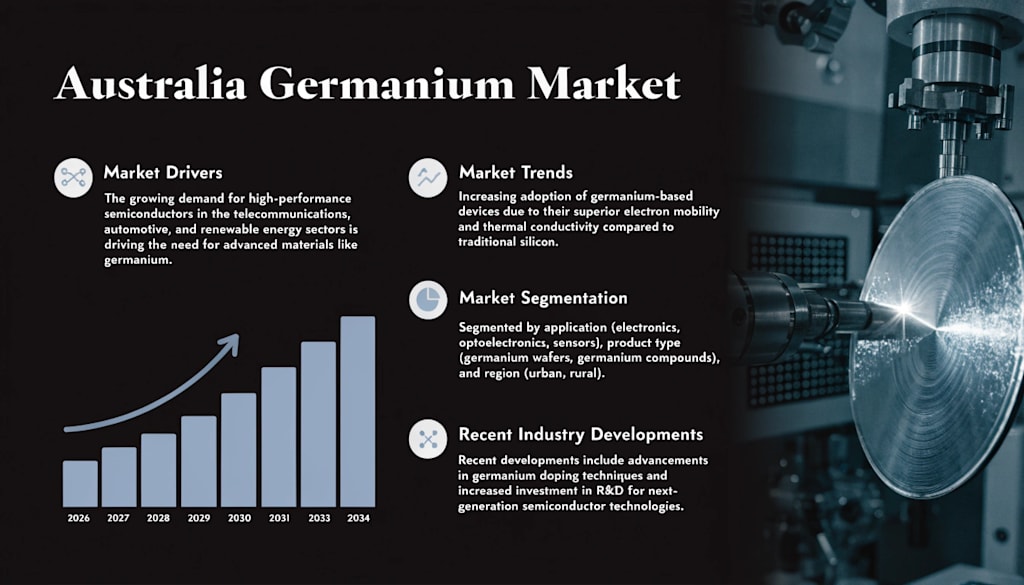
The Australia germanium market is experiencing incremental but strategically significant growth as telecommunications providers expand fiber-optic networks, the defence and space sectors adopt advanced infrared imaging technologies, and government initiatives accelerate domestic processing of by-product critical minerals. Germanium — a lustrous, hard, brittle metalloid with unique optical and electronic properties — is deployed across fiber optics, infrared optics, semiconductor devices, and high-efficiency multi-junction solar cells for demanding aerospace and concentrated photovoltaic applications.
According to IMARC Group, the market size reached USD 6.7 Million in 2025 and is projected to reach USD 9.16 Million by 2034, exhibiting a compound annual growth rate (CAGR) of 3.54% during 2026–2034. While modest in absolute terms, the market is poised to benefit from long-term structural drivers, including a strategic push to secure supply chains for high-tech industries and reduce dependency on imported critical minerals.
What's Driving Market Growth?
Fiber Optic Network Expansion and 5G Infrastructure. The telecommunications sector is undergoing a major transformation with substantial investments in fiber-optic infrastructure to support nationwide 5G network deployments and enhanced broadband connectivity. Germanium tetrachloride serves as a critical precursor material in the production of high-purity optical fibers, which form the backbone of modern telecommunications systems. The material's unique properties enable the creation of low-loss optical fibers essential for long-distance data transmission and high-speed internet connectivity. Major telecommunications providers are extending fiber-to-the-premises networks throughout metropolitan and regional areas, and government efforts like the Regional Connectivity Program are accelerating the expansion of fiber optics in underserved areas. Global germanium consumption is projected to reach approximately 280 tonnes by 2030, driven by fibre optic infrastructure buildout, defence optics investment, and energy transition deployment.
Defence, Space, and Autonomous Vehicle Applications. Germanium's infrared transmission properties make it invaluable for thermal imaging, night vision, and surveillance systems used by defence forces and increasingly for autonomous vehicle sensor suites. Germanium-based infrared optics are essential components of satellite payloads, missile guidance systems, and a growing array of industrial and automotive sensing applications. The Australian space industry, in its infancy but rapidly developing with government support for satellite manufacturing and launch capabilities, is expected to drive consumption of germanium-based infrared optics and radiation-resistant substrates throughout the forecast period. An F-35 fighter jet's sophisticated sensor suite, which incorporates many critical minerals, highlights the material's strategic importance in modern defence systems. The adoption of infrared optics in autonomous vehicle systems is expanding the Australia germanium market share.
Strategic Government Initiatives to Secure Critical Mineral Supply. The Australian government has prioritised the development of domestic critical mineral supply chains, explicitly identifying germanium as a strategic material vulnerable to disruption. Australia published its Critical Minerals Strategy 2023-2030 and updated its Critical Minerals List, with germanium included on the official list. China dominates global processing of many critical minerals, controlling approximately 60% of germanium production, and has imposed restrictions on critical minerals exports, disrupting supply chains for industries including automotive and defence, underscoring the geopolitical risks of over-reliance on Chinese refining. These restrictions have spurred Western nations to secure alternative sources, and Australia aims to position itself as a reliable and secure supplier.
The government-funded Australian Critical Minerals Research and Development Hub is focusing on extracting germanium from existing zinc mining operations. This includes a project with Geoscience Australia and CSIRO to develop process technology for separating germanium from zinc ore by-products in regions such as Western Australia and Queensland. The global germanium market itself was estimated at USD 322.90 million in 2025, growing at a CAGR of 3.3% from 2026 to 2034, underscoring the broader international context.
Market Segmentation & Key Insights
By Type, the market includes germanium ingot, germanium tetrachloride, high-purity GeO₂, polycrystalline germanium, single-crystal germanium, and others. Germanium tetrachloride is particularly important for fiber-optic applications, serving as the key precursor for germanium-doped silica glass.
By Application, the market covers fiber optics, infrared optics, electronics and semiconductors, solar cells, medical imaging, and others. Fiber optics and infrared optics are the dominant application segments globally, together accounting for the majority of germanium consumption, while electronics and solar applications are expected to grow at the fastest pace.
By End-User, the market includes telecommunications, consumer electronics, automotive, military & defence, healthcare, and others.
By Region, major markets include Australia Capital Territory & New South Wales, Victoria & Tasmania, Queensland, Northern Territory & Southern Australia, and Western Australia.
What the Opportunities Are?
Domestic Processing of By-Product Germanium from Zinc Mining. The most significant opportunity lies in unlocking the germanium contained in existing zinc operations. Germanium is not typically mined directly but is recovered as a by-product of zinc processing. Australia's substantial zinc mining sector generates significant potential volumes of germanium that currently remain unseparated. The cost of separation can be significant, so the decision to separate is often made on strategic grounds rather than pure economics. With government funding and offtake agreements becoming available, miners can retrofit refineries and smelters to capture germanium and other critical minerals, using government capital to fund improvements that might otherwise be uneconomic.
The A$135 million (US$87.4 million) support package extended to Nyrstar's smelters in South Australia and Tasmania in 2025 includes studies into producing germanium and indium at the Hobart zinc plant. Through these studies, Nyrstar proposes to explore possible production of antimony, bismuth, tellurium, germanium and indium, minerals vital to clean energy, defence, and high-tech sectors. Nyrstar contributes around $1.7 billion to Australia's economy each year and directly employs 1,400 Australians, supporting a further 6,600 indirect jobs.
Breakthrough Refining Technologies for Sovereign Capability. Australian startup Gega Elements is building scalable, sustainable refining processes to unlock Australia's vast germanium and gallium reserves. Its refining approach eliminates conventional methods that rely on toxic solvents, reducing CO₂ emissions by around 30% while significantly lowering operating costs. The company has raised pre-seed funding to build sovereign refining capability for gallium and germanium and is partnering with RareX to create Australia's first end-to-end gallium and germanium supply chain.
Strategic Alliances and Off-Take Agreements. The US–Australia Critical Minerals Framework, signed in October 2025, commits both governments to mobilize at least US$1 billion each in financing. The landmark Framework commits both nations to mobilizing at least US$1 billion in joint project financing, accelerating permitting, and supporting the development of diversified, secure and sustainable supply chains for critical minerals and rare earth elements. This injection of capital, alongside mechanisms such as offtake agreements and potential price floors, directly addresses longstanding challenges in the critical mineral mining sector, unlocking financing for new projects and expansions.
Australia's Metallium signed a 10-year US critical minerals off-take deal in March 2026 to supply gallium, germanium and indium to a US-based specialty materials refiner, with pricing set under a formula-based schedule. The company's patented Flash Joule Heating technology enables the extraction of high-value materials, including gallium, germanium, antimony, rare earth elements and gold from feedstock such as refinery scrap, e-waste and monazite. Metallium has raised AU$75 million to advance its U.S. operations and commercialisation.
Extraction from Mining Waste and Tailings. Australian scientists are exploring ways to extract rare earth metals, including germanium, more efficiently from mining waste. Refining zinc outputs germanium, and Australia's position as a significant zinc producer gives it an opportunity to invest in technologies to harvest rare earth metals from existing operations. This development would allow Australia to extract more usable material from the same amount of ore, reducing waste and increasing overall mine value.
Recent News and Developments in Australia Germanium Market
August 2025: The Australian government pledged A$135 million (US$87.4 million) in financial support for two smelters owned by Trafigura unit Nyrstar. The funding allows Nyrstar to explore modernization of both facilities and accelerate studies to produce critical minerals — germanium and indium in Hobart and antimony and bismuth in Port Pirie.
October 2025: The US–Australia Critical Minerals Framework was signed, committing both governments to mobilize at least US$1 billion each in financing within six months. Germanium was included on the official list of covered critical minerals.
October 2025: TRaCE announced its co-investment in Gega Elements, an Australian startup developing breakthrough refining technology for germanium and gallium to strengthen sovereign critical mineral supply chains.
March 2026: Australia's Metallium signed a 10-year critical minerals off-take deal with a US-based specialty materials refiner to supply gallium, germanium and indium, with automatic five-year renewal periods.
April 2026: Antimony, gallium, and germanium were noted as having moved from obscure by-products to headline-worthy national security assets, with Western governments willing to subsidize the development of secondary production capabilities to secure these supply chains.
Why Should You Know About Australia Germanium Market?
You should know about this market because it captures how strategic resource policy, telecommunications infrastructure investment, and defence modernisation intersect to create steady growth opportunities in a small but highly strategic segment of Australia's critical minerals landscape. Germanium is no longer just a niche industrial metal — it is a material essential to 5G networks, night vision, satellite communications, and national defence systems.
For investors, the germanium market offers exposure to a stable-growth strategic materials category anchored in Australia's policy-driven push to diversify critical mineral supply chains away from China, rising demand for high-speed fiber-optic broadband, and expanding infrared optics applications in defence and autonomous systems. The projected CAGR of 3.54% reflects steady baseline demand, while higher-growth opportunities — including by-product extraction from zinc processing, breakthrough refining technologies, and long-term strategic off-take agreements — offer differentiated upside potential.
For critical minerals processors, telecommunications suppliers, defence contractors, and strategic planners, understanding germanium as a critical by-product of zinc mining helps shape early-stage investment in extraction technology, partnership agreements, and procurement strategies that support long-term supply chain resilience.
In essence, the Australia germanium market captures how resource security, technological connectivity, and national defence converge — making it a compelling area for investors and strategic partners seeking to participate in the critical minerals transformation and help build a more secure and diversified supply chain for the technologies that drive Australia's digital and defence capabilities.
About the Creator
Thomas
Market Research Analyst | Industry Trends & Forecasting | Turning market data into clear, actionable business insights across global sectors.
Enjoyed the story? Support the Creator.
Subscribe for free to receive all their stories in your feed.
Comments
There are no comments for this story
Be the first to respond and start the conversation.