
Australia Fraud Detection and Prevention Market Set for Remarkable Growth as AI-Powered Security Becomes a Business Imperative
With digital payments, e-commerce, and cyber risks accelerating, Australia's fraud detection and prevention market is on track for exceptional long-term growth driven by advanced analytics and regulatory reforms.

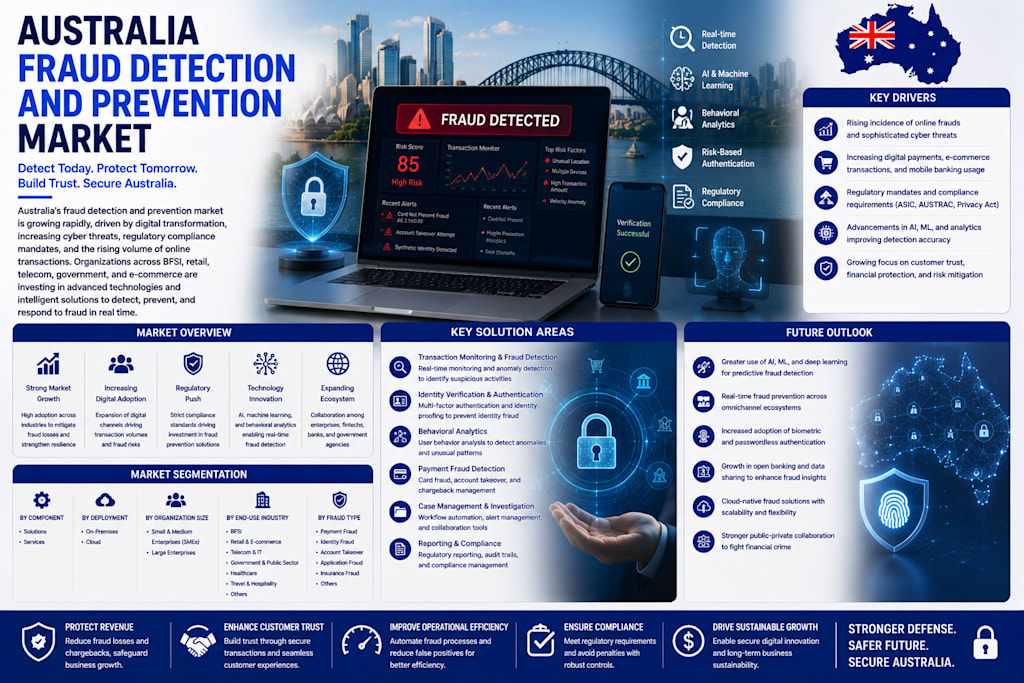
Australia's digital economy is expanding at an unprecedented pace, creating new opportunities for businesses while simultaneously exposing organizations to increasingly sophisticated cyber threats. As financial transactions, online banking, digital wallets, and e-commerce platforms continue to grow, the demand for intelligent fraud detection technologies has become a strategic priority across industries.
According to IMARC Group, the Australia fraud detection and prevention market reached USD 1.5 Billion in 2025 and is projected to grow to USD 9.2 Billion by 2034, registering a robust CAGR of 22.54% during 2026–2034. This remarkable growth reflects the country's increasing investment in cybersecurity, artificial intelligence (AI), machine learning (ML), and real-time fraud monitoring technologies that protect businesses and consumers from evolving financial crimes. The market is primarily driven by increasing cyber fraud, evolving regulatory compliance requirements, expanding digital payment ecosystems, the flourishing e-commerce sector, and growing demand for secure remote transactions.
Market Segmentation
By Component
• Solutions
• Services
By Application
• Identity Theft
• Money Laundering
• Payment Fraud
• Others
By Organization Size
• Small and Medium Enterprises
• Large Enterprises
By Vertical
• BFSI
• Government and Defense
• Healthcare
• IT and Telecom
• Manufacturing
• Retail and E-Commerce
• Others
By Region
• Australian Capital Territory & New South Wales
• Victoria & Tasmania
• Queensland
• Northern Territory & Southern Australia
• Western Australia
Why the Market Is Growing So Rapidly
Australia is witnessing an unprecedented surge in digital transactions, making fraud prevention a mission-critical investment for financial institutions, retailers, healthcare providers, and government agencies. Businesses are increasingly recognizing that preventing fraud is more cost-effective than recovering from financial losses and reputational damage. This shift has accelerated spending on intelligent fraud detection platforms that deliver real-time risk analysis.
Artificial intelligence and machine learning have become central to modern fraud prevention strategies. Instead of relying solely on traditional rule-based systems, organizations are deploying predictive analytics that continuously learn from transaction behavior and identify suspicious activities with greater speed and accuracy. These technologies significantly reduce false positives while improving customer experience.
Another major growth catalyst is Australia's rapidly expanding digital payment ecosystem. Contactless payments, mobile banking, online shopping, and digital financial services have become everyday conveniences, but they have also created larger attack surfaces for cybercriminals. As transaction volumes increase, organizations are strengthening fraud monitoring capabilities across every digital touchpoint.
Government regulations and industry-wide collaboration are also encouraging stronger investment in fraud prevention technologies. Financial institutions, telecommunications providers, and technology companies are working together to improve information sharing and develop coordinated defenses against sophisticated scam networks. This collaborative approach is helping create a more resilient digital economy.
The growing frequency of cyberattacks and identity theft further reinforces market expansion. IMARC highlights that Australia experienced approximately 47 million data breaches during 2024, underscoring the urgent need for advanced fraud detection systems capable of protecting sensitive financial and personal information.
What the Opportunities Are
• AI-powered behavioral analytics present significant opportunities for technology providers as businesses seek continuous monitoring rather than periodic fraud assessments.
• Cloud-based fraud detection platforms are becoming increasingly attractive for small and medium-sized enterprises that require enterprise-grade protection without major infrastructure investments.
• Financial institutions can improve customer trust by integrating biometric authentication, real-time transaction monitoring, and predictive fraud scoring into digital banking services.
• Retail and e-commerce businesses have opportunities to reduce chargebacks and payment fraud through intelligent transaction verification and automated risk management.
• Healthcare organizations can leverage fraud prevention solutions to secure patient identities, protect sensitive medical records, and ensure regulatory compliance.
• Government agencies are expected to increase investments in digital identity verification and cybersecurity infrastructure, creating new opportunities for solution providers.
• Managed security services represent a rapidly growing segment as organizations increasingly outsource fraud monitoring to specialized cybersecurity firms with advanced analytical capabilities.
Recent News & Developments in Australia Fraud Detection and Prevention Market
• February 2025: Telstra and CommBank introduced the Fraud Indicator technology to strengthen fraud detection capabilities across shared customers. The solution analyzes mobile behavioral patterns to identify suspicious activity and is expected to improve fraudulent account identification by more than 25%. The initiative reflects growing collaboration between telecommunications providers and financial institutions to combat increasingly sophisticated scams.
• July 2025: Australia's Scam Prevention Framework continued to advance implementation across regulated industries, requiring banks, telecommunications providers, and digital platforms to strengthen scam detection, reporting, and customer protection measures. The framework reinforces accountability throughout the digital ecosystem while introducing stronger compliance expectations and substantial penalties for organizations that fail to meet required standards.
• September 2025: Australian financial institutions reported continued momentum in AI-enabled fraud prevention, with large-scale investments supporting real-time monitoring, behavioral analytics, and automated scam detection. Industry adoption accelerated as organizations expanded partnerships and advanced security capabilities to reduce fraud losses while improving customer confidence in digital financial services.
Why Should You Know About Australia Fraud Detection and Prevention Market?
Australia's fraud detection and prevention market represents one of the country's fastest-growing technology segments, reflecting the critical importance of cybersecurity in a highly digital economy. As organizations continue embracing digital transformation, the need for intelligent fraud prevention solutions will only become more significant.
For investors, the market offers exposure to a rapidly expanding technology ecosystem supported by strong regulatory initiatives and sustained enterprise spending. For businesses, advanced fraud prevention strengthens customer trust, minimizes financial losses, and improves operational resilience. For policymakers, continued investment in cybersecurity and fraud prevention technologies supports national digital security while fostering confidence in Australia's expanding digital economy.
With AI, machine learning, and collaborative cybersecurity initiatives reshaping the industry, the Australia fraud detection and prevention market is well positioned to remain a cornerstone of the nation's secure digital future.
About the Creator
Rashi Sharma
I am a market researcher.
Enjoyed the story? Support the Creator.
Subscribe for free to receive all their stories in your feed.
Comments
There are no comments for this story
Be the first to respond and start the conversation.