
Australia Foreign Exchange Market 2026: Global Trade Flows, Digital Trading & Financial Market Expansion
How rising cross-border transactions, fintech innovation and institutional participation are shaping Australia’s foreign exchange industry

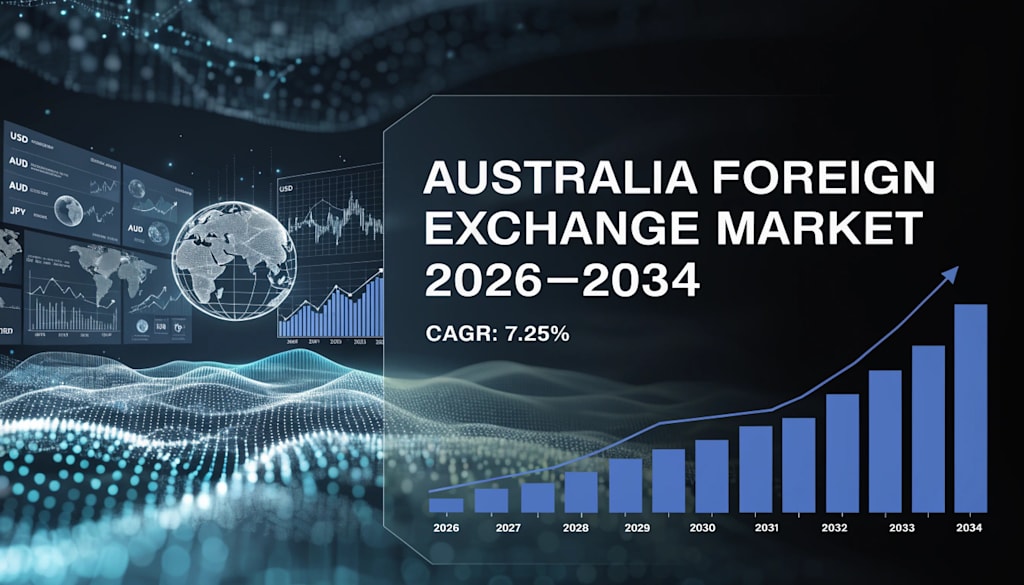
Australia Foreign Exchange Market Overview
The Australia foreign exchange (forex) market is a critical component of the country’s financial services sector, facilitating the exchange of currencies for international trade, investment and financial transactions. The market includes a wide network of banks, financial institutions, corporations and individual traders operating across global currency markets.
According to IMARC Group, the Australia foreign exchange market size was valued at USD 172.3 Billion in 2025 and is projected to reach USD 329.6 Billion by 2034, exhibiting a compound annual growth rate (CAGR) of 7.25% during 2026–2034.
The market is experiencing strong growth, driven by increasing global trade activities, rising participation from institutional and retail investors and rapid technological advancements in trading platforms. Australia’s strategic position within the Asia-Pacific region further enhances its role in global currency trading.
Key Market Drivers
Strong Global Trade and Investment Flows
Australia’s robust trade relationships, particularly with Asia-Pacific economies, are driving consistent demand for currency exchange services to support imports, exports and foreign investments.
Increasing Participation of Institutional and Retail Investors
The presence of banks, hedge funds, corporations and retail traders is enhancing market liquidity and expanding trading volumes across currency pairs.
Growth of Digital Trading Platforms and Fintech Innovation
Advancements in algorithmic trading, AI-based analytics and real-time payment systems are improving transaction speed, transparency and efficiency in forex trading.
Favorable Regulatory Environment and Market Transparency
A well-regulated financial system supported by strong institutions ensures market stability, investor protection and global confidence in Australia’s forex ecosystem.
Strategic Time Zone Advantage
Australia’s geographic position enables it to act as a bridge between U.S. and Asian markets, providing early liquidity and continuous trading opportunities in the global forex cycle.
Request a Sample Report with the Latest 2026 Data & Forecasts
What the Opportunities Are
The Australia foreign exchange market presents strong growth opportunities as financial markets and digital ecosystems evolve.
Expansion as an Asia-Pacific Trading Hub
Australia’s connectivity with major financial centers such as Singapore, Hong Kong and Tokyo is strengthening its position as a regional forex trading hub.
Growth in Digital and Mobile Trading Solutions
The increasing adoption of mobile trading apps and online platforms is making forex trading more accessible to retail investors and businesses.
Rising Demand for Hedging and Risk Management Solutions
Corporations are increasingly using forex instruments such as swaps and options to manage currency volatility and financial risk.
Development of AI and Blockchain-Based Trading Systems
Emerging technologies are enabling more efficient, secure and automated trading processes, enhancing market competitiveness.
Increasing Integration with Global Financial Markets
International trade agreements and financial partnerships are driving cross-border capital flows, boosting forex market activity.
Recent News and Developments
April 2026 – Market activity remains highly liquid, with average daily forex turnover in Australia reaching ~USD 201 billion (April 2025), marking a 34% increase from USD 150 billion in 2022, indicating strong growth in trading volumes and institutional participation.
March 2026 – Australia continues to play a key role in global currency markets, with the Australian dollar (AUD) ranking as the 7th most traded currency globally, accounting for ~6% of total global FX turnover, while AUD/USD contributes ~5% of global trades.
February 2026 – The Australia foreign exchange market reached approximately USD 172.3 billion in 2025, supported by strong trade flows, foreign investment, and active participation from institutional and retail traders.
January 2026 – Structural demand for forex services remains strong, driven by Australia’s commodity exports (iron ore, coal, LNG) and deep trade integration with Asia-Pacific economies, creating sustained demand for currency conversion and hedging activities.
December 2025 – Financial ecosystem strength supports FX growth, with increasing cross-border capital flows linked to superannuation funds and global investment exposure, contributing to higher hedging demand and transaction volumes.
November–December 2025 – Market structure remains highly developed and open, with a fully floating exchange rate system and strong institutional framework, enabling high liquidity and positioning Australia as a key Asia-Pacific forex trading hub.
Why You Should Know About the Australia Foreign Exchange Market?
The Australia foreign exchange market plays a crucial role in supporting international trade, investment flows and financial market stability.
With projected growth from USD 172.3 Billion in 2025 to USD 329.6 Billion by 2034, the market demonstrates strong expansion potential driven by globalization, technological innovation and increasing investor participation.
As global financial integration continues to deepen, the Australia foreign exchange market is expected to remain a key contributor to the country’s financial ecosystem and its position in international currency markets.
About the Creator
Amyra Singh
Market research analyst who loves spotting patterns, digging into data, and turning insights into strategies that help brands grow and stay ahead of the curve.
Enjoyed the story? Support the Creator.
Subscribe for free to receive all their stories in your feed.
Comments
There are no comments for this story
Be the first to respond and start the conversation.