
Australia Food Enzymes Market 2026: Clean-Label Revolution, Processing Efficiency & Functional Food Growth
How rising demand for natural ingredients, digestive health solutions and biotech innovation is driving food enzyme adoption across Australia

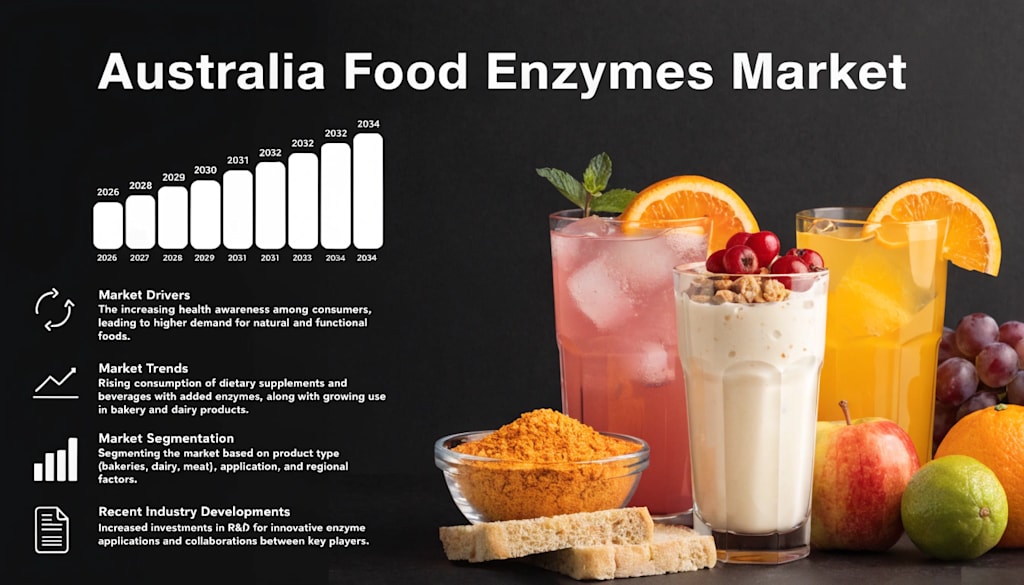
The Australia food enzymes market is undergoing steady expansion as food manufacturers, beverage producers and ingredient suppliers increasingly prioritise clean-label processing, enhanced nutritional profiles and manufacturing efficiency. Food enzymes — including carbohydrase, protease, lipase and specialty enzyme formulations — are deployed across dairy, bakery, beverages, confectionery and processed food sectors to improve texture, extend shelf life, enhance digestibility and reduce synthetic additive dependency. According to IMARC Group, the market size reached USD 82.6 Million in 2025 and is projected to reach USD 135.6 Million by 2034, exhibiting a compound annual growth rate (CAGR) of 5.66% during 2026–2034. As Australia's functional food market, valued at USD 6.89 Billion in 2025, continues to expand and consumers increasingly scrutinise ingredient labels, enzyme technologies have become central to modern food processing strategies.
What's Driving Market Growth?
Rising Demand for Clean Label and Natural Processing Solutions. Australian consumers are becoming more ingredient-conscious, favouring products with recognisable, natural components over synthetic additives. Food enzymes derived from microbial, plant and animal sources offer natural processing alternatives that enhance food attributes without introducing artificial ingredients. This clean label movement is reshaping manufacturing priorities, particularly in the bakery and dairy sectors where enzymes replace traditional chemical improvers and emulsifiers while maintaining product quality. Enzyme adoption enables formulation simplification by replacing multiple synthetic additives with single enzyme solutions delivering equivalent functionality.
Escalating Demand for Convenience and Processed Foods. Modern lifestyles characterised by busy schedules, dual income households and urbanisation have shifted consumption patterns toward ready to eat meals and pre packaged foods. Food enzymes enable manufacturers to produce large volumes efficiently while maintaining consistent quality across extended distribution timeframes. Over a third of Australian women (36%) and 30% of men report frequently feeling hurried or short on time, driving sustained demand for enzyme enabled products that preserve texture and sensory attributes throughout supply chain distribution.
Technological Advancements in Biotechnology and Enzyme Engineering. Modern bioprocessing methods — including advanced fermentation technology, precision protein engineering and optimised strain development — are improving enzyme efficiency, specificity and stability characteristics. Enzyme engineering allows development of variants with enhanced thermal stability, broader pH tolerance ranges and improved activity under challenging manufacturing conditions. Collaborations between biotechnology firms, research institutes and food manufacturers are accelerating commercialisation of next generation food enzyme solutions.
Expanding Functional Food and Digestive Health Sectors. The growing awareness of enzyme related health benefits — including improved nutrient absorption, digestive wellness and irritable bowel syndrome (IBS) prevention — is driving adoption across dairy, bakery and beverage applications. The functional food sector's substantial growth trajectory, projected to reach USD 6.11 Billion by 2033, demonstrates strong consumer appetite for products with added nutritional value and digestive health benefits.
Market Segmentation & Key Insights
By Type, Carbohydrase dominates the market with a share of 59% in 2025, driven by its essential role in starch conversion, sugar formation and texture modification across bakery, brewing and processed food applications. The bakery industry demonstrates particularly strong carbohydrase adoption where amylase enzymes improve dough handling properties, enhance bread volume and extend product freshness without chemical additives.
By Source, Microorganisms lead the market with a share of 64% in 2025, owing to cost effective production capabilities, superior scalability through fermentation processes and consistent quality characteristics. Bacteria and fungi represent the primary microbial sources, with genetically optimised strains enabling high yield enzyme production under controlled manufacturing conditions.
By Formulation, Powder commands market leadership with 61% share in 2025, reflecting extended shelf stability, ease of storage, precise dosing capabilities and cost effective transportation. Powdered enzymes exhibit lower moisture sensitivity, reducing risks of microbial growth and activity degradation during warehousing, making them particularly suitable for Australia's geographically dispersed food manufacturing facilities.
By Application, Dairy Products comprise the largest segment with 35% share in 2025, propelled by rising demand for lactose free items, functional dairy formulations and enzyme oriented improvements in cheese texture, yogurt consistency and milk processing efficiency. The lactose free dairy industry in Australia is thriving, demonstrating substantial consumer demand for enzyme enabled dairy alternatives.
By Region, Australia Capital Territory & New South Wales dominates with 30% share in 2025, driven by concentration of major food processing facilities, established dairy and bakery manufacturing infrastructure, and substantial consumer markets centred in Sydney metropolitan areas.
What the Opportunities Are?
Precision Fermentation & Hyper Fermentation Platforms. Australian biomanufacturing specialist Cauldron Ferm raised 13.25M (US19M) in March 2026 to expand its "hyper fermentation" platform, keeping microbes continuously productive for high value ingredient production. Providers investing in scalable fermentation technologies for enzyme production can capture growing demand for sustainable, animal free processing solutions across dairy, bakery and beverage applications.
Multi Enzyme Cocktail Formulations for Enhanced Functionality. Manufacturers are increasingly developing sophisticated enzyme cocktails combining amylase, cellulase, xylanase and pectinase to enable comprehensive substrate breakdown for improved nutrient availability and processing efficiency. Tailored enzyme blends addressing specific requirements in brewing, baking and fruit juice production offer differentiation opportunities for suppliers.
Lactose Free and Digestive Health Product Development. The growing awareness about lactose intolerance among Australian consumers is driving significant adoption of lactase enzymes in dairy product manufacturing. Enzyme enabled lactose free products are expanding beyond specialty channels into mainstream retail distribution, creating sustained demand for lactase and other digestive enzymes.
Clean Label Application Support & Technical Services. As advanced enzyme systems become more sophisticated, there is strong opportunity for professional technical support services — including formulation optimisation, application specific solution development, training programmes and maintenance contracts — that help food manufacturers maximise processing efficiency and product quality outcomes.
Regulatory & Safety Compliance Advisory. Navigating FSANZ approval pathways for novel enzyme processing aids presents both a challenge and an opportunity. Recent approvals of genetically modified enzymes as processing aids in brewing (April 2024) demonstrate Australia's supportive environment for enzyme innovation. Advisory services assisting suppliers with safety documentation and compliance requirements can accelerate time to market.
Recent News and Developments in Australia Food Enzymes Market
September 2025: Food Standards Australia New Zealand (FSANZ) evaluated a request from IFF Australia Pty Ltd to permit the use of thermolysin enzyme derived from Anoxybacillus caldiproteolyticus as a processing aid for protein breakdown across dairy products, eggs, meat and fish, protein concentrates and isolates, yeast, and beer brewing.
April 2024: Australia updated regulations for food processing additives, specifically emphasising incorporation of genetically modified cellulase enzymes sourced from Aspergillus niger as processing aids, improving production efficiency and quality in brewing applications — demonstrating a supportive regulatory environment for microbial enzyme innovation.
March 2026: FSANZ opened consultation on Application A1347 to approve protein glutaminase derived from Bacillus licheniformis as a processing aid, reflecting ongoing regulatory attention to novel enzyme technologies.
March 2026: Cauldron Ferm raised 13.25M (US19M) in Series A2 funding led by Main Sequence Ventures to expand its continuous "hyper fermentation" platform, with participation from Horizons Ventures, SOSV and NGS Super — positioning Australia as a emerging hub for precision fermentation biomanufacturing.
January 2026: CSIRO and the University of Leeds launched a $3 million AI powered project funded by the Bezos Earth Fund to convert agrifood waste into sustainable microbial protein using fermentation technology, reinforcing Australia's commitment to circular economy approaches and fermentation based ingredient production.
Why Should You Know About Australia Food Enzymes Market?
You should know about this market because it illustrates how processing efficiency priorities, clean label consumer demands and biotechnology innovation intersect to create steady growth opportunities in a mission critical segment of Australia's food manufacturing landscape. Food enzymes are no longer just industrial processing aids — they are intelligent biocatalysts that help manufacturers replace synthetic additives, improve nutritional profiles, reduce food waste and deliver consistent product quality.
For investors, the food enzymes market offers exposure to a stable growth food technology category anchored in Australia's expanding functional food sector, accelerating adoption of clean label ingredients and ongoing biotech R&D investments. The projected CAGR of 5.66% reflects consistent confidence in adoption trends, technological differentiation and recurring demand tied to Australia's position as a sophisticated food processing market.
For food manufacturers, ingredient suppliers, biotechnology innovators and supply chain planners, understanding food enzyme segmentation, precision fermentation trends, regulatory approval pathways and application specific formulation strategies helps shape intelligent investment decisions, procurement roadmaps and product development programmes that deliver measurable processing efficiency and consumer satisfaction outcomes.
In essence, the Australia food enzymes market captures how biocatalysis, consumer transparency and sustainable manufacturing converge — making it a compelling area for innovators, investors and organisations seeking smarter approaches to food processing, ingredient integrity and industrial biotechnology excellence.
About the Creator
Thomas
Market Research Analyst | Industry Trends & Forecasting | Turning market data into clear, actionable business insights across global sectors.
Enjoyed the story? Support the Creator.
Subscribe for free to receive all their stories in your feed.
Comments
There are no comments for this story
Be the first to respond and start the conversation.