
Australia Fasteners Market Poised for Steady Growth Driven by Infrastructure Expansion and Industrial Demand
Rising construction activity, mining expansion, and manufacturing modernization are accelerating demand for advanced fastening solutions across Australia’s key industries.

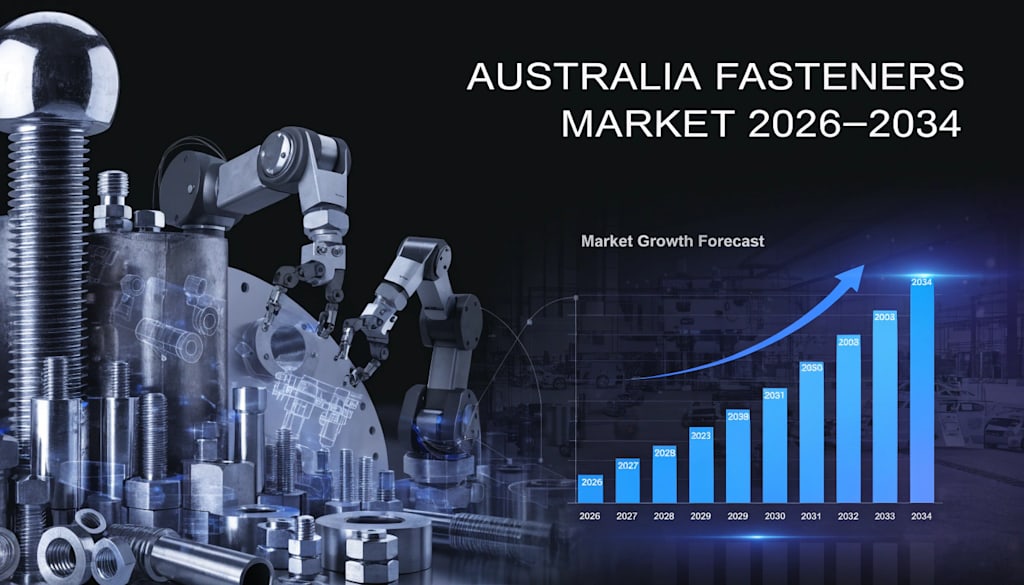
The Australia fasteners market is witnessing stable and sustained expansion, supported by strong growth in construction, automotive, mining, and industrial manufacturing sectors. According to IMARC Group, the market reached a value of USD 6,815.2 million in 2025 and is projected to reach USD 10,180.5 million by 2034, growing at a CAGR of 4.42% during 2026–2034. This growth reflects the essential role fasteners play as critical components in structural integrity, machinery assembly, transportation systems, and infrastructure development.
Fasteners—including bolts, nuts, screws, rivets, and specialized industrial connectors—form the backbone of mechanical assembly across nearly every heavy and light engineering sector. In Australia, their demand is closely tied to national infrastructure investment cycles, resource extraction activities, and ongoing upgrades in manufacturing capabilities.
Request a Business Sample Report for Procurement & Investment Evaluation:
Why the Market Is Growing So Rapidly
One of the primary growth drivers is Australia’s strong infrastructure pipeline. Large-scale construction projects across urban development, transport networks, and energy infrastructure are increasing the consumption of high-strength and corrosion-resistant fasteners. As projects become more complex, demand is shifting toward engineered fastening solutions capable of withstanding extreme environmental and load conditions.
The mining sector is another major contributor. Australia’s mining industry requires durable fastening systems for heavy machinery, processing plants, and remote-site installations. Equipment used in mining operations operates under high vibration, heavy load, and corrosive environments, which increases the need for premium-grade industrial fasteners with longer lifecycle performance.
The automotive and transport manufacturing ecosystem is also supporting market expansion. Although Australia is not a large-scale vehicle producer anymore, it has a strong automotive aftermarket, repair ecosystem, and commercial vehicle maintenance sector. These segments consistently require replacement fasteners and precision-engineered components for safety-critical applications.
Technological advancements in materials are further shaping the market. There is growing adoption of corrosion-resistant alloys, stainless steel variants, and lightweight composite-compatible fasteners. These innovations improve durability while reducing maintenance costs, making them increasingly attractive for infrastructure and industrial applications.
Lastly, industrial modernization and automation in manufacturing are contributing to demand. As factories adopt advanced machinery and modular production systems, precision fasteners are becoming essential for assembly efficiency, equipment stability, and long-term operational reliability.
What the Opportunities Are
The Australia fasteners market offers several strong long-term opportunities across industrial and infrastructure ecosystems.
First, infrastructure mega-projects present continuous demand for high-performance fastening systems. Transport corridors, rail networks, ports, and renewable energy installations require large volumes of durable fasteners designed for long-term structural integrity.
Second, renewable energy expansion is becoming a key growth area. Wind farms, solar installations, and battery storage facilities rely heavily on corrosion-resistant and high-strength fasteners due to exposure to extreme environmental conditions.
Third, rail modernization projects are increasing demand for specialized rail fastening systems capable of handling heavy loads and vibration resistance. These systems are critical for safety and operational efficiency in freight and passenger networks.
Fourth, advanced manufacturing and automation growth is creating opportunities for precision fasteners used in robotics, machinery, and high-tech assembly systems. As factories become more automated, demand for standardized and high-tolerance components is rising.
Fifth, oil, gas, and mining equipment upgrades continue to offer strong aftermarket demand. Equipment servicing, plant expansion, and safety retrofits require consistent fastener replacement cycles.
Sixth, export-oriented industrial supply chains present an opportunity for Australian manufacturers of niche and high-performance fasteners to expand into Asia-Pacific markets, particularly in construction and mining equipment supply chains.
Finally, innovation in smart and coated fasteners is emerging as a niche opportunity. Fasteners with anti-corrosion coatings, smart monitoring capabilities, and enhanced fatigue resistance are gaining traction in critical infrastructure applications.
• February 2025: Australia’s rail infrastructure development programs accelerated procurement of advanced fastening systems for heavy-haul corridors. New-generation rail fasteners designed for vibration resistance and long-term durability were introduced in large-scale testing phases across major freight routes. These developments support national logistics expansion and aim to reduce long-term maintenance costs in high-load rail environments, especially in long-distance inland freight networks.
• April 2025: The construction sector saw increased adoption of corrosion-resistant fastening solutions in energy and infrastructure projects. Projects in coastal and industrial zones emphasized the use of high-grade coated fasteners designed to withstand harsh environmental conditions. This shift reflects rising standards in infrastructure durability and aligns with Australia’s growing focus on sustainable and long-life construction materials.
• July 2025: Industrial manufacturing facilities expanded investments in automation and precision engineering systems, increasing demand for high-tolerance fastening components. Manufacturers reported rising integration of modular machinery systems, which require standardized fastener configurations for faster assembly and maintenance. This trend is improving operational efficiency while strengthening demand for advanced industrial fastening solutions across production hubs.
Why Should You Know About the Australia Fasteners Market?
The Australia fasteners market plays a foundational role in the country’s industrial and infrastructure ecosystem. While often overlooked, fasteners are critical to the safety, durability, and performance of nearly every engineered system—from buildings and bridges to mining equipment and transport networks.
For investors, the market offers steady, low-volatility growth tied to long-term infrastructure cycles and industrial demand. It is less dependent on consumer cycles and more aligned with government spending, resource development, and manufacturing investment trends.
For manufacturers and suppliers, the shift toward high-performance materials, corrosion resistance, and engineered fastening systems presents opportunities to move up the value chain. Companies that innovate in durability, efficiency, and specialized applications are likely to gain competitive advantage.
For policymakers, fasteners are a small but essential part of national infrastructure reliability. Ensuring quality standards and supporting local manufacturing capability contributes directly to construction safety, transport efficiency, and industrial productivity.
Overall, the market reflects a stable yet evolving industrial backbone—quietly powering Australia’s infrastructure growth, resource economy, and manufacturing modernization.
About the Creator
Rashi Sharma
I am a market researcher.
Enjoyed the story? Support the Creator.
Subscribe for free to receive all their stories in your feed.
Comments
There are no comments for this story
Be the first to respond and start the conversation.