
Australia Energy Storage Systems (ESS) Market: Powering the Future of Clean and Resilient Energy
Rapid renewable integration, smart technologies, and grid modernization are driving explosive growth in Australia’s energy storage ecosystem

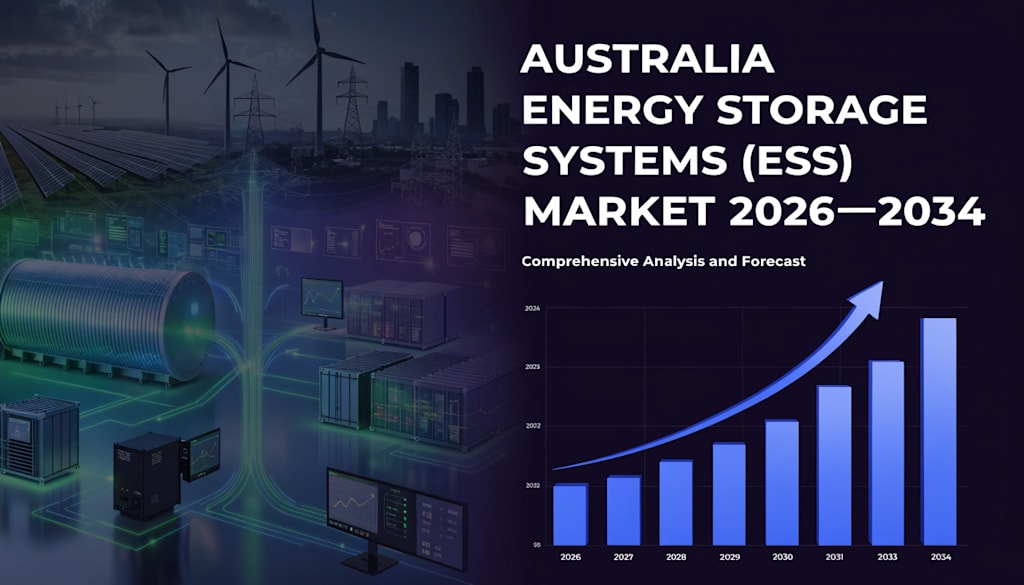
The Australia energy storage systems (ESS) market is experiencing transformative growth, positioning itself as a cornerstone of the country’s clean energy transition. According to IMARC Group, the market reached a value of USD 15.4 billion in 2025 and is projected to surge to USD 65.2 billion by 2034, expanding at an impressive CAGR of 17.40% during 2026–2034.
This rapid expansion reflects a structural shift in how Australia generates, stores, and distributes energy. As renewable energy sources such as solar and wind become dominant, energy storage systems are no longer optional—they are essential for balancing supply and demand, ensuring grid stability, and enabling a reliable energy future.
Australia’s strong renewable energy base, combined with ambitious decarbonization goals, has created ideal conditions for ESS adoption. From residential battery systems to large-scale utility storage projects, the market is expanding across multiple segments, supported by innovation, investment, and policy alignment.
Request a Business Sample Report for Procurement & Investment Evaluation:
Segmentation Categories
• Technology: Pumped Hydro, Electrochemical Storage, Electromechanical Storage, Thermal Storage
• Application: Stationary, Transportation
• End User: Residential, Non-Residential, Utilities
• Region: Australia Capital Territory & New South Wales, Victoria & Tasmania, Queensland, Northern Territory & Southern Australia, Western Australia
Why the Market Is Growing So Rapidly
A key driver of the ESS market is the rapid integration of renewable energy into Australia’s power grid. Solar and wind energy, while abundant, are inherently intermittent. Energy storage systems play a critical role in capturing excess energy during peak generation and releasing it when demand is high, ensuring a stable and reliable electricity supply.
Government support and policy initiatives are also accelerating growth. Australia’s commitment to reducing carbon emissions and transitioning to clean energy has led to incentives, funding programs, and regulatory frameworks that encourage ESS deployment. These measures are attracting both domestic and international investments into large-scale storage projects.
Technological advancements are transforming the market landscape. Innovations in battery technologies—particularly lithium-ion and flow batteries—are improving efficiency, reducing costs, and enabling long-duration energy storage. At the same time, AI-driven platforms and smart energy management systems are optimizing performance and reducing operational complexity.
The rise of decentralized energy systems is another major growth factor. Distributed energy resources, including rooftop solar panels and home battery systems, are becoming increasingly common. These systems empower consumers to generate and store their own energy, reducing reliance on centralized grids and driving demand for residential ESS solutions.
Additionally, new business models such as Virtual Power Plants (VPPs) and Energy-as-a-Service (EaaS) are reshaping the market. VPPs aggregate multiple distributed energy resources to function as a single power source, improving grid stability and efficiency. Meanwhile, EaaS models lower entry barriers by offering subscription-based access to energy storage solutions.
What the Opportunities Are
The Australia ESS market presents a wide range of high-impact opportunities:
• Utility-Scale Battery Projects: Large-scale storage systems supporting grid stability and renewable integration offer significant investment potential.
• Residential Energy Independence: Growing adoption of rooftop solar creates strong demand for home battery storage solutions, enabling consumers to achieve energy self-sufficiency.
• Virtual Power Plant Expansion: Aggregating distributed energy systems into VPPs can unlock new revenue streams and improve grid efficiency.
• AI-Driven Energy Optimization: Smart platforms that use AI for forecasting, load balancing, and predictive maintenance can enhance system performance and reduce costs.
• Long-Duration Storage Technologies: Innovations such as flow batteries and pumped hydro systems address long-term energy storage needs, opening new market segments.
• Energy-as-a-Service Models: Subscription-based and leasing solutions make ESS more accessible to businesses and households, expanding adoption.
• Grid Modernization Projects: Upgrading aging infrastructure with integrated storage solutions presents opportunities for technology providers and service companies.
Recent News & Developments in Australia Energy Storage Systems (ESS) Market
• March 2025: The Australian government continued advancing clean energy policies by supporting large-scale battery storage projects to enhance grid reliability. New regulatory frameworks and funding initiatives encouraged faster deployment of ESS infrastructure across key regions. These measures are expected to accelerate the transition toward a low-carbon energy system.
• June 2025: The market saw increased adoption of Virtual Power Plants, highlighted by large-scale implementations integrating thousands of residential battery systems. These networks are enabling real-time energy balancing and reducing electricity costs for consumers. The expansion reflects growing confidence in decentralized energy models.
• September 2025: A major investment of AU$65 million was secured to scale production of advanced iron flow batteries in Australia. The initiative aims to achieve 400 MW annual capacity by 2029, supporting long-duration energy storage deployment. This development underscores the country’s commitment to innovation and energy resilience.
Why Should You Know About Australia Energy Storage Systems (ESS) Market?
The Australia ESS market is not just another energy segment—it is the backbone of the country’s transition to a sustainable, reliable, and decentralized power system. With one of the highest growth rates among energy markets, it represents a convergence of technology, policy, and environmental priorities.
For businesses and investors, it offers significant opportunities in infrastructure, technology, and services. For policymakers and innovators, it provides a pathway to achieving climate goals while ensuring energy security. And for consumers, it signals a future where energy is not only cleaner—but smarter, more efficient, and increasingly self-managed.
About the Creator
Rashi Sharma
I am a market researcher.
Enjoyed the story? Support the Creator.
Subscribe for free to receive all their stories in your feed.
Comments
There are no comments for this story
Be the first to respond and start the conversation.